
Dundas Minerals Ltd (ASX:DUN) has kicked off exploration at its Matilda South and North-East prospects, with the start of a detailed high frequency audio magnetotellurics (AMT) geophysical survey.
The AMT survey will measure local magnetic and electrical fields, with the objective of identifying conductive anomalies beneath the regolith cover and developing drill targets from this information.
The survey areas at the company's tenure in the prospective Albany-Fraser Orogen of Western Australia are consistent with modelled gravity anomalies at the two prospects.
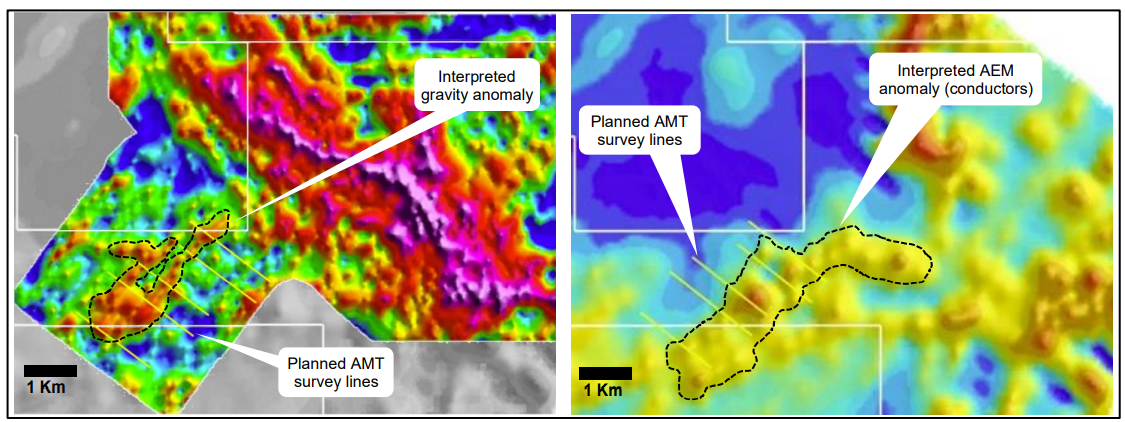
Interpreted gravity anomalies and planned survey lines at the Central target in the North-East prospecting area.
Detailed survey data
DUN's recent acquisition of detailed gravity survey data for the prospects resulted in the modelling of dense bodies (3 tonnes per cubic metre to 3.4 tonnes per cubic metre), interpreted as being due to mafic or ultramafic rocks.
The exploration model for the prospects is magmatic sulphide mineralisation associated with mafic and ultramafic intrusions, similar to the Nova-Bollinger deposit, 150 kilometres from Matilda South.
At Matilda South, the modelled depth of the gravity anomaly extends from approximately 70 metres below surface to beyond 1,000 metres and the shape is distinctly circular.
What’s happening now?
Adelaide-based Zonge Engineering and Research Organisation Ltd is conducting the AMT survey. Zonge is on-site and has tested and calibrated its equipment.
Surveying commenced at the North-East prospect area – the central target – on March 3, and will later this week move to Matilda South.
A maximum of five AMT lines are planned at the central target in the North-East prospect area. Each line is around 2 kilometres in length, with spacing between lines varying from 500 metres to 1,000 metres.
At Matilda South, a maximum of six AMT lines are planned. Each line is around 2 kilometres in length and the spacing between lines is 500 metres.
The AMT surveys are expected to wrap up towards the end of March 2022, with results due in April.
The information gleaned from these surveys will be critical for the planning of drill holes for the testing of any conductive anomalies.