
Duke Exploration Ltd (ASX:DEX) is trading higher on receiving promising assay results from the first two holes of the latest five-hole diamond drilling program at Bundarra Copper Project in central Queensland, completed at the end of January.
The purpose of the campaign was to confirm the geological composition of the various complex mineralised zones and to test the company’s exploration model, developed over the last eight months to identify potential mineralised prospects suitable for drill testing.
Shares have been as much as 44.5% higher in the first house of trading to $0.26.
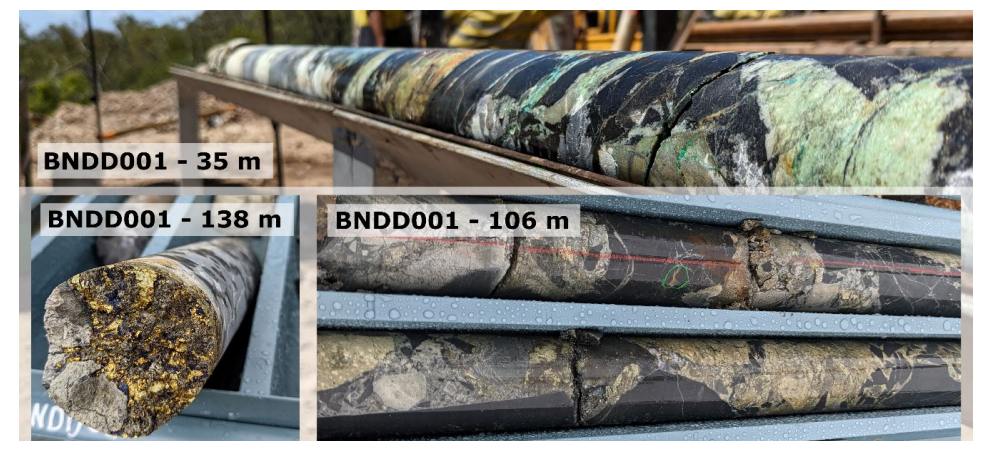
Breccia-style mineralisation found at Quorn.
Distinct copper mineralisation
The drilling in both holes has intersected "significant" zones of copper mineralisation, in two distinct styles.
Diamond drill holes at the Quorn and Isens targets intersected significant zones of copper mineralisation with “highly encouraging” grades.
The Quorn drill hole passed through a broad interval of altered breccia with visible copper oxides and sulphides in two main zones:
- 15.4 metres at 1.07 % copper and 9.52 g/t silver from 32 metres; and
- 22.35 metres at 0.71 % copper and 23.11 g/t silver from 85.3 metres including 3.1 metres at 1.77 % copper and 56.7 g/t silver from 93 metres.
The Isens drill hole intersected two significant zones of copper mineralisation within sulphide veins:
- 3.73 metres at 0.46 % copper and 4.26 g/t silver from 38.94 metres; and
- 6 metres at 1.04 % copper and 9.34 g/t silver from 109 metres including 3.7 metres at 2.06 % copper and 13.95 g/t silver from 110.66 metres.
This hole was terminated early due to poor ground conditions and may not have reached the main zone of mineralisation exploited by the historic Isens mine.
The current reverse circulation (RC) drilling program includes follow-up holes at both prospects, which will test the extent of mineralisation.
Exciting few months ahead
Commenting on the first assays of the recently completed diamond drilling program, managing director Philip Condon said: “These assay results are highly encouraging in multiple ways.

“The thickness and grade of the intercepts are significant in themselves, the confirmation of our targeting model allowing further enhanced mineralised prospect identification accuracy, and a deeper understanding of the complex geology in the mineralised zones complementing our prospect targeting and prioritisation.
"With the follow up 46-hole RC drilling campaign currently underway, these mineralised targets will be further tested for scale along with the other recently announced primary targets. It’s early days yet but it looks like we might have a very exciting few months ahead of us.”