
Dundas Minerals Ltd (ASX:DUN) is a junior explorer fresh to the ASX, having listed in mid-November last year following an oversubscribed IPO that raised $6 million before costs.
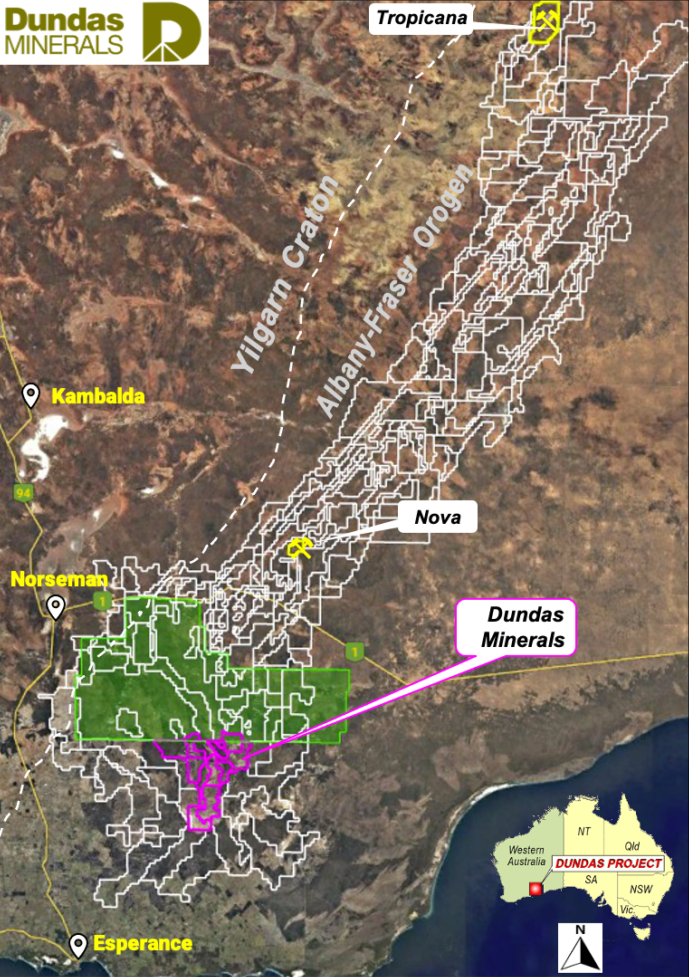
The company is exploring for nickel-copper and gold mineralisation in an underexplored region of the Albany Fraser Orogen in Western Australia – home of the company-making Nova-Bellinger Nickel-Copper-Cobalt Mine and the multi-million-ounce Tropicana-Havana Gold Mine.
Dundas brings a team of industry veterans and an extensive land package of over 1,200 square kilometres to the table, making for a promising mid-to-long-term exploration outlook for the company.
Managing director Shane Volk spoke to Proactive about the Albany Fraser Orogen, Dundas’ exploration strategy for its expansive greenfield tenure, and what gives Dundas the edge over other companies in the region.
In this article:
- Nickel, Copper and Gold
- The Albany Fraser Orogen
- Project-wide exploration strategy
- The Dundas Edge
Nickel, Copper and Gold
Critical minerals have been at the forefront of the discussion around resource extraction in recent years, made ever more relevant by the burgeoning needs of the electric vehicle and rechargeable battery sectors.
Nickel has moved up in the world as lithium-ion battery manufacturers sought to move away from cobalt-heavy cathodes and toward cheaper, more available materials.
The global nickel market reached a volume of 2.5 million tonnes in 2020, with a compounding annual growth rate (CAGR) of about 5% in the 2021–2026 period and a current price of US$24,887 per tonne at time of writing.
While not quite as valuable per tonne as nickel, copper – currently trading at US$9,830 a tonne – has been on a general upward trajectory since 2018, experiencing rapid annual growth of over 25% in both 2020 and 2021 as the market recovered from a pandemic-borne dip in April 2020.
The copper market’s volume in 2020 was estimated at 23.8 million tonnes, expected to grow at a more modest CAGR of 1.7% until 2027.
Perhaps a testament to how turbulent the last few years have been, the gold price reached an all-time high of US$2,029.08 per ounce in August of 2020, and while it hasn’t maintained those lofty numbers, the gold price currently remains at a historical high of US$1,930.89 an ounce.
It’s unlikely gold will drop much further, given the global market’s tendency to use it as collateral or a risk hedge and the current state of international relations.
Together, these three minerals represent a strong growth outlook with great potential for future gains and continued price stability.
The Albany Fraser Orogen
The Albany Fraser Orogen (AFO) is an emerging mineral exploration province in Western Australia, only relatively recently recognised as a region with vast untapped mineral exploration potential.
Two company-making deposits were found in the Orogen in the last 20 years:
- The 8-million-ounce Tropicana-Havana hydrothermal gold deposit in 2005 by AngloGold Ashanti (ASX:AGG); and more recently,
- The 15-million-tonne combined Nova-Bollinger magmatic nickel-copper-cobalt deposit in 2012 by Sirius Resources Ltd (acquired by Independence Group for $1.8 billion in 2015).
These discoveries demonstrated the potential mineral endowment of region, which is considered highly prospective for further discoveries of economical-scale nickel-copper and gold deposits.
The south-eastern portion of the AFO, where Dundas holds its exploration licences, has remained underexplored for a number of reasons; it’s fairly remote, with limited pastoralism and agriculture-related infrastructure, basement rocks are covered by a complex layer of regolith (also known as cover) with little surface outcrop, and until recent bushfires, much of the area was covered by dense mallee eucalyptus vegetation.
However, recent advances in geophysical surveying technology and computing power have helped to trivialise regolith cover, allowing exploration companies to look deep into the geological structures and bedrock stratigraphy beneath their tenements.
“And this is what will really be the key to our discovery. This is what's delivering a whole new pipeline of mineral discoveries at depth and will continue to result in new mineral discoveries in Australia, and Western Australia in particular,” Dundas Minerals managing director Shane Volk said in an interview with Proactive.
Project-wide exploration strategy
Dundas had the advantage of being one of the first companies to recognise the prospectivity potential of the south-eastern AFO, taking its pick of 1,200 square kilometres of tenure a mere 120 kilometres to the southwest of the Nova-Bollinger nickel-copper-cobalt deposit.
“The underlying strategy is to use the latest technology to identify, especially in terms of nickel exploration, areas that we think are highly conducive to the hosting of nickel-copper deposits using that technology, and then ultimately the proof is in the pudding by drilling,” Volk explained.
“It’s a systematic, disciplined process of reducing, reducing, reducing, until you get into an area to drill.
“You do spend a considerable amount up front, but in the end, it stops you just peppering holes into areas where you’ve got limited information – which perhaps previously was a bit more the case, but now doesn't need to be if you're prepared to be disciplined and do the work upfront.”
Dundas’ tenure is predominantly greenfield with very little historical data, but the company is already targeting three main exploration prospects with mafic or ultramafic geology conducive to a nickel sulphide discovery.
Detailed gravity geophysical surveys have been completed over the Matilda South, North-east and Central prospects, with the first round of drill testing scheduled for mid-2022.
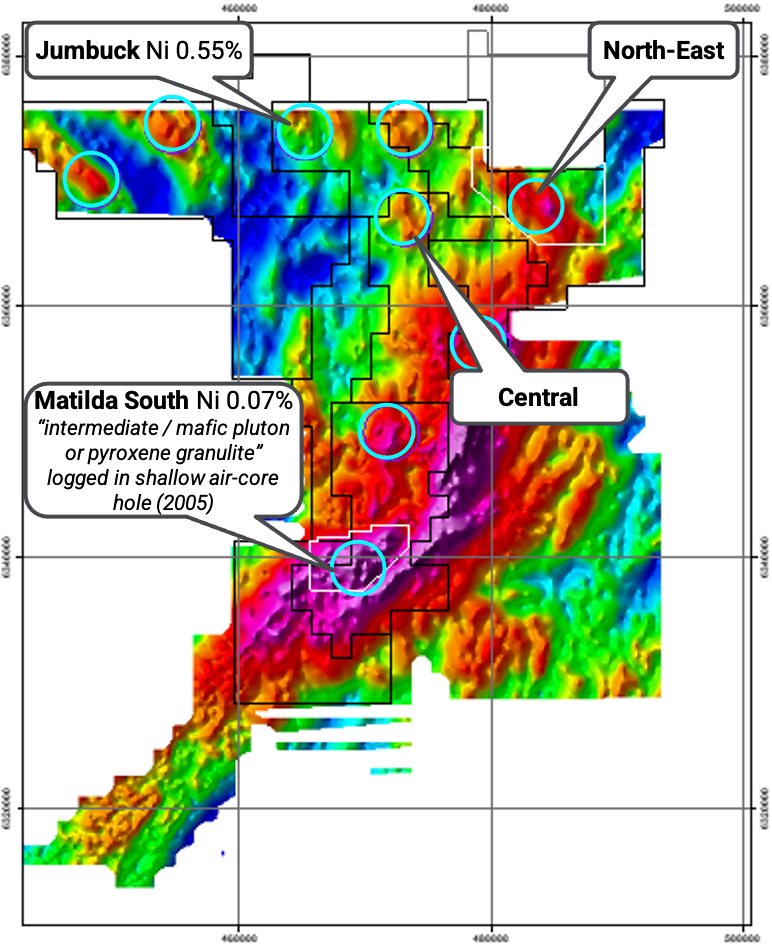
A representation of geophysical survey results over Dundas’ tenement, with interpreted prospective mafic/ultramafic intrusions marked with blue circles.
“The short and medium-term goal is of course to find an outstanding mineral deposit containing nickel, copper and gold, and that will take time,” Volk said.
The Dundas Edge
Many companies – especially small cap explorers – are now engaged in exploration activities on the Albany Fraser Orogen. Dundas Minerals enjoyed its pick of tenure in the south-eastern AFO as an early adopter, but the company’s advantages don’t end there.
“One of our main strengths is our geophysics capability, and that comes through Steve Massy, who was the head geophysicist at Placer Dome Exploration here in Western Australia, and technical director Tim Hronsky, also ex Placer Dome.” Volk explained.
“There’s also the fact that we run a very small and nimble team that can make decisions quite quickly, and we're committed to spending the majority of the money in the ground, be it geophysics or ultimately drilling.”
Massey has held geophysicist roles in the mineral industry since 1985, serving as geophysicist and then exploration manager at Placer Dome for a decade, consultant geophysicist and company director for 12 years at Western Geoscience and principal geophysicist and director for both Spinifex Geophysics and Western Geophysics for five and seven years respectively.
Hronsky has similarly been engaged as a geologist since 1989, serving in numerous non-executive director and mining adviser roles including at Placer Dome, Emmerson Resources and St George Mining over the intervening decades.
“The other advantage we’ve got is being so close to Esperance, which is a real strategic advantage in terms of moving in and out of site and getting things done quickly,” Volk continued.
“It cannot be underestimated how much of an advantage that is compared to being further north or further east in the Albany Fraser.
“If we're drilling out there and something breaks on the drill rig, the guys can be in Esperance within two and a half hours, and usually if the part is not available in town, one can be delivered from Perth overnight, or there are several engineering firms that may be able to assist.”
Dundas’ tenure is located just 120 kilometres from Esperance, a major agricultural and mining port, handling over 200 ships per annum exporting nickel, iron ore and grain.
The port city also operates a daily overnight freight service to Perth, allowing for easy access to laboratories and more advanced fabrication capabilities should they be required.
Altogether, Dundas has a cherry-picked, expansive tenure in highly prospective ground, with robust infrastructure, easy access to an industrial port, and extensive geophysical capabilities and experience.
Given that the company has already picked out nine areas of prospective interest with nickel-copper conducive geophysics, it’s likely only a matter of time until Dundas discovers its first mineralised body.