
Westar Resources Ltd (ASX:WSR)’s airborne XciteTM electromagnetic survey (AEM) has identified four highly prospective conductors at the Opaline Well project in the Pilbara region of Western Australia.
Systematic exploration to refine drill targets will focus on Anomaly 101 - regarded as the highest priority for follow-up work - and will consist of ground-truthing in the next field campaign.
Westar’s highest priority remains progressing the Gidgee North Project, where the company is scheduled to commence a maiden drill campaign late in the current quarter.
Anomaly 101 "standout target"
Westar managing director Karl Jupp said: “The AEM geophysics and modelling have proven to be a rapid and effective exploration tool, identifying several prospects for further evaluation.
“Anomaly 101 is the standout target and will be the focus for ground-truthing in our next field campaign at Opaline Well.”
AEM survey
The AEM program was the next systematic step in identifying priority drill targets after a successful field reconnaissance and rock-chip sampling program conducted earlier in 2021.
An AEM survey, using NRG’s ExciteTM airborne electromagnetic system covered the entire project tenure – about 70 square kilometres and 372-line kilometres on 200 metres line spacing.
The survey was intended to rapidly identify discrete conductors representing potential massive sulphide drill targets.
Follow up ground truthing is being planned.
Main area of interest
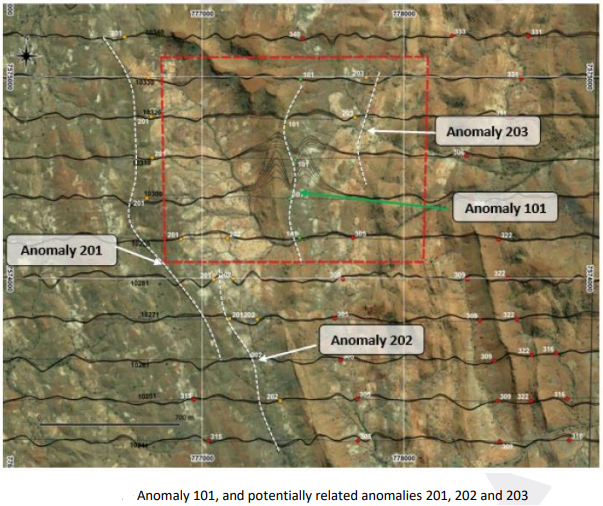
The main area of interest is Anomaly 101, which is a high-amplitude, mid to late time EM anomaly and appears as discrete, steeply dipping, relatively conductive body at depth.
A series of early time anomalies (201, 202 and 203) appear spatially related.
Additional ASTER, SENTINAL 2 and radiometric data indicate anomalies 201, 202 and 203 are conceivably a weathering product from the deeper, underlying more conductive body associated with Anomaly 101, however, the possibility remains these may potentially be related to surficial cover and ground truthing is required.
The EM anomaly extends for approximately 800 metres in strike length, with depth to centre top of the plate approximately 40 metres below surface in the south and 75 metres in the north, dipping steeply to the east.
Anomalies 200, 102, 103 and 104
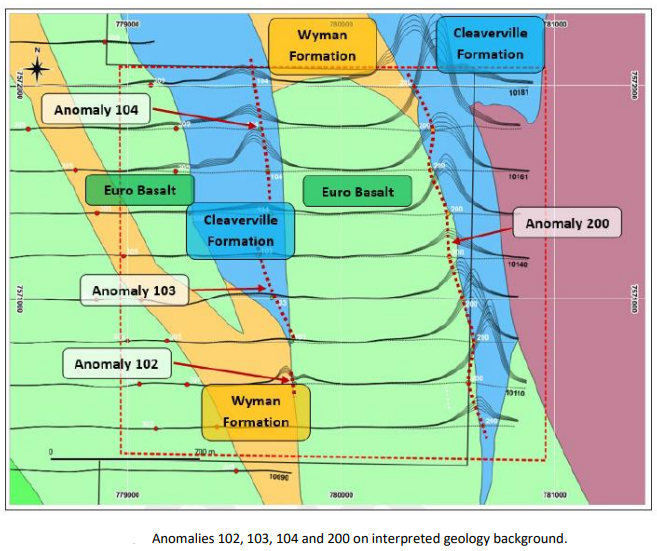
Anomaly 200 is the highest amplitude EM anomaly in the survey area, spanning nine flight lines (about 2 kilometres) and extends off the edge of the survey on both the north and south edges.
The anomaly appears as a broad, irregular asymmetric single peak anomaly with a very large early time anomaly, grading to a low, late time anomaly and has been modelled as a series of shallow westerly dipping plates.
It is possible the early time, surficial conductor may be a weathering product from the deeper conductive body, most likely a stratigraphic unit such as BIF.
Anomalies 102, 103 and 104 trend north-south along the western contact of the Euro Basalt (a mixture of basalt, komatiitic basalt, sills and volcaniclastic rocks) and the Cleaverville Formation (BIF, chert, sediments and volcaniclastic rocks) and appear related.
Slivers of the Wyman Formation (felsic volcanic and volcaniclastics and local sedimentary rocks) are also present in the area.
These anomalies are much smaller in amplitude than Anomaly 200 and it is possible the same type of causative body is responsible for these anomalies as Anomaly 200, most likely thin BIF units along a faulted contact between the Euro Basalt and Cleaverville Formation.
Next steps
Westar will integrate the plate models and results of the Newexco findings with other geophysical datasets to plan for field reconnaissance during the upcoming field season.
Future work programs will include ground-truthing of the identified anomalies, field mapping, rock-chip sampling and establishing access and logistical constraints for potential future ground-based geophysics (such as moving loop electo-magnetic, MLEM survey) and, if ultimately justified, drilling.