
Kazia Therapeutics Ltd (ASX:KZA, NASDAQ:KZIA) has initiated a Phase II study of its investigational new drug, paxalisib, in combination with metformin and a ketogenic diet for the treatment of newly diagnosed and recurrent glioblastoma.
The first patient has been successfully initiated in the study and a second patient already in screening at Weill Cornell Medicine.
This study is expected to recruit between 30 and 60 patients, and to take around two years to complete.
The oncology-focused drug development company will provide support, including study drug and a financial grant.
Exciting year for Kazia
Kazia CEO Dr James Garner said: “We are delighted to have this study now underway and look forward to following its progress.
"This important milestone kicks off an exciting year for Kazia, with at least six potential data read-outs anticipated over the course of 2022.
"The GBM AGILE study continues to progress well and additional studies, such as this one, have the potential to substantially extend and enhance the use of paxalisib in clinical practice.”
Shares have been as much as 5.13% higher this morning to A$1.025.
“Very significant difference in treatment”
Dr Howard Fine, principal Investigator on the study, added: “We have extensive and very convincing preclinical data to support this approach.
“My colleagues and I believe that administering paxalisib to patients in a ketogenic state may significantly enhance its efficacy.
“That, in turn, offers the potential to make a very significant difference in the treatment of glioblastoma, which remains one of the most challenging cancers in modern medicine.”
Clinical trial
Research by Professor Lew Cantley, who discovered the PI3K pathway, suggests that a low-insulin state may enhance the activity of PI3K inhibitors such as paxalisib.
Inducing a ‘ketogenic’ state, in which the body is fuelled by fats and proteins rather than by glucose, is a very effective way to reduce insulin levels.
Patients in the study will also be treated with metformin, a common anti-diabetic drug, which is intended in this case to further reduce insulin levels.
The Cornell study will explore this approach. One arm of the study will enroll newly diagnosed patients and the other will examine patients with recurrent disease.
The first arm will contain patients with newly diagnosed glioblastoma, who have unmethylated MGMT promotor status.
These patients have historically responded poorly to the current standard of care, temozolomide.
The second arm will contain patients with recurrent disease, regardless of the methylation status of their MGMT promotor, who have progressed after taking standard-of-care therapy. In each arm, paxalisib will be combined with metformin and with a ketogenic diet.
The diet will be overseen by expert clinical dieticians to ensure that it is scientifically appropriate and that patients are compliant.
An initial cohort of around 16 patients will be recruited to each of the two study arms.
If there are signals of activity in a given arm, that arm will be expanded to around 30 patients.
The primary endpoint will be progression-free survival at six months. In addition to efficacy and safety, the study will examine a range of metabolic, pharmacodynamic, and novel radiographic imaging biomarkers to inform future research and clinical practice.
Principal investigator
Dr Fine is the founding director of the Brain Tumor Center at New York-Presbyterian Weill Cornell Medical Center, Feil Professor of Medicine a Professor of Neurology at Weill Cornell Medicine.
He is an internationally recognized leader in the field of neuro-oncology, with more than 30 years of experience in both laboratory and clinical research as well as in the care of patients with brain tumors.
He has built large multidisciplinary brain tumor programs at top academic institutions such as the Dana Farber Cancer Institute / Harvard Medical School and the National Institutes of Health.
He has conducted more than 100 clinical trials, published in excess of 250 papers and book chapters on brain tumors, and for over two decades has run a continuously operating translational genetic/molecular laboratory devoted to a better understanding of, and better therapies for, brain tumors.
Eight ongoing clinical studies in brain cancer
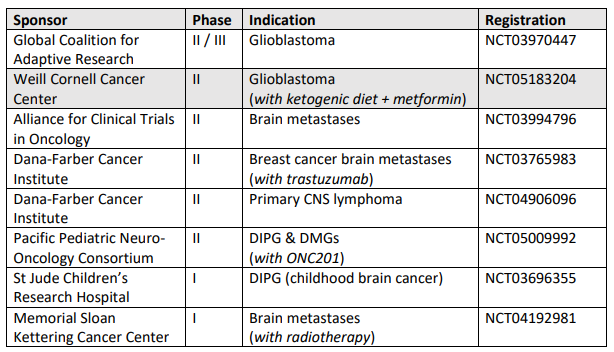
The initiation of this trial in glioblastoma brings the number of ongoing clinical studies of paxalisib in brain cancer to eight.
Weill Cornell Medical Centre
The Joan and Sanford I Weill Medical College, known generally as Weill Cornell Medicine, is the medical school of Cornell University, in New York, and is one of the leading medical research centres in the US.
Its notable alumni include Dr Anthony Fauci, director of the National Institute of Allergy and Infectious Disease.