
Alkane Resources Ltd’s first stage of resource drilling at its Boda Prospect in Central New South Wales is nearing completion.
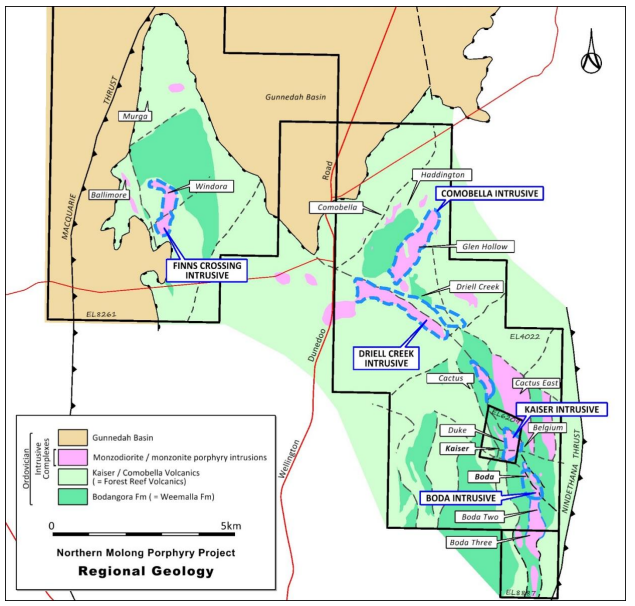
Drilling currently suggests the higher-grade central zone has a strike length of 500 metres, up to 400 metres wide, at least 900 metres deep and extends to surface within the larger, low-grade alteration envelope that runs around three kilometres from Kaiser to Boda Three.
Final assays from the Boda higher-grade resource drilling are scheduled for March and will be incorporated into the maiden resource estimation database.
Due to delays in the laboratory due to the recent wave of COVID-19 cases in NSW, the initial Boda resource is now expected in April 2022.
The targeting of higher-grade zones within the extensive mineralisation at Boda Two/Three will commence once the initial results from that drilling have been received in the second quarter of 2022.
Two reverse circulation (RC) drilling rigs have also commenced work on the Kaiser-Duke prospect.
Tier-one resource in great location
Alkane managing director Nic Earner said: “Our resource drilling program is methodically growing our knowledge of the higher-grade material at Boda.
“We have experienced some delays at the laboratory, pushing our initial resource model back to April.
“Boda is just the first of the resource models we expect to put together in this area and we look forward to bringing Boda and subsequent models to investors, as we develop our understanding of what is emerging as a tier-one resource in a great location.”
Boda Prospect
Assay results were recently received for four RC drill holes (1,620 metres) and five diamond core drill holes (4,581.1 metres) for a total of 6,201.1 metres.
Significant intercepts from the drilling include:
➢ 557 metres grading 0.52 g/t gold, 0.12% copper from 147 metres
- including 207 metres grading 0.65 g/t gold from 147 metres (gold only flanking zone);
- including 12 metres grading 5.54 g/t gold from 296 metres (gold only flanking zone);
- including 2 metres grading 28.9 g/t gold from 305 metre (gold only flanking zone);
- also 26 metres grading 1.00 g/t gold, 0.18% copper from 392 metres;
- also 27 metres grading 0.88 g/t gold, 0.30% copper from 441 metres;
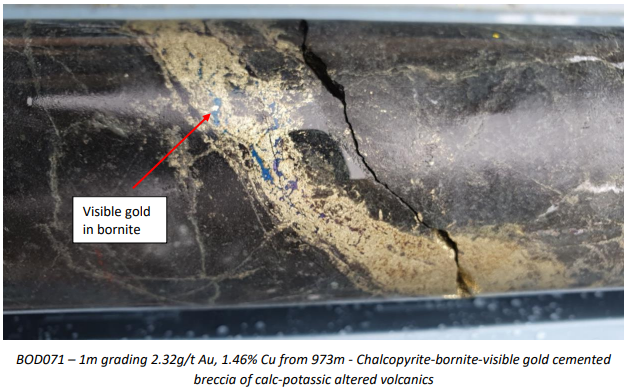
- including 4 metres grading 3.43 g/t gold, 1.03% copper from 645 metres;
- and 37 meters grading 0.36 g/t gold, 0.14% copper from 784 metres; and
- and 88.4 metres grading 0.21 /t gold, 0.18% copper from 963 metres.
➢ 639 metres grading 0.36 g/t gold, 0.14% copper from surface
- including 115 metres grading 0.75 g/t gold, 0.32% copper from 427 metres;
- including 45.7 metres grading 1.18 g/t gold, 0.44% copper from 474.3 metres; and
- also 6 metres grading 1.58 g/t gold, 0.11% copper from 189 metres.
➢ 466 metres grading 0.34g/t gold, 0.14% copper from 60 metres
- including 20 metres grading 1.14 g/t gold, 0.16% copper from 275 metres;
- also 13 metres grading 0.75 g/t gold, 0.28% copper from 316 metres;
- also 21 metres grading 0.56 g/t gold, 0.39% copper from 487 metres;
- and 10 metres grading 0.30 g/t gold, 0.12% copper from 608 metres;
- and 13 metres grading 0.20 g/t gold, 0.13% copper from 624 metres;
- and 74 metres grading 0.15 g/t gold, 0.12% copper from 746 metres;
- including 3.4 metres grading 0.43 g/t gold, 0.43% copper from 795.6 metres; and
- and 22 metres grading 0.20 g/t gold, 0.14% copper from 885 metres.
Boda Two prospect
The Boda Two prospect is defined by coincident high magnetic and gold-copper soil anomalies combined for an estimated north-south 1,100-metre by 500-metre footprint.
Drilling continues to identify extensive and continuous zones of low-grade gold-copper porphyry mineralisation with internal high-grade zones associated with weakly developed hydrothermal breccias of magnetite ± pyrite ± chalcopyrite.
Assay results were received for one diamond core drill hole for 1,297 metres with significant intercepts of:
➢ 561 metres grading 0.19 g/t gold, 0.12% copper from 293 metres
- including 9 metres grading 0.63 g/t gold, 0.25% copper from 398 metres; and
- also 26 metres grading 0.42 g/t gold, 0.18% copper from 782 metres.
The initial phase of widely spaced drilling continues at Boda Two and Three with one diamond drill rig, and demonstrates many encouraging similarities to Boda, including the existence of low-grade gold-copper mineralised breccias that may zone to high grading zones as defined at Boda.
These breccias will be targeted with a second phase of drilling in the second half of 2022.
Planned exploration programs
The Duke Zone within the Kaiser Prospect is estimated from drilling to be around 250 metres wide and striking over 800 metres.
RC drilling of 13,000 metres commenced in January to estimate a shallow resource.
Drilling completed on the Korridor Zone during this period consisted of five drill holes for about 2,900 metres.
Processing and sampling of the core is underway with final assay results expected in two months.
Other exploration is focused on delineating additional intrusive and mineralising centres within the 15-kilometre-long northwest corridor from Boda Three to Finns Crossing.
Electrical geophysics (IP) and magnetotellurics (MT) surveys – covering northwest of Kaiser within a 5 kilometre section of the northwest structural corridor that includes the Driell Creek Magnetic Complex – will commence this month.
Additionally, a drone aeromagnetic survey is planned to commence in March over a similar area to improve the structural mapping of the Boda corridor.