
In this article:
- Are we there yet
- Origins
- New frontier
- Building the Metaverse
- Synergy with Crypto and NFT’s
Are we there yet?
Could you envision an immersive virtual world where people live, work and socialise connected to a VR device in the comforts of their own home?
Well, that is the Metaverse for you!
In the past decade, we have witnessed a revolutionary change in how we humans interact on the internet.
In the beginning, we had a textual relationship with the internet, where we interacted with each other, and the web interface was predominantly based on text and vice versa.
With the advent of mobile camera technology, our relationship with the internet traversed into a more multi-dimensional space.
Consequently, we started to share more audio-visual content on the web such as our social media content, videos on YouTube and Twitch streams.
Then, we levelled up even further with Massively Multiplayer Online Roleplaying Games (MMPROG), where we started assuming alternate realities and identities.
This progression eventually led us to the Metaverse ecosystem, where immersion doesn’t stop at sight and sound alone, instead, it has opened a new potential to host a manifestation of our reality online.
Origins
The word 'Metaverse' was coined by Neal Stephenson in his cult science fiction novel Snow Crash, where he envisioned virtual lifelike avatars who congregate in realistic 3D virtual reality environments.
In the novel, Metaverse is the sum of virtual and augmented realities concentrated on a super long 'Street' through which people walk as avatars and can access using goggles and plugging into terminals.
One of the notable examples of earlier Metaverse initiatives is Second Life, a widely successful alternative reality computer game developed in 2003, in which you play with an avatar in an open world environment that does not stick to storylines.
Like second life, we have witnessed a couple of iterations of hype created around metaverse through the years, but many of today's techno-evangelists will insist that for the first time, we have the technology, protocols and infrastructure to make metaverse a reality.
New frontier
Trailblazing this new frontier is Facebook founder Mark Zuckerberg, with the recent Meta rebrand, which triggered a new wave of interest in the Metaverse.
Zuckerberg said: “In the metaverse, you’ll be able to do almost anything you can imagine — get together with friends and family, work, learn, play, shop, create — as well as completely new experiences that don’t really fit how we think about computers or phones today.
“In this future, you will be able to teleport instantly as a hologram to be at the office without a commute, at a concert with friends, or in your parents' living room to catch up. This will open up more opportunity no matter where you live.
“You’ll be able to spend more time on what matters to you, cut down time in traffic, and reduce your carbon footprint,” he said.
Within the Microsoft eco-system, the metaverse applied to Microsoft Teams - the software giant's online meetings competitor for Zoom.
This augmented application will allow users in different geographic locations to have shared holographic experiences during virtual meetings.
Aptly named 'holoportation, this is a 3D capture technology that lets users reconstruct and transmit high-quality 3D models of people in real-time.
Following suit, Epic Games, makers of the popular game Fortnight, has planned to stake its claim in the metaverse following a $1 billion round of funding in 2021 - including from the likes of Sony.
Further, Decentraland is one of the early key players who explicitly mentioned the metaverse as their core product.
Building the Metaverse
“The Metaverse is best understood as ‘a quasi-successor state to the mobile internet,” says Mathew Ball, managing partner EpyllionCo.
“This is because the Metaverse will not fundamentally replace the internet, but instead build upon and iteratively transform it,” he said.
Although we haven’t gotten there yet, there are several large and small players alike who set out to build this platform where we hope that smooth interoperability between these metaverse eco-systems will be a key factor in their success.
Jon Radoff, author of the Building the Metaverse blog posits seven distinct layers a metaverse environment need to have:
- Infrastructure – Connectivity technologies like 5G, Wi-Fi, cloud, and hi-tech materials like GPUs.
- Human interface – VR headsets, AR glasses, haptics, and other technologies users will leverage to join the metaverse.
- Decentralisation – Blockchain, artificial intelligence, edge computing, and other tools of democratisation.
- Spatial computing – 3D visualisation and modelling frameworks.
- Creator economy – An assortment of design tools, digital assets, and e-commerce establishments.
- Discovery – The content engine driving engagement, including ads, social media, ratings, reviews, etc.
- Experiences – VR equivalents of digital apps for gaming, events, work, shopping, etc.
Interestingly, there are more than 160+ companies operating across these seven verticals and they are together building the metaverse.
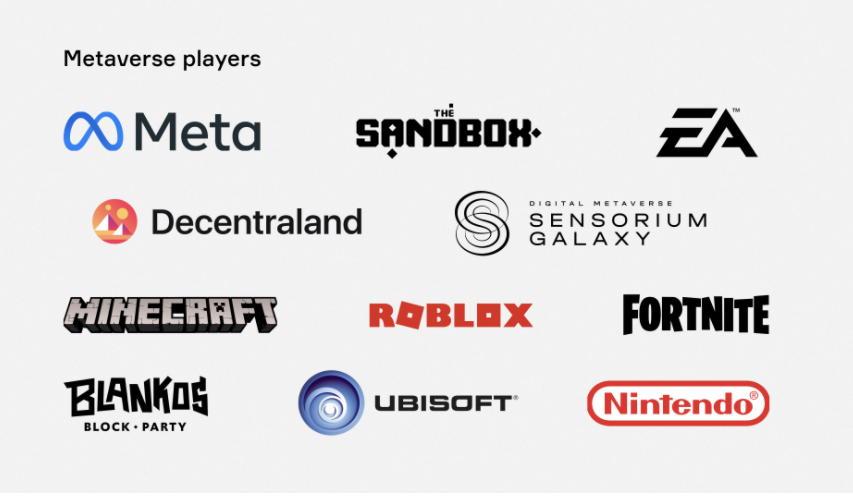
Key players on the Metaverse.
Synergy with Crypto and NFT’s
Notably, crypto, NFTs and the wider blockchain technology will be key to growing the metaverse, where ownership of identity, utilities and access to environments will be at the crux of this virtual world.
Goldman Sachs Group senior equity analyst Rod Hall said it is the only technology that can “uniquely identify any virtual object independent of a central authority”, and this ability to identify and track ownership will be crucial to how the metaverse functions.
Apart from crypto being the potential tender, NFTs will also play an integral role in forming identity, community and social experiences in the metaverse.
Interestingly, this will allow like-minded individuals to form communities that share experiences, develop parallel economies and create content together.
Are we there yet?
Well, there are already some ‘metaverse-like’ experiences out in the market, especially in the gaming industry.
Video gaming platform Roblox has experimented in meta events like hosting Gucci's 100th anniversary or opening NFL's first meta store
Meanwhile, competitor Fortnite isn't trailing much behind after holding mega-successful virtual concerts by Ariana Grande, Travis Scott, Marshemello and others.
In his annual year in review blog post, Microsoft co-founder Bill Gates noted that most people don't have the VR goggles and motion capture gloves to accurately capture their expression, body language and quality of their voice.
But for business, Gates predicts that in the next two to three years most virtual meetings will move from two-dimensional square boxes to the metaverse – a 3D space with participants appearing as digital avatars.
Since its inception in 2017, Decentraland has steadily gained momentum – a piece of real estate inside its VR world recently sold for a record $2.4 million.
And there's plenty more to buy in virtual worlds like, for example, Sandbox. You'll be able to find not only land but also houses or even yachts (equipped with helipads, hot tubs and DJ booths) for those into more exotic real estate options.
However, a full-fledged metaverse might be years away, if not more, with core technologies like 5g, affordable AR and VR technology and edge computing still in its infancy, complex demands of Metaverse operations still need some time.