
Cauldron Energy Ltd (ASX:CXU) has made strong progress across ongoing exploration and work programs at its highly prospective Blackwood Gold JV Project in Victoria.
The company is preparing for Phase 2 drilling using a new 3D structural and geochemical model suite, for smarter drill design and better targeting of historic high-grade mineralised zones.
Notably, gold values in channel samples across the interpreted Western Leader Reef zone support historical grades targeted in recent drilling including 2 metres at 1.27 g/t gold, 187ppm arsenic, 51ppm copper, 23ppm lead, 4.5ppm antimony and 78ppm zinc.
Interestingly, systematic channel sampling confirms alteration halo of arsenic, antimony, silver and potential zinc associations within the mineralised structures.
Looking ahead, Cauldron remains committed to achieving a net-zero carbon emissions target for its operations, proven by the continuous use of biofuel and a saving of 1,949 kilograms of carbon dioxide equivalent.
“Advance geological understanding”
Cauldron executive chairman Simon Youds said: “Despite various delays, we have been able to significantly advance our geological understanding of Blackwood.
“Importantly, we are using the underground platform in the Tyrconnel Adit to ground truth our geochemical and structural targeting tools, as well as validate the historically theorised high-grade shoots.
“The new platform under construction will allow drilling to recommence later this month.
“This has important implications for future targeting of down dip extensions of the high-grade, historically mined Western Reefs (Sultan/Pioneer).”
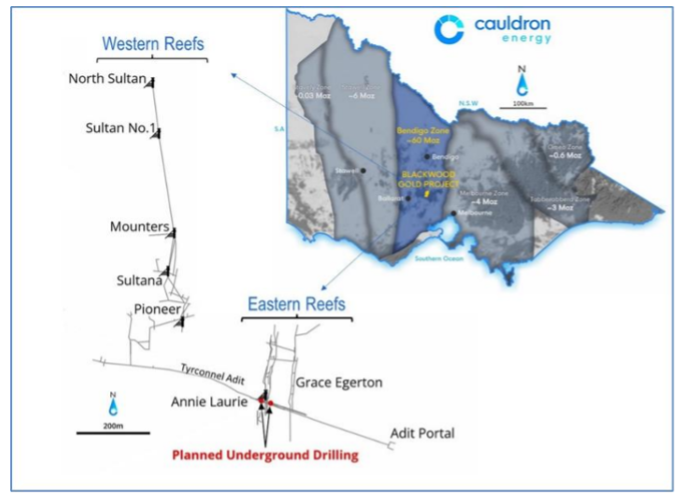
Eastern and Western Reef systems, showing relative positions of Phase 1 drilling (December 2021) and proposed Phase 2 diamond drilling.
Drill program
Phase 1 drilling undertaken in December 2021 consisted of three holes designed as a fan from inside the Tyrconnel Adit, to test the high-grade Annie Laurie and associated Western Leader Reef, mined in the 1880s.
Notably, modelling and historical reports indicated that the drilling should have intersected high-grade gold mineralisation.
Instead, drilling intersected multiple voids and incompetent ground in unpredictable places resulting in significant core loss and the failure to reach predicted depths for the intersection of high-grade mineralisation.
Although the drilling failed to reach the expected mineralisation, the geochemical patterns recognised in the assay results strongly support the area chosen for the next round of drilling.
The Phase 2 drill campaign is being prepared using a new 3D structural and geochemical model suite, for smarter drill design and improved targeting of historic high-grade mineralised zones.
This drilling will target the competent hanging wall, or western side of the reef structures, from the drill cuddy under construction adjacent to and within the Tyrconnel Adit.
Ten new holes are planned on a fan design to intersect both the hanging wall and footwall of the Western Leader and associated Annie Laurie Reefs, based on a range of azimuths and dips considered the most optimal for target penetration.
As with any exploration program, the final number of holes drilled will depend highly on ground conditions and penetration rates once drilling commences.
Channel sampling and geochemical modelling
As part of the general exploration work, Cauldron had also initiated systematic channel (face) sampling to map out geochemical pathfinder elements laterally along the Tyrconnel Adit, which trends east-west for about 1.5 kilometres and intersects most of the North-South striking reef structures in the Barrys Reef area.
The objective of the channel sampling is to provide a horizontal, 'across-strike' geochemical 'vector' map to complement the downhole geochemistry obtained from the drilling.
This data will be added to the 3-Dimensional geochemical model which, together with the structural model, will then allow for a more accurate targeted drill design to optimise exploration success.
“The ongoing historical compilation, new acquisition of the remote sensing LiDAR (Light Detection And Ranging) data, new channel sampling suite and now the drilling data are all being utilised to construct new 3D geological models for the project.
“Analysis of the LiDAR has also revealed multiple exploration targets which, together with the 3D model suite, will form the basis for regional exploration around EL5479.”
Forward plan
Specialist crews will be arriving shortly to restart drilling from within the Tyrconnel Adit.
“Irrespective of obstacles, ongoing clearance work in the Adit has allowed the establishment of a drill cuddy,” Youds said.
“This will optimise the Phase 2 drilling, designed to target high-grade gold values in the west dipping reef structures.
“These drill site preparations are possible without impact to the surface environment, enabling Cauldron to live up to its commitment to operate in a non-invasive, low-carbon, narrow-vein approach, aligning neatly with statutory, commercial and community expectations.”