
UK retail sales volumes rose 1.9% in January, bouncing back from December’s 4.0% decline.
January’s rise was the largest monthly increase since lockdown rules for non-essential shops were loosened in April 2021 and well ahead of the consensus forecast of 1.2%.
Compared to a year earlier, retail sales volumes were up 9.1%, whereas in December they had been down 1.7% year-on-year; however, the 9.1% increase was below the 9.4% consensus forecast because of revisions to the previous month’s data.
“A rebound in seasonally adjusted retail sales in January always was on the cards after they slumped in December, due to a combination of earlier than usual Christmas gift buying and concerns about Omicron," declared Samuel Tombs, the chief UK economist at Pantheon Macroeconomics.
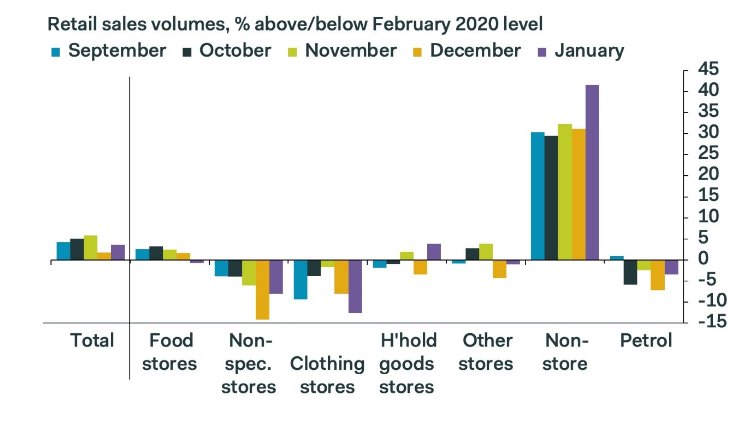
“January's pick-up was supported by a 3.4% month-to-month increase in non-food sales and a 4.1% jump in petrol sales, as people gradually overcame their Omicron fears. In addition, non-store retailing surged by 8.0%, to exceed its February 2020 level by 41.5%. Food store sales, however, fell by 2.3%, perhaps in a sign that rising food prices are forcing households to purchase fewer goods,” he added.
Despite the recovery in January, sales volumes still were 0.5% below their fourth-quarter 2021 average, and the near-term outlook remains overcast, according to Tombs.
According to James McDonald, a retail partner at auditing firm Deloitte, retailers avoided “the January blues” as consumers took advantage of the end of season discounting.
“Today’s figures form the initial sketches of a more positive picture for retail recovery in 2022. Despite worries about inflation, consumers continued to spend. The loosening of restrictions has resulted in more consumers heading to the high street and boosting overall in-store footfall,” McDonald said.
“Improved stock levels for large ticket items and a strong housing market boosted spending for the home, as non-food sales volumes grew by 3.4% compared to December. Whilst January food sales volumes slowed in contrast, falling 2.3% month-on-month, this is likely a result of more consumers rebalancing their shopping trolleys from December’s festivities. This also marks a return to pre-pandemic levels,” he noted.
“The rising cost of living is firmly front of mind. 29% of UK consumers expect their personal expenditure to go up in the first quarter of 2022 due to rising inflation, and more expensive utility and grocery bills,” McDonald warned.
“The question is whether retailers will absorb growing costs or pass this on to the consumer, adding further strain to consumer pockets and impacting the industry’s speed of recovery. Finding ways to continue to entice consumers to spend in-store or online will be key to a sustained recovery for the retail industry. To aid this, many retailers are exploring new digital ways of engaging with consumers both online and in-store.
“This could prove pivotal in the months ahead as those consumers who are in a position to spend head out as the economy continues to open up,” he suggested.
UK January retail sales +1.9% vs +1.0% m/m expected https://t.co/OfPZkwwH7g
— Joolt Finance (@JooltFinance) February 18, 2022
Martin Beck, the chief economic advisor to the EY ITEM Club, said January's rise went some way to reversing the previous month’s (downwardly revised) 4% month-on-month (m/m) fall.
"Growth at the start of 2022 was likely helped by both an easing of consumer caution as COVID-19 infection numbers fell back from December’s high levels and a return to more normal spending patterns. December’s fall in sales partly reflected some consumers bringing forward shopping ahead of the holiday season," Beck said.
“That COVID had a smaller impact on shoppers’ behaviour in January was also consistent with a fall in the share of spending made online – to 25.3% from 27.0% the previous month. This was the lowest proportion for online spending since March 2020.
“A continued decline in infection numbers and the relaxation of isolation rules should have supported a further recovery in retail sales in February. But the sector faces growing headwinds. One is a continued rotation of consumer spending away from goods and back towards services. The second is the squeeze on households’ spending power from high inflation – the EY ITEM Club expects the CPI measure to peak at over 7% in April – and forthcoming increases in personal taxes. Low unemployment and strong household balance sheets will go some way to offsetting these pressures. But the outperformance of the retail sector relative to the wider economy observed during the pandemic may soon come to an end,” he concluded.