
REITs, or Real Estate Investment Trusts, have been around since 1960 and have grown in stature ever since, but how rewarding are they and are they worth investing in?
In this article:
- What is a REIT?
- REIT categories
- Why invest in REITs?
- How have REITs performed?
- Australian REITs
- Pros and cons of investing in REITs
It happened in 1960.
- OPEC (Organization of Petroleum Exporting Countries) was formed;
- To Kill a Mockingbird was published by Harper Lee;
- John F Kennedy won the US Presidential election in the first year it was televised;
- The Cold War got colder;
- The Soviet Union shot down a US U2 spy plane. Unfortunately, they found what they were looking for;
- Brasilia was constructed to become the new capital of Brazil;
- Italy held the Rome Olympics;
- Alfred Hitchcock’s Psycho was released;
- Sri Lanka elected the world’s first-ever female Prime Minister;
- The IRA started its war against Britain;
- Johnny Cash played his first gig at San Quentin prison; and
- President Dwight D Eisenhower signed the Civil Rights Act of 1960 into law.
President Eisenhower was busy that year. 1960 was also the year, the outgoing president established REITs to give investors access to income-producing real estate assets.
The REIT model has broadened and flourished since then and more than 40 countries throughout the world have a REIT model.
Essentially, what Eisenhower did was give regular Americans the opportunity to invest in commercial real estate – a privilege that up until that time had only been available to large financial institutions and high net worth individuals.
Today, that privilege extends to all investors around the world who may want to invest in local or international REITs.
The most common index for the global listed property markets is the FTSE EPRA/Nareit Global Real Estate Index Series.
It was founded by index provider FTSE Russell, Nareit, and the European Public Real Estate Association, or EPREA and is used by a variety of institutional investors, money managers and funds to manage real estate investments on a global basis.
The index holds REITs and non-REIT listed property companies and includes the Developed Markets and Emerging Markets indices.

Source: NAREIT.
What is a REIT?
REITs are companies that own or finance income-producing real estate in a range of property sectors, while providing investors with a chance to buy into those sectors and access dividend-based income and total returns.
Most REITs are publicly traded like stocks and therefore highly liquid (unlike physical real estate investments).
Sectors within a REIT may include office and apartment buildings, warehouses, hospitals, shopping centres, hotels and commercial forests, while some REITs engage in financing real estate.
REITs may generate a steady income, however, there is little in the way of capital appreciation.
Anyone can invest in a REIT through the purchase of individual company stock, a mutual fund or exchange traded funds (ETFs).

REIT categories
As with stock investing, Real Estate Investment Trusts are broken up into easily digestible categories and present an investment option for investors with a low-risk appetite.
Of course, there is the small issue of interest rates to consider which would see them lose value, but this would appear to be a negligible risk in the current interest rate climate (even with interest rates moving higher).
There are three types of REITs:
- Equity REITs
- Mortgage REITs
- Hybrid REITs
Equity REITs are the most common class. These REITs own and manage income-producing real estate, with revenues generated primarily through rents (not by reselling properties).
Mortgage REITs lend money to real estate owners and operators. This can be done directly through mortgages and loans, or indirectly through acquiring mortgage-backed securities (an investment similar to a bond that is made up of a bundle of home loans bought from the banks that issued them). Earnings from this class are generated primarily by what is called a net interest margin, that is the spread between the interest they earn on mortgage loans and the cost of funding these loans.
As expected, Hybrid REITs are a mix of Equity and Mortgage classes.
Why invest in REITs?
They may deliver competitive total returns, based on high, steady dividend income and long-term capital appreciation.
REITs also provide an excellent way to diversify your portfolio.
They are comparatively at low correlation with other assets. This makes them an excellent portfolio diversifier which helps in reducing overall portfolio risk and increase returns. They are also important for retirees who need an income stream to cover living expenses.
The importance of REITs lies in the dividend payouts, which can be substantial as they required to distribute at least 90 percent of their taxable income to their shareholders annually.
Dividends are fuelled by contractual rents paid tenants.
Here are the benefits:
- Competitive long-term performance;
- Substantial, stable dividend yields;
- Liquidity (traded on the stock market);
- Transparency (constant oversight makes it easy for investors to track performance); and
- Portfolio diversification.
How have REITs performed?
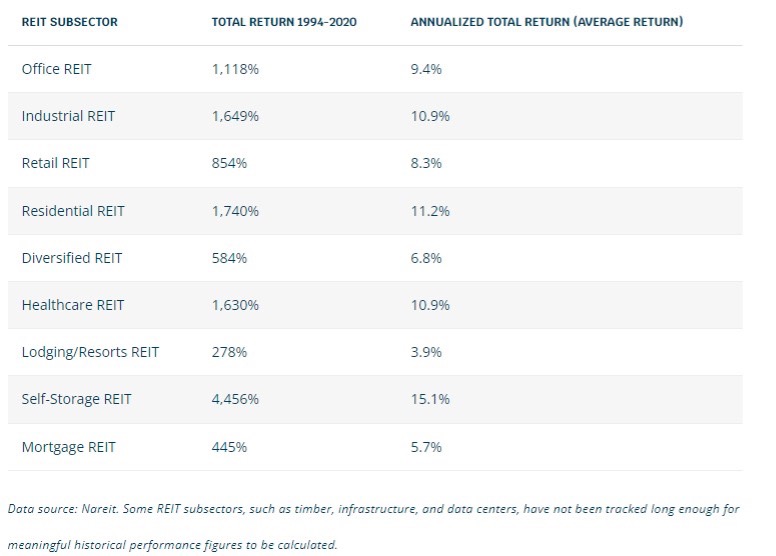
According to The National Association of Real Estate Investment Trusts, or Nareit, the FTSE Nareit All REITs index, produced a total REIT average return of 1,460% over the 30-year period through December 31, 2020.
On an annualised basis, this translates to an annualised average total return of about 9.6% including equity REITs and mortgage REITs.
Nareit also tracks sub-sector performance:
However, it’s not all rosy: the pandemic has taken a toll on commercial real estate.
There was a rebound in 2021, as 2020 really cut into commercial real estate investments (and rents) with the sector as a whole falling 8% last year compared with an increase of 18.4% for the S&P 500, Green Street analysts said.
This year could also be difficult as commercial property plays catch up.
That said, inflation could be positive for the sector.
Real estate is an inflation hedge as owners raise rents to combat rising prices.
“If the cost of building real estate goes up because of inflation, you don’t have the ability to build more supply until rents get to a certain level to justify it,” JPMorgan analyst Tony Paolone said.
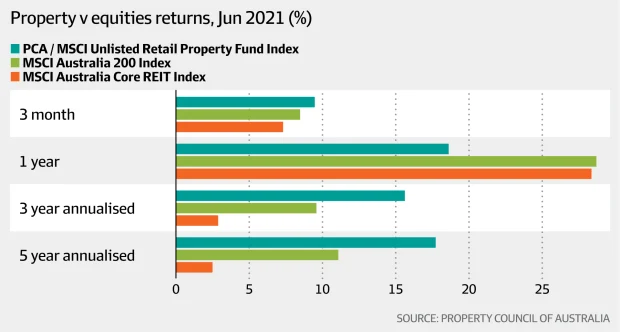
In Australia last year, REITs were among the top performers with sector returns of more than 28.4% as they rebounded from the COVID-19 slump.
This marginally lagged Australian equities at 28.8%.
There is a feeling of cautious optimism in the sector.
“We appreciate the structural pressures from online and cost inflation, but believe the market is underestimating the growth and re-rating potential,” JP Morgan noted.
While Australian Unity real estate portfolio manager and head of property research Damian Diamantopoulos said, “There is still uncertainty. Everyone is looking to the reopening of central business districts.”
Australian REITs
These are known as A-REITs. They are listed on the Australian Stock Exchange (ASX) and you can buy them the same way you would buy shares.
Generally, the minimum amount you need to invest in a REIT is $500.
There are more than 70 A-REITs listed on the ASX, with market capitalization in excess of A$100 billion and Australia has the world’s largest REIT market outside the US.
Interestingly, more than 12% of global listed property trusts can be found on the ASX.
As with any other REIT, A-REIT’s give investors access to commercial property assets that are generally out of their reach as an individual investor and offer capital growth and consistent income.
A-REITs may come in the form of a stapled security meaning investors have exposure to a real estate portfolio and a funds management company or property development business. That is you may have one unit in the property and one unit ion the company that are stapled together and can’t be sold separately.
This has tax implications as each unit is deemed to be separate by the tax office.
As with any investment, you should seek professional financial advice to understand the risks and benefits.
The performance of Australia’s A-REITs is tracked by the S&P/ASX200 A-REIT index.
Pros and cons of investing in REITs
While REITs can provide investors with a strong, stable annual dividend and potentially long-term capital appreciation, they do have disadvantages.
On the pro side, they are easy to buy and sell, offer stable cash flow, high dividends and diversification.
As for the cons, there isn’t much in the way of capital appreciation, they are subject to market risks including fluctuating interest rates and will be taxed as regular income.
You should also be aware of management fees.
Advantages
- Stable cash flow through dividends
- Diversification
- Liquidity
- Transparency
- Attractive risk-adjusted returns
Disadvantages
- Subject to market risk
- Dividends are taxed as regular income
- Low growth
- High management and transaction fees (depending on the manager)