The use of lithium-ion batteries continues to grow exponentially, with some predicting the sector to be worth over $90 billion dollars by 2026.
However, as EVs roll off the factory line and the need for Li-ion batteries becomes more ubiquitous, there are challenges ahead.
In this article:
- Baby, you can drive my car ... or how I learned to love the lithium-ion battery
- King of the road … or how lithium-ion batteries became so popular
- Drive slow … or understanding the vast challenges lithium mining presents
- Travelling in a fried-out Kombi … or why Australia is ditching the Kombi to take a strong lithium position
- Little Red Corvette … or the end of the article
Oh lord, won’t you buy me a Mercedes Benz.
But only if it’s an electric vehicle fueled by lithium-ion cells (and everything else in the cache of environmentally friendly car manufacturing).
Speaking of Mercedes, parent company Daimler (ETR:DAI) AG want to beat Tesla at its own game.
The company recently brought in experts from its Formula 1 team to produce an electric prototype that it believes will be an EV industry game-changer.
The car, known as the ECQX, was put on show at the CES in Las Vegas: it can drive more than 1000 kilometres with a battery that is just half the size of its current flagship EQS model.
“This isn’t a show car but a protagonist for technology development,” Daimler (ETR:DAI)’s head of development and procurement Markus Schaefer said in an interview.
“Mercedes has worked hard in the last few years – it’s our ambition to not only keep up but to be at the top of the game.”
It is the company’s ambition to be fully electric by 2030 and is spending $62.1 billion to meet this aim.
Over the last two years, Mercedes has been accelerating its "Electric First" strategy with advanced, carbon-neutrally produced battery cells, modules and systems supplied by Contemporary Amperex Technology Co., Limited (CATL), a technology leader in lithium-ion batteries.
It is not the only car company doing this: US automobile giant General Motors aims to stop selling petrol-powered and diesel models by 2035, while Audi plans to stop producing these types of vehicles by 2033.
Most major car manufacturers have developed a roadmap to full EV sales in under 20 years.
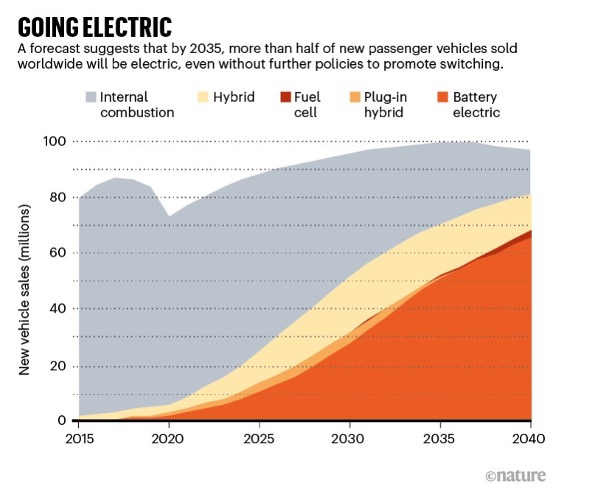
Source: nature.com
The race to full EV implementation provides several interesting conundrums.
First, how do you reduce the impact of mining in-demand materials? According to Argonne National Laboratory a single car lithium-ion battery pack (of a type known as NMC532) could contain around 8 kilograms of lithium, 35 kilograms of nickel, 20 kilograms of manganese and 14 kilograms of cobalt.
Second, the cost of lithium-ion batteries continues to decrease and therefore they are likely to remain the dominant technology in EV manufacture, which could have a major impact on supply. Australia could become a major supplier, but we’ll get to that shortly.
In short, lithium-ion is crucial to the future of manufacturing. Not just with EVs, but as a power source for many everyday and essential items: mobile phones, laptop computers, digital cameras … the list goes on.
Baby, you can drive my car … or how I learned to love the lithium-ion battery
Beep, beep. Yeah!
By now, we’ve all heard of lithium-ion batteries.
A few years ago, most of us wouldn’t have paid attention or cared about the batteries we put in our Walkmans, boom boxes, tape recorders, bedside clocks or whatever other devices we put batteries into.
Today, with the advent of the EV and the sustainability zeitgeist, we haven’t just heard of lithium-ion we are contributing more greatly to its uptake.
That has led to an exponential rise in demand for lithium-ion ... which has been a boon for several miners.
Especially for those serving the EV boom.
But this isn’t about miners. This is about the market. So just how big is this market?
According to Grandview Research, the global lithium-ion battery market size was valued at US53.6 billion in 2020 and is expected to grow at a compound annual growth rate (CAGR) of 19% from 2020 to 2028.
As discussed, the growth is attributed to the growing demand for the lithium-ion battery in electric vehicles (EVs) and grid storage as it offers high-energy density solutions and lightweight.
The subsequent increase in the registration of EVs and a decrease in the price of the lithium-ion battery is estimated to expand market size over the forecast period.
Grandview reports that growth is also projected to come via “the mounting number of photovoltaic installations and nuclear power plants, along with the beginning of the wind energy projects.
Expanding off-grid installations in the US, India, China and Germany, along with the growing acceptance of lithium-ion batteries in equipment used in the medical sector, is expected to encourage the market for lithium-ion batteries over the forecast period.
Statista’s valuation is a little more conservative, but it estimates the market will hit almost 92 billion US dollars by 2026.
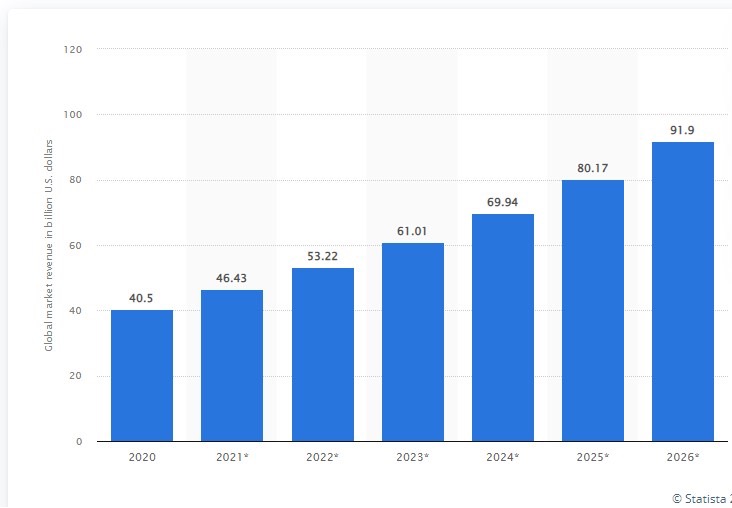
Source: Statista
That kind of growth is hard to ignore, or love if you are invested in the mining or manufacture of the material.
King of the road … or how lithium-ion batteries became so popular
The popularity of lithium-ion batteries can be put down to its many uses.
Pound for pound, there is nothing that comes close to them as far as energy-storing, rechargeable batteries go.
The advantages are:
- They are lightweight;
- They are highly reactive and can store a lot of energy;
- They are high density;
- They hold their charge;
- They do not have to be completely discharged to recharge;
- Lithium-ion batteries can handle hundreds of charge/discharge cycles or between two and three years; and
- The cost: According to BloombergNEF, the average cost of a lithium-ion battery pack fell to $137 per kWh in 2020. For a smartphone, the battery costs between $2 to $4, but for an electric car, a lithium-ion battery can range between $7,000 and $20,000. The price of these batteries have come down by about 88% in the last decade and are still falling.
When you compare batteries and density, a typical lithium-ion battery can store 150 watt-hours of electricity in 1 kilogram of battery, while a nickel-metal hydride (NiMH) is typically 60-70 watt-hours per kilogram, although it can go to 100 watts.
A lead-acid battery can store only 25 watt-hours per kilogram.
Shame on you, lead-acid batteries.
Given all these factors, along with cost-effectiveness and multiple uses, it is not hard to see why lithium-ion batteries have become so popular.
They may also play a large role in US President Joe Biden’s infrastructure plans.
He understands lithium is an essential component of batteries used in electric cars and renewable power and he is monitoring a range of contracts between major car companies such as General Motors and resources companies.
The trick is to allay the fears of environmentalists and consumers as to the benefits.
It is not an easy sell, but it is a bill of sale the President is willing to highlight and bring attention to.
Madeleine Tyson of GreenBiz writes: “A healthy domestic battery supply chain has many benefits for Biden’s plan to align climate spending with clean energy jobs. The price of batteries has dropped precipitously since 2010 (from $1,000 per kilowatt-hour (kWh) to less than $150/kWh today) enabling them to become more fundamental to clean energy business models in both electricity and mobility.
Biden’s plan outlines significant funding in these battery-dependent sectors: $174 billion to "win the EV market," $100 billion for grid infrastructure, $180 billion for research and development, and $300 billion for manufacturing and small businesses”.
Lithium-ion batteries are a political, social and environmental peacemaker. Hence the popularity.
Or so we thought.
Drive slow … or understanding the vast challenges lithium mining presents
Politico journalist Jordan Wolman wrote in January this year, “To win the war on global warming and triumph in an economic showdown with China, President Joe Biden needs an essential weapon — lithium”.
The US has the largest reserve of lithium in the world, but due to environmental concerns and political manoeuvring by states, it only produces 12% of global output. For instance, in Maine and North Carolina, existing laws make it almost impossible to mine.
Biden must overcome environmental concerns. That's easier said than done.
“I don’t think that we’re ultimately going to save the planet by blowing up places like Thacker Pass,” said environmental activist Max Wilbert.
The Thacker Pass lithium project is an open-pit mine proposed to be developed in Humboldt County, Nevada, US, by Lithium Americas.
Wolman wrote: “Weaning the economy off fossil fuels comes at its own environmental cost, a truth that is just now dawning on many Americans, especially those living near valuable mineral deposits.
The transition will require mining massive quantities of metals and minerals, a practice that carries its own pollution, said Jordy Lee, a program manager at the Payne Institute for Public Policy at the Colorado School of Mines.
“Investors consider it worse than oil and gas from an environmental perspective,” Lee said. “It’s a weird mess of a problem.”
The trick, if we can call it that, is to find a balance between clean mining practices and mining necessities to best contribute to a green economy.
Of course, there are always alternatives to lithium-ion.
Read: Challengers emerge: alternatives to lithium-ion batteries
Travelling in a fried-out Kombi … or why Australia is ditching the Kombi to take a strong lithium position
If there is any nation that could best benefit from the move to the green economy and its relationship with lithium, it is Australia.
The Australian battery market was valued at US$1,002.9 million in 2020, and it is expected to reach US$1,702 million by 2027, registering a CAGR of about 8.41% during the forecast period between 2022 and 2027.
According to Mordor Intelligence, Australia is the world’s largest producer and exporter of lithium. Most of the lithium is exported as spodumene concentrate, which requires further processing.
Several Australian mining companies are starting to collaborate with foreign companies to commercially set up lithium extraction and enrichment plants to produce battery-grade lithium in Australia.
In August 2021, IGO Limited (ASX:IGO) and lithium joint venture partner Tianqi Lithium produced the first lithium hydroxide at their Kwinana refinery in Western Australia.
The factory has started operating its first production train, Train 1, which is expected to reach its design production rate of 24,000 mt/year lithium hydroxide by the end of 2022. In September 2021, Covalent Lithium announced a project to construct a new world-class 50,000-metric ton lithium hydroxide refinery in Kwinana.
Lithium Australia NL (ASX:LIT, OTC:LMMFF) is another player in the mix, as it seeks to vertically integrate lithium extraction, processing and recycling … and, in so doing, transform the battery industry for a cleaner, greener, more liveable world.
Large-scale lithium refining projects are expected to strengthen Australia’s domestic battery supply chain and drive the Australian battery market during the forecast period.
Little Red Corvette … or the end of the article
Baby, you’re much too fast.
The rising uptake of electric vehicles and the manufacturers’ desire to go electric in the next 20 years has sped up the need for lithium.
The market is growing bigger, with some analysts predicting it will be too fast for demand.
However, right now there’s no stopping the momentum.
The mining companies are ramping up exploration. The manufacturers are becoming impatient for supply. The suppliers are struggling to keep up with demand. While consumers are adopting a raft of climate-friendly step-changes which has shifted expectations.
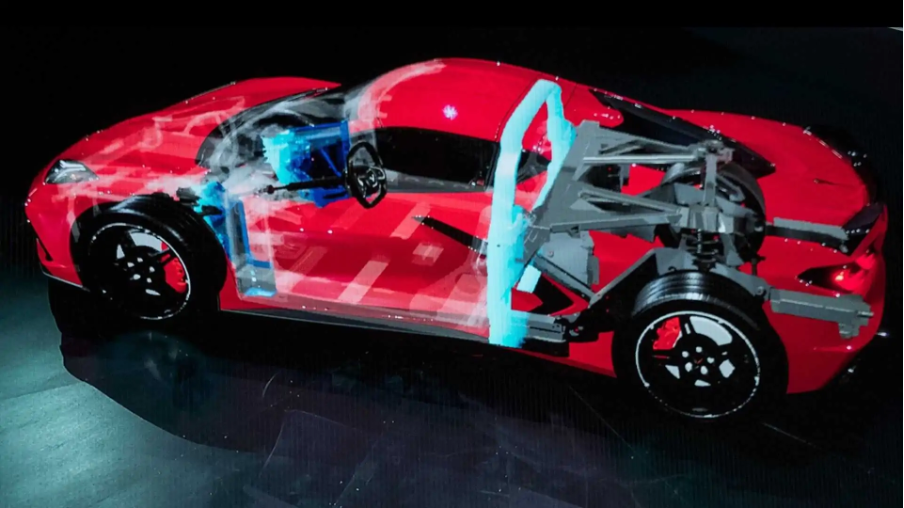
So now, is not the time to put the brakes on. This isn’t a matter of Cruisin’. It’s a matter of finding the rules of the road, buying an electrified red corvette (the Corvette E-Ray – see below – or whatever your fancy is) and running down the dream.