
Venture Minerals Ltd (ASX:VMS, OTC:VTMLF) continues to deliver strong intersections of high-grade mineralisation from its new drilling program at the Mount Lindsay Tin-Tungsten Project in north-western Tasmania, including 119.2 metres at 0.8% tin and 0.2% tungsten from 75.8 metres.
The company’s drill program is designed to confirm the continuity of high-grade zones and provide additional metallurgical samples, part of the updated feasibility study for an underground mine.
Significant intersections from the new drill program include:
- 45 m at 1.0% tin and 0.2% tungsten or 1.2% tin equivalent from 147 metres;
- 23.2 metres at 1.6% tin and 0.03% tungsten or 1.7% tin equivalent from 75.8 metres;
- 9 metres at 2.5% tin and 0.03% tungsten or 2.6% tin equivalent from 90 metres; and
- 3 metres at 4.1% tin and 0.1% tungsten or 4.3% tin equivalent from 90 metres.
Notably, drilling on the Main Skarn’s high-grade MacDonald Shoot is complete and the rig is now drilling on No. 2 Skarn’s high-grade Radford Shoot.

“Ramping up exploration efforts”
Commenting on the latest high-grade results from the Mount Lindsay, Venture managing director Andrew Radonjic said: The new drilling at Mount Lindsay continues to deliver outstanding tin intersections within the high-grade MacDonald Shoot beneath historical tin workings.
“The value of Mount Lindsay today continues to grow, already having more than 80,000 tonnes of tin metal in JORC complaint resources at a time of record tin prices.
“Venture looks forward to completing this feasibility drilling shortly and ramping up our exploration efforts with drilling scheduled to test multiple high priority targets over the coming months within Australia’s premier tin district on the west coast of Tasmania.”
Drill program
Venture has completed drilling on the Main Skarn’s high-grade MacDonald Shoot and is currently drilling similarly targeted holes on the No. 2 Skarn’s high-grade Radford Shoot.
The preliminary assay results reported here were from a nearby laboratory that generated results using a similar analytical technique for some of the suite of elements that are routinely tested for on Mount Lindsay drill core.
The pulps will be submitted to the preferred laboratory to provide assays for the missing elements and to check the values reported here using the analytical method chosen for the JORC-compliant resource.
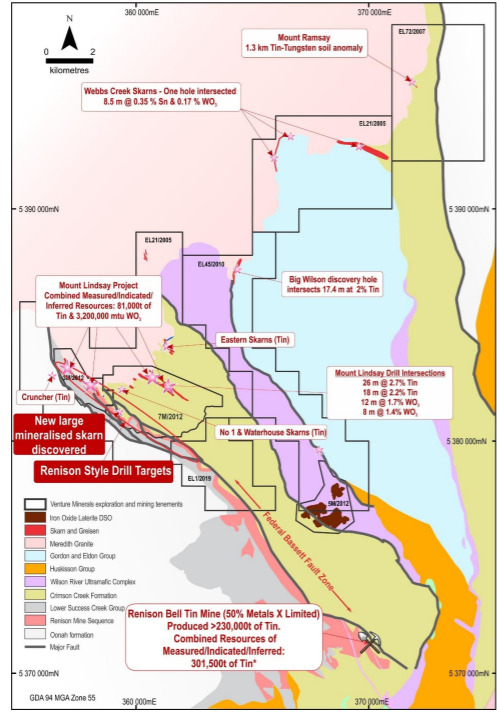
Geology Map showing High Grade Tin-Tungsten Targets at Mount Lindsay
Feasibility study underway
The underground feasibility study will advance previous scoping study work and includes additional drilling to further confirm the continuity of the High-Grade MacDonald Shoot in the Main Skarn and the High-Grade Radford Shoot in the No.2 Skarn.
Current drilling will also provide material for finalising a cost-effective, gravity-focused, processing flowsheet to concentrate the high-density minerals cassiterite.
Venture recently engaged BHM Processing Consultants to manage the metallurgical part of the study.
Additional work will include further detailed engineering studies to firm up the mine design and update the permit to reflect the change in mining and processing strategies.
Furthermore, Venture continues to build a dedicated team to manage the study program and to that end has just engaged a resource development geologist.
EV Metal
Tin is now recognised as a fundamental metal to the battery revolution and new technologies.
It is listed as a critical mineral (as is tungsten) by numerous countries around the world and is currently trading at around US$44,000 per tonne, which is over four times the price of copper at around US$10,000 per tonne.
Interestingly, there is currently about two days’ global supply of tin held in stockpiles by the London Metal Exchange (LME).
Looking ahead, The International Tin Association is predicting a surge in demand driven by the lithium-ion battery market, of up to 60,000 tonnes per annum by 2030.
About the Mount Lindsay Project
The Mount Lindsay Project is already classified by the Australian Government as a Critical Minerals Project with an advanced tin-tungsten asset.
This is significantly enhanced by the recent discovery of two new skarn zones, one within the Renison Mine Sequence in the Mount Lindsay area and the other along strike from Mount Lindsay’s main tin deposits.
Mount Lindsay is already one of the largest undeveloped tin projects in the world, containing more than 80,000 tonnes of tin metal and within the same mineralised body a globally significant tungsten resource containing 3,200,000 metric-tonne units of tungsten.