
Horizon Minerals Ltd (ASX:HRZ) has tabled the first lot of reverse circulation and aircore drilling results from the Yarmany project area — assays the company believes highlight the property’s multi-commodity potential.
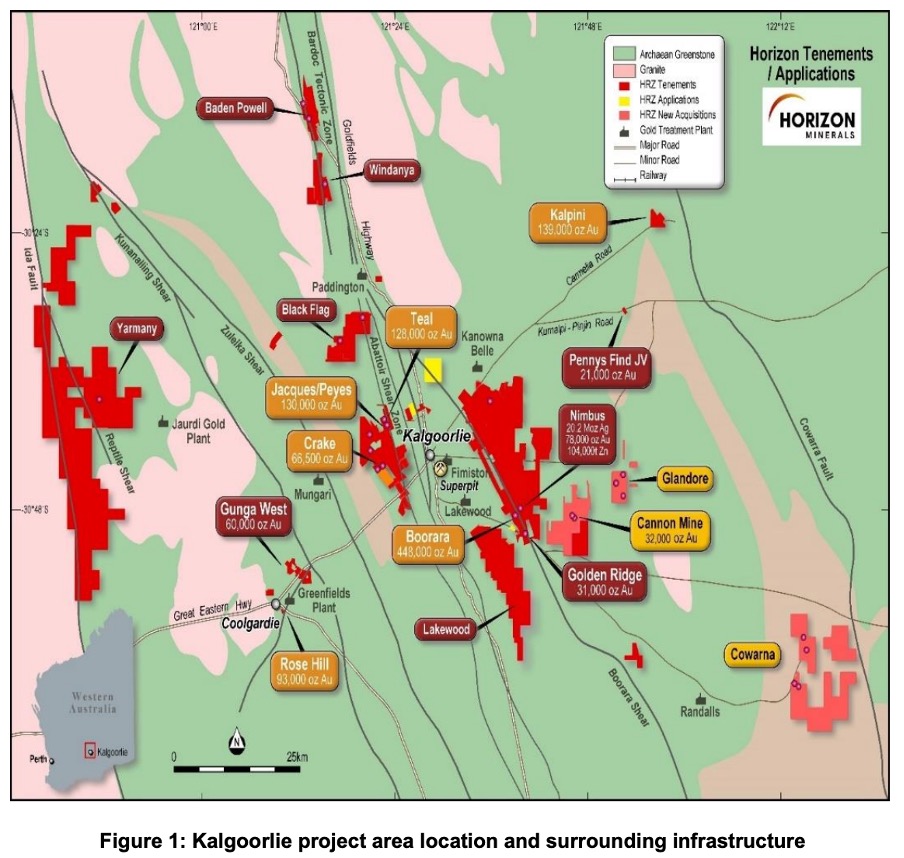
The drilling activity forms part of HRZ’s 2021 and 2022 programs, testing new discovery targets for multiple commodities across its 1,100-square-kilometre portfolio with a focus on the Yarmany, Greater Boorara and Lakewood project areas in Western Australia.
Since the main Yarmany tenements were granted in 2020, the company has completed extensive geophysical/geochemistry work, soil and rock chip sampling and field reconnaissance that identified prospectivity for multiple commodities.
All assays are being analysed for gold, silver, nickel, cobalt, copper, lead, zinc and platinum group elements (PGEs).
Potential to discover new gold and base metal deposits
Commenting on the first-pass results at Yarmany, Horizon managing director Jon Price said: “While the company remains focused on growing our gold business, these first-pass results have highlighted the potential for the discovery of new base and energy metals deposits as well as gold in a relatively unexplored region in the goldfields.
“The company has more than 50 kilometres of the highly prospective Mt Ida fault at Yarmany and we look forward to the release of further results and the commencement of the large-scale multi-commodity exploration program in coming months.”
Turing the soil at Yarmany
The Yarmany drilling campaign was the company’s first program at this underexplored project.
The drilling was completed in two phases, namely reverse circulation (RC) and aircore drilling.
Aircore drilling is typically used as a lower-cost alternative to RC drilling, especially during the early exploration stage while covering a larger testing area.
It is, however, often limited to drilling within the softer, more weathered rocks.
All up, 47 RC holes, covering 4,413 metres, and 72 aircore holes, spanning 2,617 metres, were completed at Yarmany.
Reptile shear
Two small, historical prospects along the Reptile shear, which had reported high-grade gold mineralisation (up to 14.5g/t gold), were tested by six RC holes with no significant results.
Better results were achieved in areas where there was only minimal historic rotary air blast drilling.
The best Reptile shear results to date came from a quartz stockwork zone, where 19 scout RC holes discovered at least two new gold systems.
Significant results include:
- 2 metres at 4.95 g/t gold from 86 metres;
- 2 metres at 3.58 g/t from 66 metres and 2 metres at 1.25 g/t from 78 metres;
- 1 metre at 1.27 g/t from 54 metres and 2 metres at 1.41 g/t from 59 metres;
- 2 metres at 1.33 g/t from 63 metres; and
- 1 metre at 1.81g/t from 111 metres.
A further 1 kilometre to the southeast, another emerging prospect at Wotan reported:
- 1 metre at 1.61 g/t from 48 metres; and
- 1 metre at 1.81 g/t from 111 metres (bottom of hole terminated at 114 metres, assaying 0.34 g/t).
Big Red
Further encouraging gold mineralisation was observed at the Big Red prospect, where historic auger sampling had outlined a 3.5-kilometre by 2-kilometre soil anomaly with a peak value of 75 parts per billion gold.
Around 6,500 metres of rotary air blast drilling delineated six anomalous areas that recorded bottom-of-the-hole results of more than 1.0 g/t gold.
In addition, four diamond drill holes that followed up the better prospects returned modest levels of gold — the best result was 1.1 metres at 2.56 g/t from 56.9 metres.
Horizon drilled five RC holes into the main Big Red prospect area, where old drill spoils showed strong alteration and pyrite mineralisation.
Better results include:
- 1 metre at 2.91 g/t from 39 metres;
- 2 metres at 2.94 g/t from 82 metres;
- 2 metres at 2.37 g/t from 86 metres; and
- 6 metres at 1.14 g/t from 66 metres.
Horizon considers these results highly encouraging, noting they provide a solid lead in progressing Big Red.
During routine logging at the prospect, there were some trace occurrences of sphalerite (zinc) and possibly galena (lead) in the fresh chips.
As a result, all composite samples were tested for multi-element analysis, with one hole returning 4 metres at 5.2 g/t silver, 498 parts per million (ppm) lead and 202ppm zinc from 20 metres.
Nickel and lithium exploration
Horizon’s recent aircore program was designed to test some magnetic highs for nickel and follow up on the pegmatite outcrops observed in October 2021.
Drilling across the many magnetic highs outlined a regolith with anomalous nickel-chromium-cobalt — and sometimes copper — geochemistry.
Bulked results from the aircore drilling include:
- 27 metres at 0.42% nickel and 299ppm cobalt from 4 metres, including 4 metres at 0.71% nickel and 767ppm cobalt from 20 metres;
- 3 metres at 0.58% nickel and 412ppm cobalt from 28 metres;
- 16 metres at 0.33% nickel and 344ppm cobalt from 4 metres; and
- 30 metres at 0.26% nickel and 130ppm cobalt from surface, including 2 metres at 0.67% nickel and 136ppm cobalt from 28 metres.
Ultimately, Horizon says the results confirm the nickel prospectivity of this 1.6-kilometre-long magnetic ultramafic unit.
Although there are low-grade laterites and clays in the Yarmany regolith, Horizon is focused on finding nickel sulphides that could be located beneath this laterite mineralisation.
HRZ notes there is very little historical or recent drilling targeting nickel sulphides along this or any of the other mapped ultramafics of magnetic highs within the 50-kilometre tenure.
The bulk of the aircore drilling was directed to locating and testing pegmatites, in particular lithium-rich pegmatites.
The pegmatite outcrop discovered in October gave Horizon a starting point as very few pegmatites had been documented at Yarmany.
However, lithium pegmatites have been well documented in the broader region, with several nearby companies progressing their projects.
Next steps
The 50-kilometre Ida Fault zone within the Horizon tenure, including secondary structures and ultramafic rock associations, remains a key exploration target for the company in 2022.
Unlike many of the other major faults in the Eastern Goldfields, the Ida Fault remains one of the few to have received little significant modern-day exploration despite having some major deposits close by.
Several new gold prospects and leads were discovered during the 2021 drill program.
The Big Red and Reptile shear zone prospects are encouraging and will be explored in more detail.
Priority targets also include testing several more of the ultramafic outcrops or magnetic highs along the Ida Fault with deep RC drilling, targeting nickel sulphides.
Planned exploration along the Mt Ida Fault includes broad spaced, multi-element soil or ultrafine geochemical sampling and aircore/RC drilling.
Together with the 2021 gravity survey, a new generation of gold, nickel and pegmatite targets are being delineated and will be tested.