
Kin Mining NL (ASX:KIN) has reported more strong results with significant shallow gold discovery at the Pegasus Prospect, adjacent to the 374,000 ounces Bruno-Lewis deposit at its 100%-owned 1.275 million-ounce Cardinia Gold Project (CGP) near Leonora in Western Australia.
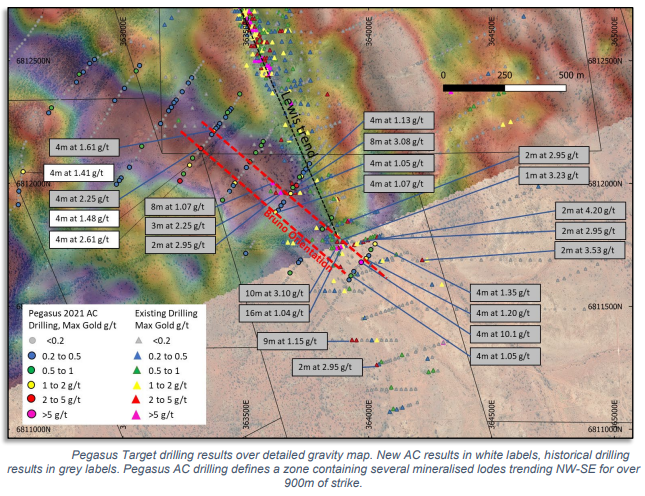
The final results include more strong intersections such as 4 metres at 2.61 g/t gold from 4 metres in and 4 metres at 1.48 g/t gold from surface, together with other significant results on the eastern edge of the Pegasus Gravity Target.
The next phase of deeper reverse circulation (RC) drilling is scheduled to commence in March.
Strategy continues to deliver
Kin Mining managing director Andrew Munckton said: “These results from the north-western extension of the area provide further evidence that Pegasus is an emerging discovery within the 1.275 million-ounce Cardinia Gold Project.
“Our systematic, exploration-driven strategy continues to deliver.
“The full batch of air-core data, including the exciting high-grade drill results reported on 15 November last year, show that Pegasus comprises a shallow zone of gold mineralisation extending over a strike length of at least 900 metres and up to 100 metres wide."
Prioritise Pegasus
“Pegasus appears to form part of a parallel structure adjacent to the Bruno-Lewis deposit and the mineralisation appears to have similarities to the north-west trending Bruno lodes.
“The proximity of this mineralisation to a significant gravity low confirms that our exploration targeting methodology is working.
“Given the widespread nature of the ore grade intercepts and the nearby location of this exciting new area, we intend to prioritise Pegasus for deeper RC drilling that is scheduled to commence next month.”
Watch: Kin Mining reports promising aircore drilling results at the Pegasus prospect
Results
The final 4 metres composite assay results include the following significant intercepts:
- 4 metres at 1.41 g/t gold from surface;
- 4 metres at 1.48 g/t from surface; and
- 4 metres at 2.61 g/t from 12 metres and 2 metres at 0.55 g/t from 24 metres to bottom-of-hole.
Reinforces initial exciting results
The new assay results support and reinforce the initial exciting results, confirming a significant new zone of shallow, high-grade gold mineralisation at Pegasus that represents an outstanding target for follow-up exploration.
The results also reinforce Kin Mining’s view that gravity lows highlighted in the recent detailed geophysical survey over the greater Cardinia area represent priority exploration targets for new discoveries for the company’s exploration team.
The Pegasus prospect was first identified as a soil geochemical anomaly after regional, wide-spaced auger sampling undertaken in early 2020.
The auger program identified a number of gold-in-soil anomalies in the western corridor including the Eagle-Crow prospect, which was tested recently by RC drilling in 2021 with strong initial results.
The prospectivity of the Pegasus target was enhanced with the completion of the detailed gravity survey in the September 2021 quarter, which showed that the anomalous soil geochemistry was coincident with the edge of a large, NW-SE trending gravity low.
Gravity lows have shown a strong correlation with gold mineralisation at the adjacent Bruno-Lewis deposit and recent high-grade discoveries at Cardinia Hill and Rangoon in the Eastern Corridor at Cardinia.
2021 aircore drilling program
Aircore drilling completed in September and October 2021 comprised 405 aircore holes of 10,914 metres on 12 lines, which was designed to:
- test at 200 metres line spacing the anomalous soil geochemistry coincident with the eastern edge of the gravity target;
- test at 200 metres line spacing the western edge of the gravity target which lies within the Cardinia Creek system where soil geochemistry is not effective and where access is limited; and
- confirm the relationship of the historical Pride of the North and Lewis drilling results to the Pegasus Gravity target.
Multi-element assay results for bottom-of-hole samples used to characterise the rock types have confirmed that the gold mineralisation is associated with anomalous silver, antimony, zinc and tungsten in sulphide-rich vein structures within altered mafic rocks.
The next phase of work, comprising RC and diamond drilling to confirm mineralisation in fresh rock, is planned to commence in March.