
Pan Asia Metals Ltd (ASX:PAM) has released assays from another bout of drill holes completed at the Reung Kiet Lithium project in southern Thailand.
What’s more, results are in from a sampling campaign over a series of infill and extensional holes at the project, indicating material increases in the overall lithium oxide content.
Assays for holes RKDD036-042 are expected shortly and will be reported when available, while drill rigs continue to turn the soil at Reung Kiet.
In the meantime, the project’s inaugural mineral resources and exploration targets are anticipated in the current quarter, followed by a scoping study.
“A good outcome”
Speaking to the latest findings, Pan Asia Metals managing director Paul Lock said: “The infill and extensional sampling has delivered a material increase in overall lithium content at the Reung Kiet Lithium Project.
“This is a good outcome in the lead up to the reporting of an inaugural mineral resource.
“With infill assaying our objective is to determine whether metasediment adjacent to and in-between lithium and or tin rich pegmatites is mineralised, and if so whether this mineralisation is above our lithium cut-off grade, which is 0.20% Li2O.
“If so, then our overall mineral resource will increase, inclusive of the higher grading pegmatite intersections previously announced.
“In turn, this positions PAM well, as what may be dilutionary waste in the mining process has the potential to be economic.
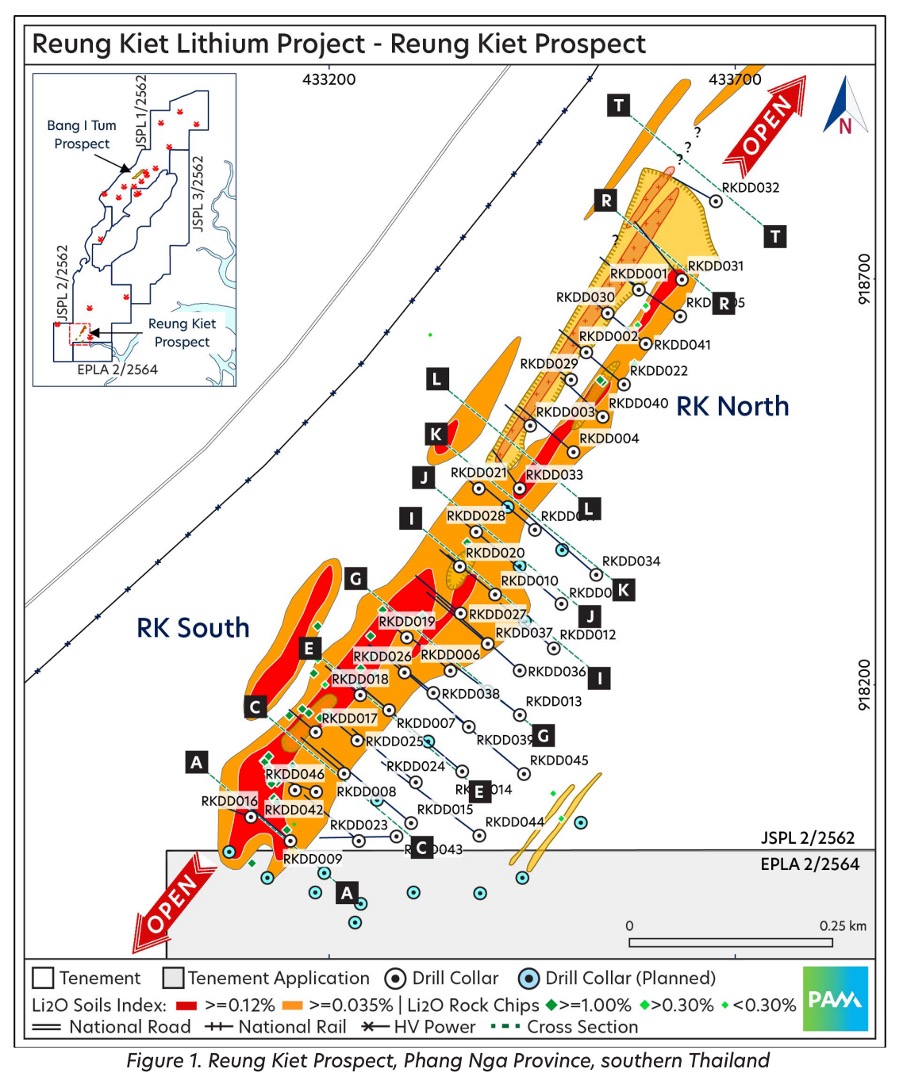
“Holes 31 to 35 were extensional and or infill holes. Holes 31 and 32 confirm that the Reung Kiet Prospect remains open to the north and holes 33 to 35 indicate a thickening of the pegmatites at depth and in most cases a continuation of lithium mineralisation above cut-off.
“What is most interesting is that where lithium grades drop off, we often see an increase in tin and tantalum. To clarify, Reung Kiet remains open to the south as well.
“Overall, we are very pleased with our progress and we are on track to report an inaugural mineral resource this quarter.”
The results are in
The best assays for five of Reung Kiet’s latest drill holes, dubbed RKDD031-035, include:
- 14.85 metres at 0.31% lithium oxide (Li2O) from 90.1 metres and 5 metres at 0.61% from 145 metres;
- 10 metres at 0.32% from 0 metres and 10.05 metres at 0.42% from 77.25 metres; and
- 4 metres at 0.72% Li2O from 4 metres, 10.95 metres at 0.20% tin, 121 parts per million (ppm) tantalum pentoxide from 191.3 metres and 18.45 metres at 0.19% tin, 123ppm tantalum pentoxide from 238.75 metres and 12.85 metres at 0.20% tin, 97ppm tantalum pentoxide from 261.7 metres.
PAM has also released results for additional infill and extensional sampling across holes RKDD006- 022. Composite mineralisation includes:
- 58.2 metres at 0.53% Li2O from 23 to 101.25 metres;
- 47.9 metres at 0.49% from 29.3 to 81.6 metres;
- 43.4 metres at 0.61% from 8.6 to 93 metres;
- 56.85 metres at 0.55% from 12.7 to 111 metres;
- 28.35 metres at 0.73% from 0 to 58.1 metres
- 16.75 metres at 0.85% from 0 to 53.5 metres;
- 24.4 metres at 0.67% from 0 to 50.5 metres; and
- 25.95 metres at 0.80% from 1 to 55.5 metres.
Overall, results indicate that tin, tantalum, rubidium, caesium and potassium mineralisation occur in association with lithium, with tin and tantalum also occurring in pegmatites with lower lithium grades.
Exploring Reung Kiet
As one of PAM’s key assets, Reung Kiet represents a priority exploration opportunity.
In the past, open-pit mining extracted tin from Reung Kiet’s weathered pegmatites and was conducted into the early 1970s.
This old pit is roughly 500 metres long and up to 125 metres wide, and it forms part of a prospective zone that runs for at least 1 kilometre across the property.
The Reung Kiet pegmatite trend is divided into two main parts — RK North and RK South — and each measures roughly 500 metres long.
The whole 1-kilometre trend remains open to the north, south and down dip on many sections, and additional infill and extensional drilling is underway to better understand its prospectivity.
Forward program
PAM has further drill holes planned at both the Reung Kiet and Bang I Tum lithium prospects in a bid to define further mineral resources and exploration targets.
At Reung Kiet, drilling will focus on deeper holes at RK South, seeking to extend higher grade zones down-dip.
PAM is now awaiting results for holes RKDD036-042, which are expected in the near term.
Meanwhile, drill holes RKDD043-046 are being logged and sampled, and results will be reported when available.
Additional drilling will also target potential for mineralisation north of the old pit, as well as geochemical targets on the eastern and western sides of RK South.
Drilling is also planned to target strike extensions at RK South where mineralisation remains completely open along trend. This drilling will commence once EPLA 2/2264 is granted.