
Chase Mining Corporation Ltd (ASX:CML) has identified a new large-scale rare earths and base metals project area during a geochemical and geophysical review on the northern Barkly Tableland within the North Barkly Project in the Northern Territory.
The Barkly region has been subject to intensified geophysical, geochemical and geological investigation by Geoscience Australia over recent years, leading to the recognition of the potential for repetitions of the large mineral deposits such as those mined at McArthur River and in the Mount Isa area.
Looking ahead, Chase proposes to define the sources of the stream sediment metals and rare earths by conducting more detailed sampling with drilling to take place after the targets are well defined.
Shares have been trading as high as $0.017 intraday, up 22% from the previous close.
Rare earths deposit
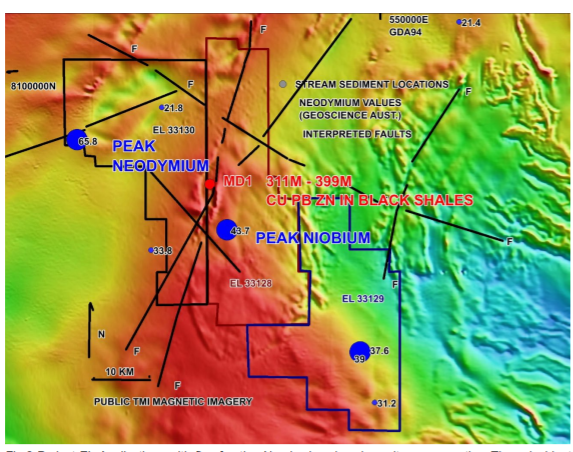
Project EL applications with fine fraction Neodymium (ppm) results on magnetics.
Chase has examined the large volume of data and has identified this area as having the strongest indicators of a major rare earths deposit.
A peak rare earths trend runs northwest to southeast through the project area and is strongly supported by peak niobium, scandium, tellurium, palladium and cobalt values in the centre.
The project area is characterised by a lack of outcrop and strong weathering, features conducive to rare earths enrichments in the near-surface.
Base metals potential
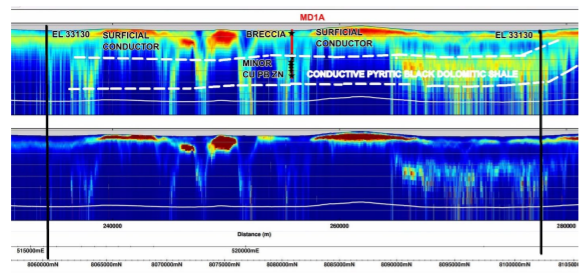
Geoscience Australia Tempest Airborne EM Section 117002 N-S through hole MD1A.
Base metals potential also exists within the project with the tuffaceous black dolomitic pyritic shale intersected by BHP in MD1A being the preferred host rock for major base metals deposits in this region.
The base metal sulphides indicate that a mineralising process has occurred locally, and viable grades may be found in a more favourable site nearby.
The Geoscience Australia geophysical data demonstrates that this prospective conductive horizon underlies the entire project area, generally at about 350 metres depth.
Proposed exploration program
After exploration licensing is granted, Chase Mining proposes to define the sources of the stream sediment metals and rare earths by conducting more detailed sampling.
The current and any future Geoscience Australia data will also be examined in more detail, in particular the geophysics.
Further, the BHP MD1 drill core will be located and, if possible, be analysed for more elements, including rare earths with drilling to take place once the targets are well defined.