
Critical Resources Ltd (ASX:CRR) has moved to increase its holding around the Mavis Lake Project in Ontario, Canada, by claiming an additional 2,700 hectares of adjacent land as part of the company’s aggressive land acquisition strategy.
CRR says the new ground further validates this strategy and demonstrates the company’s intent and focus on lithium exploration in Canada.
Tenure allows thorough exploration
Critical Resources managing director Alex Biggs said: “Increasing our landholding around Mavis Lake is part of our strategy, allowing us to conduct additional exploration works, test any continuities in geology and importantly providing the ability to expand our exploration thesis in a highly prospective and emerging lithium region.
“We are excited to begin work at Mavis Lake. An aggressive work program has been planned towards meeting the milestone targets. We look forward to updating the market in due course.”
These new claims increase the total area of the Mavis Lake project to about 6,500 hectares, on top of 1,600 hectares held in the Graphic Lake Lithium Project, which may offer strong synergies for the company to leverage.
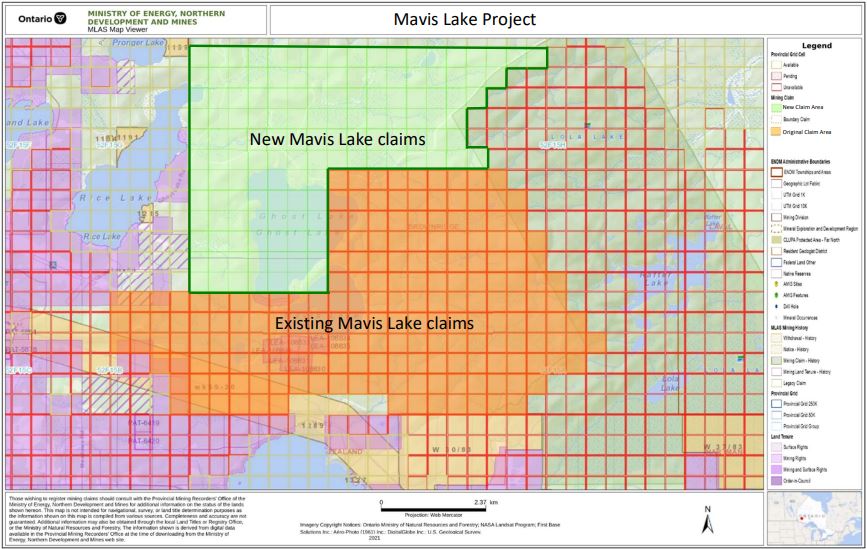
Critical Resources is now securing permitting for Mavis Lake, after which the company will begin an aggressive work program to explore the project area.
About Critical Resources
Critical Resources is an emerging base metals and lithium exploration company based in Perth, Western Australia with assets in New South Wales, Australia, Ontario, Canada, and the Sultanate of Oman.
The Halls Peak asset in New South Wales, Australia, represents multiple base metal exploration targets with historic mining of high-grade zinc, copper and silver.
The company has also recently acquired the high-grade Mavis Lake lithium asset in Ontario, Canada, which represents exploration potential with historic results including 26.3 metres at 1.7% lithium oxide (Li2O), 55.25 metres at 1.04% Li2O and 15.20 metres at 1.56% Li2O.
Sohar Copper Project in Oman holds a JORC resource of 819,000 tonnes at 3.4% copper for 28,000 tonnes of copper metal, with high-grade volcanogenic massive sulphide (VMS) style deposits and a large exploration area of 1,000 square kilometres within a well-established mining region.