
Shree Minerals Limited (ASX:SHH)’s exploration studies have highlighted strong prospectivity including for lithium at its Dundas Project in the Albany Fraser Orogen, Western Australia.
The project is interpreted to occur along strike of the well-endowed Boulder Lefroy Fault Zone and the Zuleika Shear.
World-class lithium in pegmatite deposits are spatially related to these mineralised structural corridors to the north of Shree’s exploration licences.
Pegmatites have been recorded from historical drill logs within Shree’s tenure while magmatic mafic-ultramafic intrusions of the Nova Bollinger type may have been discovered immediately to the south of Shree's tenure, again in these structural corridors.
Several aeromagnetic anomalies within Shree’s tenements resemble these intrusive bodies and have the potential to contain nickel sulphides.
Historical drilling intersections up to 3 g/t gold remain open and the associated soil geochemistry suggests the mineralisation is much more extensive than indicated by drilling.
Broad zones (30 metres) of highly anomalous base metal sulphides occur in Shree’s exploration licence application.
Investors have expressed their approval of the Dundas prospectivity, driving shares 118% higher to $0.024, a new high of more than seven years, with almost 175 million changing hands.
Delighted with outcomes
Shree Minerals executive director Sanjay Loyalka said: “We are delighted with the outcomes of technical studies at the Dundas Project that have concluded the presence of gold mineralisation and the identification of numerous coarse-grained pegmatite intersections from past explorers has significant implications for additional discoveries within our tenements.
“Shree considers the Dundas tenements to be ideally located within a major regional structural corridor containing world-class deposits of gold and lithium.
“Prospective mafic and ultramafic rocks and untested gold and base metal and silver drilling intersections and geochemical soil anomalies lay adjacent to major regional structures.
“Their location in an under-explored region leads Shree to rate the exploration potential of the project as very high.
“Liontown’s world-class Buldania Lithium Project is only 25 kilometres away.
“The structural setting at Buldania (adjacent to Zuelika Shear) resembles the same settings within Shree’s tenements, highlighted by major regional structures, as suggested from aerial magnetic images.”
Dundas Project
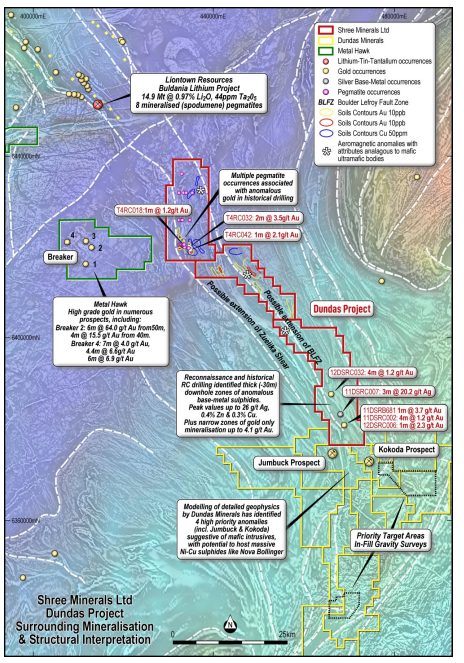
The Dundas Project consists of two exploration licences (E63/2046 and E63/2048) and one exploration licence application (E63/2136) within the inferred SE extensions of the mineralised Norseman-Wiluna Belt of the Archaean Yilgarn Craton.
It comprises a tectonostratigraphic assemblage of mafic, ultramafic and sedimentary dominated units.
A major northwest-trending fault system transects the tenements and may represent southeast extensions of the prolifically mineralised and regionally continuous Zuleika and Boulder-Lefroy Fault systems.
Due to the widespread but thin, transported cover seen within the tenements, Shree’s exploration strategy is built upon the geophysical and geochemical characteristics of these targets.
Lithium occurrences
Shree has compiled a geological database of the structural controls and lithological characteristics of lithium occurrences within the Dundas Goldfield.
The largest is the Buldania Lithium Project, which contains a mineral resource of 14.9 million tonnes at 0.97% lithium dioxide and 44 ppm tantalum pentoxide and occurs in a greenstone belt within the Zuleika Shear, which is interpreted to continue through Shree’s tenements.
Within Shree’s tenement areas, aeromagnetic images display linear features suggestive of Archaean greenstone stratigraphy – mafic, ultramafic or Banded Iron Formation rock type.
Pegmatitic intrusions are often associated with Archaean greenstone stratigraphy and their presence has been recorded in the historical drilling.
Reconnaissance traverses of RAC and RC drilling by Pan Australian Exploration Pty Ltd in the 1990s intersected gold mineralisation associated with the remnant greenstone belts.
Many of the holes drilled also intersected pegmatites but these were not the target of the exploration at the time and were not assayed for lithium or lithium pathfinder elements.
Gold mineralisation
Only very limited historical exploration has been carried out in the area due to the thin blanket of transported cover.
One kilometre spaced auger soil traverses undertaken by AngloGold Ashanti (ASX:AGG) Australia and a localised RAB/RC drilling program by Pan Australian Resources during the 1990s identified the presence of gold mineralisation hosted by mafic rocks in E63/2046.
Reported intersections include:
➢ 2 metres at 3.5 g/t gold from 23 metres;
➢ 1-metre at 2.1 g/t from 87 metres; and
➢ 1-metre at 1.2 g/t from 53 metre.
Shree’s Dundas Project is 16 kilometres east of Metal Hawk Limited’s Breaker Prospect, within the Albany Fraser Province, illustrating the prospectivity of the Dundas area that is a poorly exposed and lightly explored greenfield area.
Base metal, silver and gold
In 2011-2012, Ausquest Ltd conducted wide-spaced (>800 metres) reconnaissance RAB and RC drilling in the southern areas of Shree’s tenements.
The drilling reported anomalous gold (up to 4.1 g/t) with associated copper (up to 0.26%), zinc (0.42%) and silver (up to 26 g/t).
Some intersections are associated with thick downhole (~30m) intervals of anomalous base metal sulphides.
Better intersections include:
➢ 4 metres at 1.2 g/t gold from 51 metres, followed by 1-metre at 1.6 g/t gold from 89 metres (EOH);
➢ 1-metre at 3.7 g/t gold from 29 metres and 1-metre at 13 g/t gold from 30 metres; and
➢ 1-metre at 2.3 g/t gold from 46 metres.
The base metal results are considered highly encouraging, given the thickness of the intersections, the metal associations and that only limited drill testing was completed on the targets, which extend for at least 1 kilometre in length based on early RAB drilling.
Nickel
In December 2021, Dundas Minerals completed two close-spaced infill gravity surveys across priority nickel and copper targets to enable more precise modelling.
The exploration model for the two prospects is magmatic sulphide mineralisation associated with mafic-ultramafic intrusions, similar to the Nova-Bollinger deposit which is around 150 kilometres to the north-northeast.
At Jumbuck, a series of RAB holes drilled by Ausquest Ltd in 2011 intersected up to 0.5% nickel in ultramafic rocks and have highlighted a discrete target area, which is also earmarked for gravity surveys by Dundas Minerals.
The prospects may be spatially related to extensions of the regionally significant Zuleika Shear and the Boulder Lefroy Fault Zone, that may strike through the Dundas Minerals’ tenure.
Exploration program and next steps.
Shree applied for the two tenements E63/2046 & E63/2048 in June 2020 and has worked on processes to get the tenements granted.
These included preparation of a conservation management plan (CMP) as the tenements are within the Dundas Nature Reserve.
Shree received notification in November 2021 that these two tenements have been granted following acceptance of the CMP by Department of Biodiversity, Conservation and Attractions (DBCA).
A flora & fauna survey was carried out in November.
Shree is coordinating with Ngadju Native Title Aboriginal Corporation (NNTAC) to have Heritage surveys conducted in autumn this year as it has been advised that survey activities would resume after the summer season.
RAB and aircore drilling is planned in E63/2046 in the southern portion of the tenement initially, around and along strike of historical drillholes with recorded pegmatite intervals.
Samples will be assayed for gold and lithium pathfinder elements.
Anomalous gold and lithium pathfinder geochemistry will then be tested by reverse circulation (RC) drilling.
Shree Minerals plans to infill the soil contours in E63/2048.
Soil sampling will be conducted with a powered auger over the geochemical anomalies to refine and prioritise these target areas.
Auger drilling will target a buried carbonate layer that has been a successful sample medium in outlining gold mineralisation at Dundas and elsewhere in the southern goldfields of WA.
Samples will be assayed for gold, nickel, base metals and lithium pathfinder elements.
Anomalous soil geochemistry will then be tested by RAB and RC drilling.
These drilling programs are expected to commence following the completion of statutory surveys.
Shree has made a further application for E63/2136 in end August 2021 and is working on processes to get the tenements granted.