
Altech Chemicals Ltd (ASX:ATC) subsidiary Altech Industries Germany GmbH (AIG) has completed the preliminary design for a pilot plant, to be constructed in Germany demonstrating its proprietary battery materials alumina coating technology.
The pilot plant is designed to produce up to 120 kilograms of coated anode material per day totalling to about 36,680 kilograms of anode grade coated battery material per year.
Looking ahead, AIG is in the final stages of engineering contractor selection, with the chosen company to be responsible for detailed engineering design, equipment procurement and installation.
Plant design
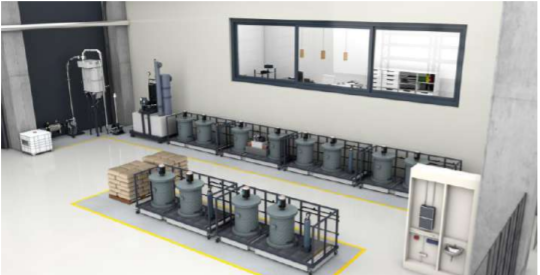
Pilot Plant design.
The plant design is intended for installation in the Dock3 facility adjacent to AIG’s designated site at the Schwarze Pumpe Industrial Park.
AIG has secured approximately 300 square metres of floorspace within the Dock3 where the pilot plant will be located.
Also, an on-site analytical laboratory is in the cards allowing for the rapid assessment of pilot plant product purity and monitor physical parameters which will enable changes in processing parameters and operational setpoints to be modified quickly, as required.
Notably, the pilot plant to provide optimised inputs for 10,000 tonnes per annum commercial plant design, and produce customer samples for testing and qualification.
Forward plan
AIG is in the final stages of engineering contractor selection, with the chosen company to be responsible for detailed engineering design, equipment procurement and installation.
At its Perth research and development laboratory, Altech has been successful in applying its alumina coating technology to both silicon and graphite particles, typical of those used in the anode of lithium-ion batteries, such as in the burgeoning electric vehicle industry.
Altech’s potentially game changing technology has demonstrated that silicon particles can be modified to resolve the capacity loss caused by swelling and first-cycle-loss capacity.
Furthermore, Phase 2 of Altech’s planned R&D program will see the company strive to improve on the 30% energy increase achieved in the first phase.