
Tamboran Resources Ltd (ASX:TBN) has released an operations update for its EP 161 natural gas project and increased the asset’s contingent resources.
EP 161, which forms part of the prolific Beetaloo Sub-Basin in the Northern Territory, is currently the site of initial flow tests for the Tanumbirini 2H and 3H wells.
Promisingly, both natural gas wells have delivered gas to surface from the Beetaloo Sub-Basin’s Med-Velkerri ‘B’ Shale over a 30-day period.
The forward plan is to continue flow testing both T2H and T3H to gather further information on the shale formation.
Following the successful flow to surface, the company has increased EP 161’s 1C and 2C contingent resources.
Tamboran holds a 25% interest in the property, which is operated by Santos, and is looking to increase the size and efficiency of a fracture stimulation design for the Maverick 1H well slated for drilling this year.

Initial flow tests at EP 161
Speaking to the resources upgrade, Tamboran managing director and CEO Joel Riddle said: We are encouraged by the initial flow rates, which support and validate Tamboran’s Mid-Velkerri shale model.
“The flow tests have proven that the hydrocarbon system is working as expected and, similar to the evolution of the best North American shales, the next steps are to optimise the results with larger and more effective fracture stimulation designs, with well design completion techniques expected to have a considerable impact on the ultimate recovery of these wells.
“The rocks are working as expected and the next steps are to optimise the results with larger and more effective fracture stimulation designs.
“The drilling of the T2H and T3H wells have de-risked the geology within the Core Beetaloo.
“Coupled with results from the Velkerri 76 S2-1 well drilled by Origin in the neighbouring permit, EP 76, these results validate an active hydrocarbon system surrounding Tamboran’s 100 per cent owned and operated EP 136 permit.
“We are planning to drill the M1H well between the Tanumbirini and Velkerri 76 S wells, in the heart of the Core Beetaloo.”
Planning for Maverick 1H
Looking ahead, Tamboran will use its learnings to enhance fracture stimulation design for the soon-to-be-drilled Maverick 1H asset.
Riddle stated: “We are excited to demonstrate our proprietary and independent intellectual property with the drilling of the M1H appraisal well, which is planned to commence by mid-2022.
“The M1H well will be a significant milestone in not only proving the commerciality of the basin, but also demonstrating Tamboran’s operational capability, supporting our aspirations to be the preferred operator and partner within the Beetaloo.”
Resource increase
Thanks to the initial flow tests, contingent gas resources within EP 161 now stand at:
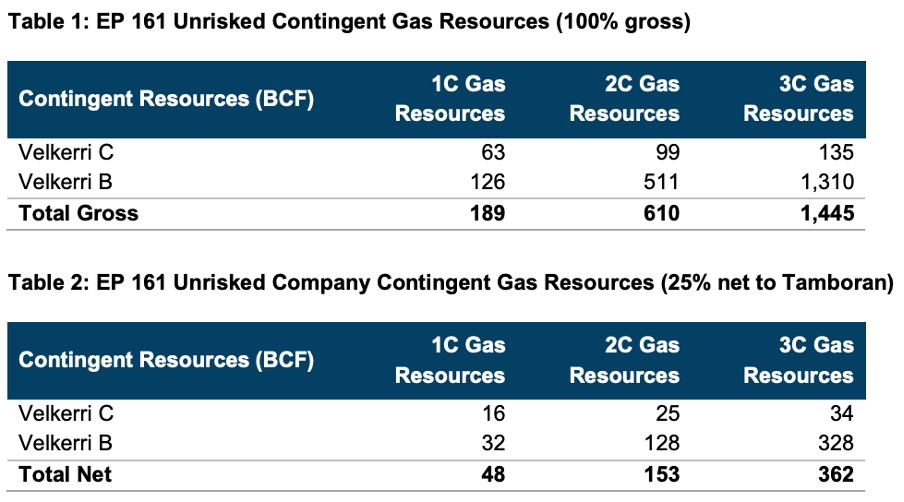
Riddle continued: “The successful gas flow rates to surface achieved during the testing of the T2H and T3H wells have demonstrated an active hydrocarbon system within the Santos-operated EP 161 permit of the Core Beetaloo Sub-basin.
“Incorporating these results has delivered a more than 400% increase to our unrisked gross 2C contingent resources within the EP 161 permit to 610 billion cubic feet (BCF), 153 BCF net to Tamboran.
“Unrisked gross 1C contingent resources have increased by more than 300% to 189 BCF, 48 BCF net to Tamboran.
“With a best estimate of approximately 12.3 trillion cubic feet (TCF) of unrisked prospective gas resources net to Tamboran within EP 161, additional activity has potential to add further contingent resource as we mature and de-risk our significant prospective gas resources.
About Tamboran
Tamboran is relatively new to the ASX register. The energy stock made its debut in July 2021 following a $61 million initial public offering (IPO) — the largest IPO for an oil and gas explorer and producer in nearly a decade.
The ASX-lister ended the financial year with slightly more than $63 million on hand to progress its development strategy in the Northern Territory’s Beetalo Sub-Basin, a world-class shale gas resource.
Ultimately, Tamboran dreams of developing and commercialising natural gas resources with low levels of carbon dioxide (CO2) within its core Beetaloo holding.
It’s working to generate the energy sources of the future with a focus on zero-carbon gas production.