
Aeris Resources Ltd (ASX:AIS) has delivered significant exploration advancements at its 100%-owned Cracow Operation in southeast Queensland, identifying several priority exploration targets within the tenement package.
The company's two-fold exploration strategy entails discovering extensions within the known goldfields and finding the next significant field in the region.
Encouragingly, Cracow now has more quality exploration targets than when it was acquired by Aeris 18 months ago.
Priority exploration targets
Aeris executive chairman Andre Labuschagne said: “Over the last 18 months we have made significant advancements in our geological understanding of the Cracow gold field.
“We now have more priority exploration targets than when we acquired Cracow.
"What is particularly exciting are the results from the recent MT geophysical survey, which has identified favourable structural corridors under cover and to the south of the Western Vein field, opening potential for a new Southern Vein gold field.
“We have also identified an exciting new target (Enigma), close to current underground infrastructure.
“There are some very encouraging signs from the historical data intersecting the structure.
“ An underground drill rig has been moved and drilling has commenced to start testing the target.”
Advances since acquisition
Significant advances have been made in the geological understanding of Cracow goldfield since acquisition in July 2020:
- New epithermal structures (including Enigma) were identified at the southern end of the Western Vein field.
- A potential “new” Southern Vein field has been identified undercover – 5km x 4km prospective corridor – a new geophysical tool, the MT Survey, has identified six new priority targets.
- There is potential for depth extensions at the Western Vein field into the previously considered barren FoD.
- The recent RC drill program at Golden Plateau (Eastern Vein field) confirms continued prospectivity despite being a mature goldfield.
Cracow tenement package
Mineable gold mineralisation within the Cracow tenement package is associated with geographical areas, referred to as the Western Vein and Eastern Vein goldfields.
Gold mineralisation at Cracow is associated with a style of deposit referred to as low sulphidation epithermal (LSE) deposits which are characterised by high-grade gold and silver mineralisation.
Interestingly, the discovery of an LSE deposit at Cracow is considered a two-staged approach, initially focusing on three key features, namely structure, stratigraphy and fluid flow.
Once a prospective fault has been identified the focus switches to the second stage, again focusing on three key features – vein textures, quartz facies and geochemistry.
Ballymore and Enigma structures
The Ballymore fault structure is a greenfield exploration target located along strike (south) from the current underground workings at the Western Vein field.
This remains a priority exploration target and ongoing exploration activities will be focused along with the prospective target.
Further, the interpreted east-west Enigma structure is a newly identified significant (fertile) fault structure.
Notably, the structure was first identified from recent underground development within the southern limits of the current underground workings.
The Enigma fault is interpreted to be the same age as the highly endowed Royal – Klondyke quartz vein structure and appears to have direct connectivity with the magmatic-hydrothermal system responsible for driving the epithermal process at Cracow.
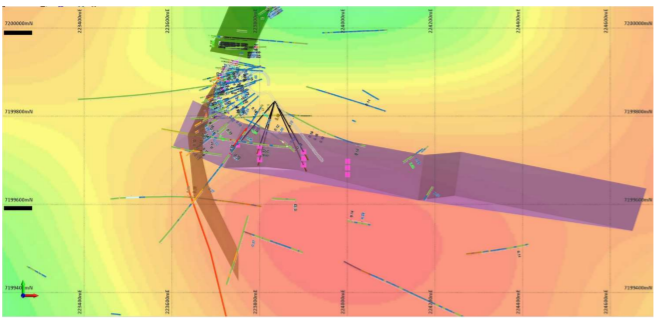
Enigma epithermal structure (purple), Ballymore epithermal structure (orange)
Southern Vein field
The Southern Vein field represents a prospective 5x4-kilometre corridor directly south from current underground operations at the Western Vein field.
Aeris completed a trial MT survey in late 2021 over the Southern Vein field, during which the primary aim of the survey was to elucidate the regional fault architecture below the Back Creek cover sequences to 1–1.5 kilometres below the surface.
The MT survey was able to successfully identify key lineaments within the Camboon Volcanics to depths exceeding 1,000 metres below the surface.
Furthermore, preliminary geological interpretation based on the MT dataset has defined six key target areas which warrant further investigation and represent an increase from two broad conceptual targets identified before the completion of the MT survey.
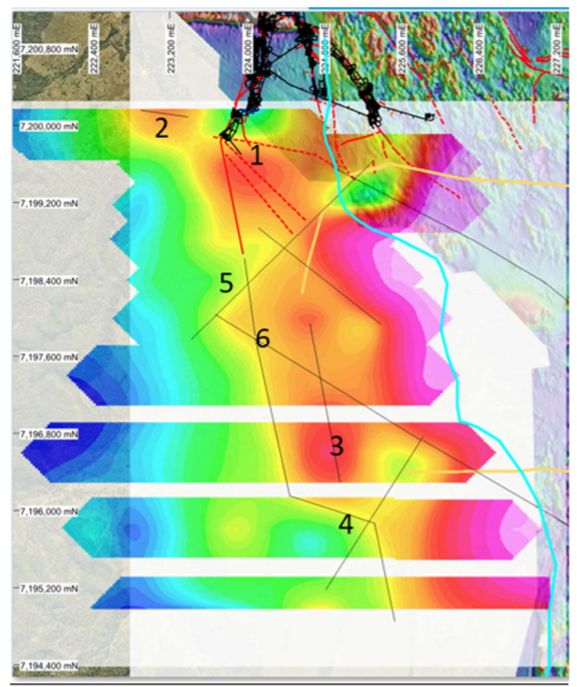
Resistivity shaded contours (red – high resistivity blue – low resistivity), interpreted lineaments (black and red lines) and priority target areas.
Golden Plateau Deposit
Gold mineralisation across the Eastern Vein field has been focused at the Golden Plateau deposit, which produced approximately 850,000 ounces of gold over a 60-year period from the 1930s.
An initial RC drill program by Aeris was recently completed to confirm prior drill hole intersections and test epithermal quartz structures along strike and down plunge from historical workings.
Notably, these results highlight the continued prospectivity of the site, despite it being a mature goldfield.
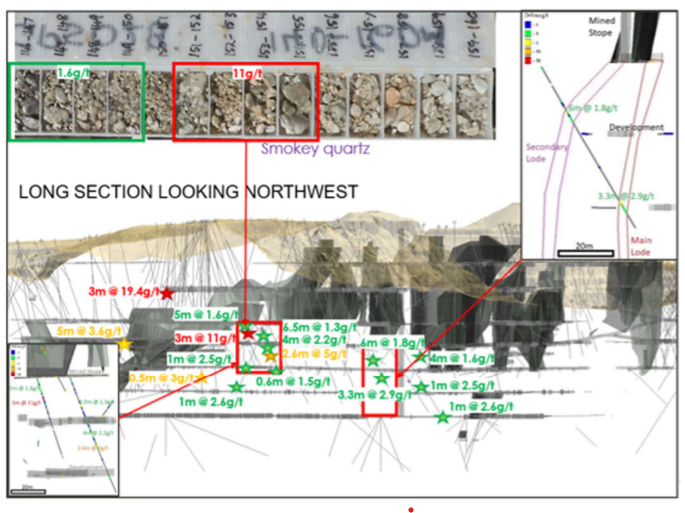
Historical underground workings shown by dark grey shaded regions
Next steps
At Ballymore, Aeris is planning a follow-up MT survey for the December quarter which will assist in identifying high potential targets along strike, such as prospective changes in orientation (strike) and/or interpreted intersections with earlier structural features.
At the Southern Vein field, a follow-up MT survey is also planned that aims to provide a more detailed dataset to refine the structural architecture and constrain the priority target areas further.
At Golden Plateau Deposit, a follow-up diamond drill program has commenced targeting splay faults and interpreted high-grade shoots along the main epithermal quartz structure.
Geological data collected from the drill programs are being incorporated into an updated predictive geological model.
Furthermore, the model will be used to inform future drill programs and used as an input for a maiden mineral resource at Golden Plateau.