
Oar Resources Ltd (ASX:OAR) is continuing a maiden drilling program at the high-grade Douglas Canyon Gold Project in Nevada while its 2022 field season is set to begin at the Crown Nickel-Copper-PGE Project in the Julimar District in Western Australia.
As part of work at the Crown project, planning is underway for an airborne geophysical survey over the eastern portion of the project area.
Soil sampling results from late 2021 have highlighted zones of low-level nickel and copper anomalism at Crown, with field checking and results verification to be completed to assess their significance.
Also, as part of an ongoing strategic asset review process, the company is reviewing several investment and divestment opportunities for its portfolio of exploration assets on the Eyre Peninsula in South Australia.
Douglas Canyon Gold Project
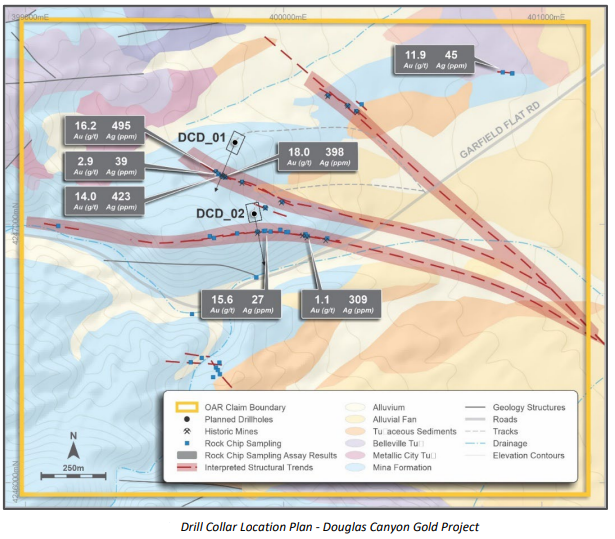
At Douglas Canyon, drilling in the first hole of the program has been completed to a depth of 213.5 metres to date, with 175 samples collected from the available drill core and sent for analysis.
The program consists of up to four diamond holes for a total of around 1,000 metres of HQ drill core, testing high-grade outcropping gold and silver mineralisation.
Drilling is targeting a series of parallel vein structures where previous outcrop sampling has confirmed high-grade gold and silver mineralisation.
To date drilling has intersected a series of highly weathered, sheared and fractured meta sediments, with intermittent hard silica cherty bands and quartz stringer veinlets throughout.
Given the fractured nature of the core, the company has taken a steady, cautious approach to drilling, with a primary focus on maximising the amount of core recovered for analysis over speed of drilling.
Drilling is currently at a depth of 213.5 metres and is interpreted to have intersected the target shear structure, and remains within this structure.
Logging has confirmed the presence of silica flooded host rock, with thin quartz stringers, along with a silica matrix brecciated vein close to the current depth of the hole.
While these observations are considered to be very encouraging, sampling to date of the available drill core, has not returned any significant (>1 g/t gold) assay results.
Drilling is scheduled to recommence once favourable weather conditions prevail, and hole DCD_02 will be continued to test the target structure to its planned depth.
The drilling rig will then be relocated to the second hole, situated to the north of DCD_02, to test a parallel high-grade structure.
Crown Project
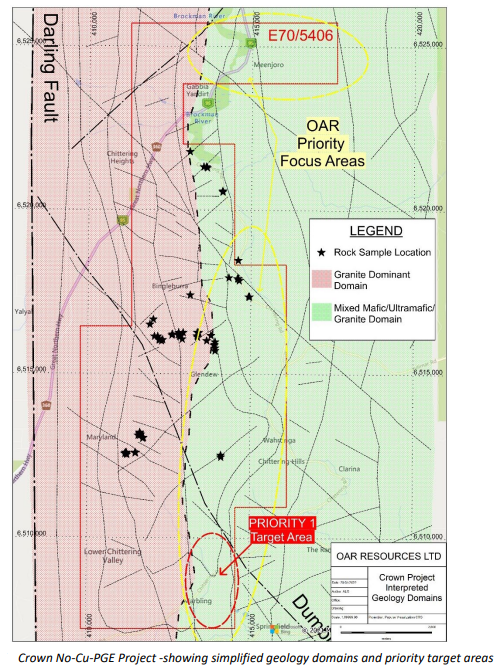
The initial phase of field work at Crown is designed to deliver a thorough understanding of the geological setting of the Project area and help define drill targets for a first phase of drilling, and includes detailed geological mapping and grid surface geochemical sampling.
This work has resulted in the definition of two broad geological domains - the Western Domain, which is dominated by granitic lithologies and is interpreted as being less prospective, and the Eastern Domain, which is characterised by a mixture of the targeted mafic, ultramafic, and granitic lithologies and will be the focus of exploration moving forward.
A total of 74 outcrop rock-chip samples have been collected and submitted for laboratory multi-element analysis.
Results for the first 60 samples have been reported and assays for the remaining 14 samples have now been returned with no significant results to report.
The results from 380 soil samples collected over a Priority 1 target area in the southeast of the project area highlight several areas of low-level nickel and copper anomalism.
These results require field verification and this will be undertaken in conjunction with the extension of the soil sampling program to the north and west, in January and February.
Airborne geophysical survey
As a next step, the company plans to conduct a detailed airborne electromagnetic (EM) survey, which will target the favourable 'mixed geology' domain along the eastern flank of the project area.
The survey is in the final stages of planning and will be undertaken pending survey contractor availability.
EM surveys are a powerful exploration tool in the detection of blind sulphide ore bodies similar to Chalice's Gonneville massive sulphide discovery at its Julimar Project.
Eyre Peninsula portfolio
OAR is investigating divestment opportunities for its Eyre Peninsula project portfolio.
These projects comprise six contiguous exploration licences covering around 1,520 square kilometres of the Gawler Craton on the western flank of the Eyre Peninsula.
The portfolio consists of three main projects, which have been subject to considerable exploration work by OAR over a number of years:
➢ The Oakdale Graphite Project where the company has defined a JORC resource of 6.22 million tonnes at 4.8% TGC;
➢ The Bramfield Iron Ore Project, where previous drilling has returned significant iron grades from magnetite banded iron formation, including 36.2 metres at 42.39% iron from 77.0 metres and 53 metres at 39.77% iron from 82.0 metres; and
➢ The Gibraltar Halloysite-Kaolin Project, where the company has outlined a large area (2.5 kilometres x 5 kilometres), of high-grade halloysite within bright white kaolinitic clays including results of 14 metres at 76.2 ISO-B from 14 metres and 8 metres at 28.5% halloysite from 20 metres.