
Australian Gold and Copper Ltd (ASX:AGC) has closed the books on one drilling campaign and started up another along the 15-kilometre-long Boxdale-Carlisle Reefs gold trend at the Moorefield Project in central NSW.
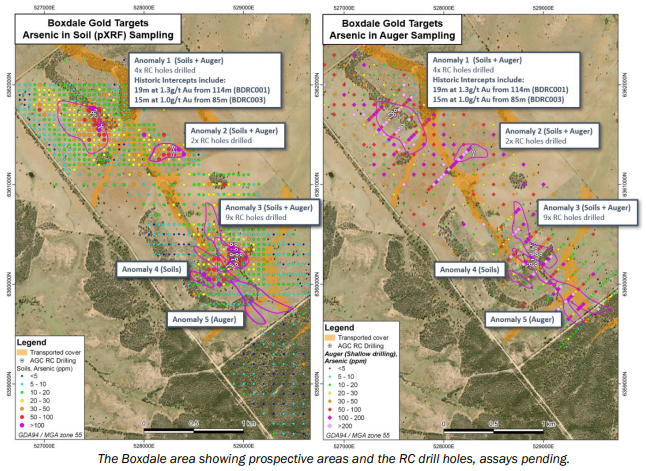
The explorer has finished reverse circulation (RC) drilling at the Boxdale target, with 1,560 metres drilled across 15 holes at the prospect.
Assays remain pending for this leg of the program, but most of the holes intersected arsenic-bearing sulphides — a development welcomed by AGC’s geologists.
Now, the drill rig will turn its attention to the Carlisle Reefs target, where it is expected to execute eight planned holes on the hunt for extensions to known gold mineralisation.
Turning the soil at Boxdale
AGC’s Boxdale expedition honed in on three key targets within the broader prospect area.
At Anomaly 1 and 3, drilling intersected multiple, encouraging zones of sulphides (specifically pyrite and arsenopyrite, which were visually logged and pXRF analysed).
RC drill samples have been submitted to the laboratory in Orange, NSW and will be reported upon once received.
Ground magnetics were also completed at Boxdale.
New campaign at Carlisle Reefs
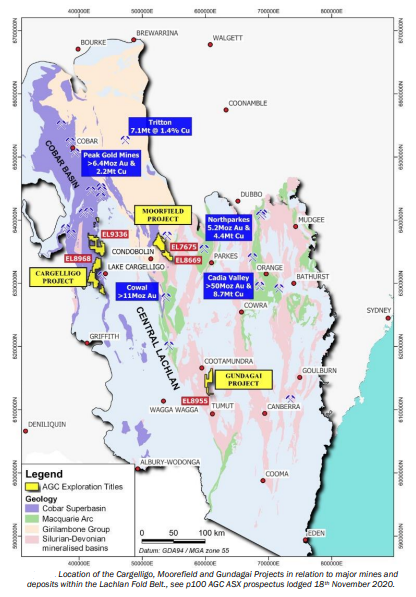
Just 15 kilometres southeast of Boxdale lies the Carlisle Reefs target — the subject of AGC’s next drilling campaign.
Eight holes are planned to look for extensions to known gold mineralisation, as well as test under major mine workings at the property.
Hunting for orogenic gold
AGC is out to discover orogenic gold deposits across the Moorefield project.
Essentially, this style of deposit occurs when gold has strong ties to arsenic mineralisation and the precious metal is hosted in brittle fractures in the rock.
Examples of these structures include the world-class, multi-million-ounce Victorian gold deposits — the biggest being Bendigo and Fosterville, which is operated by fellow ASX-lister Kirkland Lake Gold Ltd.
Outside of Moorefield, AGC is developing its Cargelligo copper-gold/base metal project in the southern Cobar Super-Basin, where it is exploring for Hera- and Federation-style mineralised deposits.
It’s also advancing the Gundagai gold project, a target prospective for multi-million-ounce McPhillamy’s-type gold deposits.