
Critical Resources Ltd (ASX:CRR) shares rose as much as 18.7% intra-day to $0.102 after encountering visible chalcopyrite in its seventh diamond drill hole (Hole 11A) at the Gibsons prospect, part of the broader Halls Peak project in New South Wales.
The 7.6-metre interval (from 41 metres) hosts multiple sheeted veins and stockwork fractures that contain two sulphide minerals, pyrite and chalcopyrite.
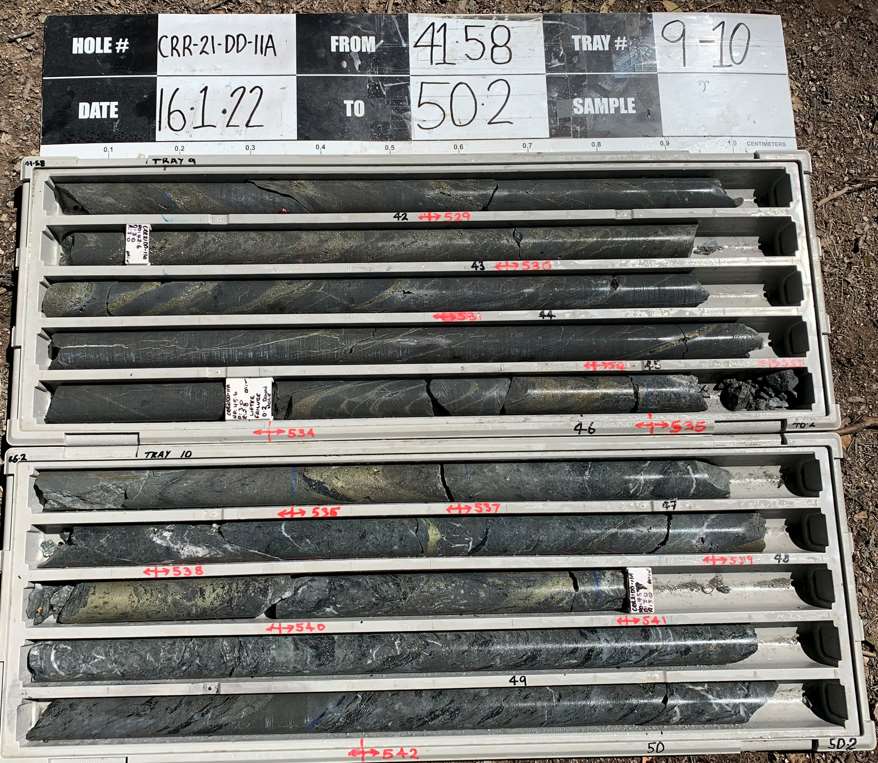
Detail of core with intervals of sheeted veins and stockwork mineralisation with visible chalcopyrite and pyrite intersected from 41.58 metres to 48.60 metres. 41.00-46.51 metres hosts a series of sheeted veins with an abundance of pyrite of 80% and chalcopyrite of 20%. 46.51- 48.60 metres hosts veins with an abundance of chalcopyrite of 45% and pyrite of 55%.
Critical Resources managing director Alex Biggs said: “Hole 11A is an outstanding outcome and represents what we as a company consider to be a significant development that is indicative of a potential large scale, multi-element, base metals system at Halls Peak.
“Our drill program has been focused on confirming near surface mineralisation first, then incrementally defining mineralisation at greater depths.
“These visual results are outstanding and we are excited to see the further potential Halls Peak has to offer.”
Next steps
Drilling at Halls Peak continues to expand areas of known mineralisation.
Pyrite is the dominant sulphide in some veins, but others are dominated by chalcopyrite.
Petrographic and geochemical studies are being undertaken to identify the causative mineral system of this potentially new style of mineralisation.
Core from completed hole 11A will be expressed to the ALS laboratory in Brisbane for assaying.
Halls Peak Project
Critical's 100%-owned Halls Peak project is about 45 kilometres southeast of Armidale in the New England Fold Belt, an area known for its mineral endowment and production.
The Halls Peak massive sulphide deposits were discovered in 1896 where near-surface mining extracted high-grade zinc, lead, copper and silver.
More recent near-surface exploration has yielded high-grade intercepts to a depth of about 150 metres at the Gibsons prospect.
Some near-surface historical mining has occurred around the Sunnyside prospect.