
Future Metals NL (ASX:FME, AIM:FME) has received further high-grade platinum group metals (PGM) assay results from metallurgical drilling completed at its 100%-owned Panton PGM Project in northern Western Australia.
The palladium-rich results are from the remaining three of eight metallurgical holes drilled to provide samples for flotation optimisation and variability test work which is underway.
Assay results remain pending for a further 52 exploration drill holes, with initial results expected in the first quarter of 2022.
Strong results
Highlights are 8.4 metres at 4.89 g/t PGM (4.90 g/t palladium equivalent) from 32.6 metres and 4.6 metres at 5.42 g/t PGM (5.34 g/t palladium equivalent) from 54.4 metres within 12.6 metres at 2.58 g/t PGM (2.81 g/t palladium equivalent) from 54.4 metres.
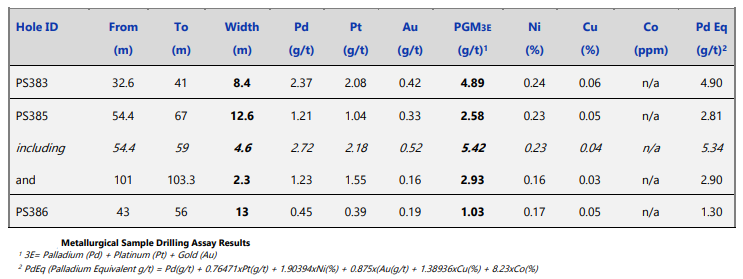
A total of eight metallurgical holes were drilled (PS382 - PS389) to recover sufficient mineralised chromitite reef and associated mineralised dunite for metallurgical test-work.
Another strong result was 13 metres at 1.03 g/t PGM (1.30 g/t palladium equivalent) from 43 metres.
Metallurgical flotation test-work is underway at ALS Laboratories in Perth, Western Australia.
Tests are being carried out on both high-grade and lower-grade bulk samples composited from the eight metallurgical drill holes.
Pending exploration results
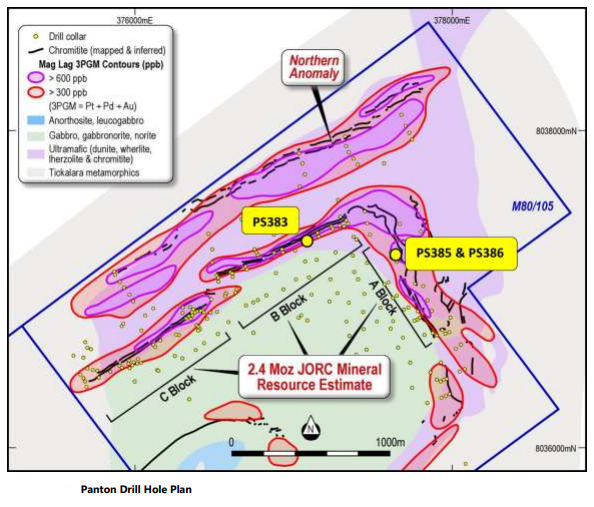
Future Metals has completed 27 drill holes.
Eight holes were drilled to provide metallurgical samples and assay results from the remaining 19 exploration holes remain pending with samples submitted to Bureau Veritas in 11 batches between October 2021 and January 2022.
The company has now completed sampling of the partially unassayed holes that were drilled into the mineralised footwall dunite.
A total of 33 historical drill holes that were not previously completely assayed have now been sampled and submitted for assaying in December 2021 and January 2022.
The company expects to progressively report assay results from a further 52 drill holes (comprising 19 recently drilled holes and 33 historical holes) over the next two to three months. An initial batch of results is expected to be received in the next few weeks.
New MRE
Once received, all new assay data will be incorporated into a new mineral resource estimate (MRE) for the Panton Project.
The planned updated MRE will take into consideration shallow, bulk PGM-nickel mineralisation of up to 20-40 metres in thickness, that sits outside of the current MRE.