
Orion Minerals Ltd (ASX:ORN, JSE:ORN) has unearthed shallow, high-grade copper hits during its maiden drilling program at the Okiep Copper Project in Northern Cape, South Africa.
The copper explorer received results from the first four holes at the project, where assays have reportedly confirmed and exceeded expectations.
Three holes were drilled at Okiep to confirm historical mineralisation, fielding high-grade hits like 10.36 metres at 1.84% copper, 5.71 metres at 1.93% and 4.69 metres at 2.05%.
Along with delivering a series of promising copper hits, the maiden campaign has also demonstrated the potential for additional high-grade mineralised lenses at depth.
The program intersected a new mineralised zone at the Koperberg West target, supporting Orion’s geological model and generating as much as 4.76 metres at 3.99% copper.
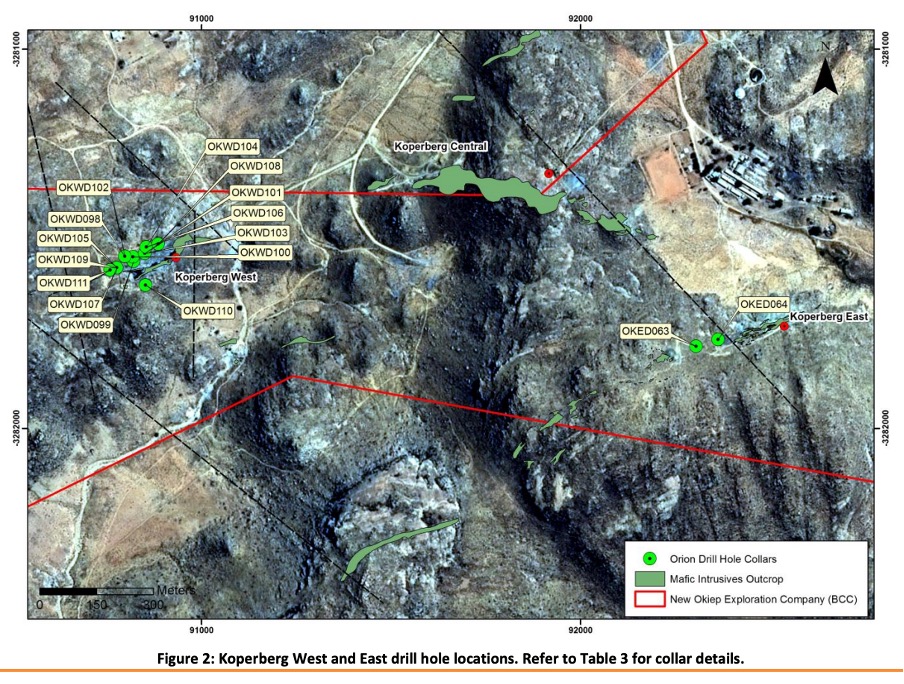
This maiden drilling program is now 55% complete, with 14 diamond holes completed at Koperberg West and two at Koperberg East, comprising nearly 2 kilometres of drilling to date.
High priority focus for 2022
Speaking to the progress to date, Orion managing director and CEO Errol Smart said the company was thrilled with the first assays from its ongoing drilling program.
“The results we’ve received to date have confirmed the historical drill results for high-grade sulphide copper mineralisation near-surface and more importantly, confirming our geological hypothesis for a model for intrusive bodies arranged in en-echelon, sidestepping lenses,” he explained.
“Historical drilling focused on drilling down-dip projections, without adequately testing the probable sidestepping of mineralised lenses as encountered at the 38-million-tonne Carolusberg Deeps mine, which sits along strike from and on the same structure as Okiep.
“This potential for offset, high-grade lenses, which continue down-dip below the extensive, shallow historical mining on the 5-kilometre strike Carolusberg line, presents a very exciting exploration opportunity.
“Drill testing this down-dip position has been elevated to a high priority focus for 2022, alongside the testing of EM targets identified through our recent SKYTEM™ survey.
“Our engineering and permitting teams are also making good progress on the early mining project we announced on May 3, 2021, and we anticipate being able to provide market updates on this work shortly.”
Turning the soil at Okiep
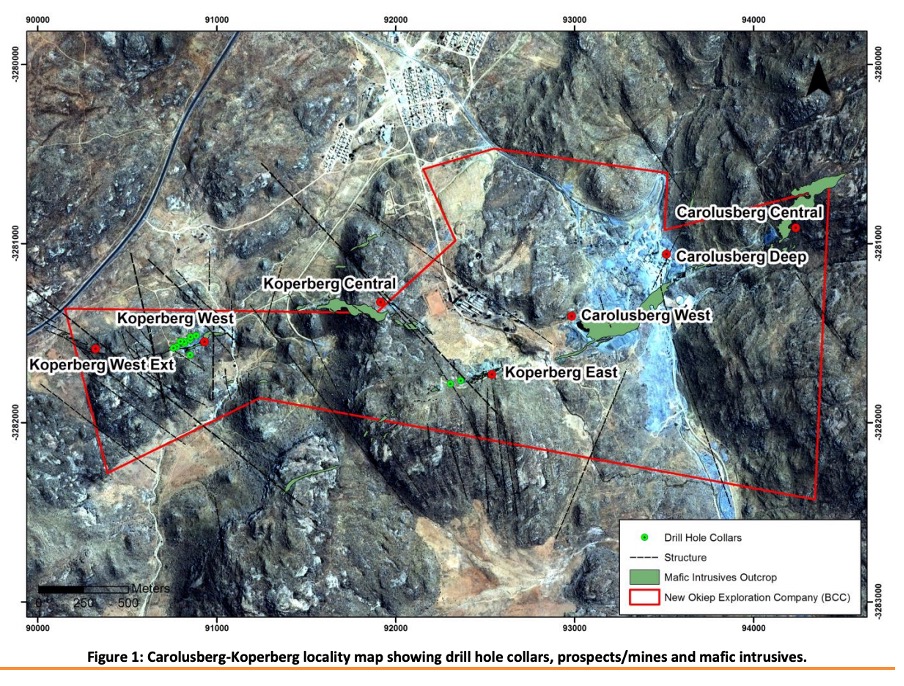
Currently, drill rigs at Okiep are honing in on the Carolusberg–Koperberg line of intrusives, which forms part of a complex that was the biggest contributor to historical mining in the Okiep Copper District.
The Carolusberg Complex delivered 38 million tonnes grading 1.54% copper out of the reported total of 105 million tonnes mined over the past 100 years.
Orion is exploring prospects with known copper mineralisation along strike of Carolusberg, applying an exploration model derived from a structural interpretation of the Carolusberg Mine mineralisation.
The current drilling program also includes twin and infill drilling to verify historical drilling results and to allow future resource estimation.
To date, 1,900 metres of the Orion’s planned 3,500-metre diamond drilling program has been completed, representing 16 of the 26 planned holes.
Assay results from 39 samples have been received, while further drill holes are being logged and sampled by Orion’s geological team, prior to dispatch to ALS Laboratory in Johannesburg.
Key findings
Some of the best results from the program to date include:
- 10.36 metres at 1.84% copper from 58.94 metres;
- 5.71 metres at 1.93% from 72.85 metres; and
- 4.69 metres at 2.05% from 49.22 metres.
Ultimately, Orion reports the results to date confirm high-grade, near-surface sulphide copper mineralisation at the Okiep asset.
Importantly, one extended hole intersected 4.76 metres at 3.99% copper from 95.08 metres, representing a new intrusive lens and supporting a model for en-echelon, sidestepping mineralisation occurring along the entire strike of the Carolusberg line.
High-grade mineralisation at the Carolusberg Mine was mined down to 1,900 metres depth and comprised several en-echelon sidesteps down-dip.
What’s more, several other recent holes, with assay results pending, intersected the en-echelon downdip lenses of sulphide mineralisation, supporting this geological model and presenting high-priority follow-up drill targets for follow-up.
Further, drill core logging identified 10 more mafic intersections.