
- FTSE 100 rises 34 points
- Index calm as US investors sell
- Anglo American the day’s top performer
5.00pm: FTSE 100 closes higher
The FTSE 100 closed higher Friday, bucking a decline in US stocks as inflation, looming interest rate hikes and weak jobs report spook investors.
At the close, the UK blue-chip index increased 34 points, or 0.47%, to hit 7,458.
Chris Beauchamp, chief market analyst at online trading group IG, said rising wages and falling unemployment in the US have sparked further weakness in equities, with bets on a rate hike soon increasing.
“Aside from the FTSE 100, which appears once again to be an island of calm amid the panic, most indices are firmly in the red, and a slightly better performance from the Dow has been reversed as a rise in US yields past their 2021 peak prompted another bout of selling,” he said.
The top gainer was Anglo American, which increased by 3% to 32.62p.
4.00pm: Perkier end to session
A bit late in the day, the FTSE 100 has perked up as the market digests the implications of today’s US jobs report.
London’s index of heavyweight shares was up 20 points (0.3%) at 7,470.
“For another month, payroll data has been at odds with the broader labour market data set. Improvements across unemployment, underemployment and participation is reflective of seasonal growth in the labour market as Christmas hospitality roles were filled. More broadly, the reading will supply ammunition to those members of the Fed looking for evidence of maximum employment, fulfilling part of the criteria to encourage an interest rate rise,” said Rober Alster, the chief investment office of Close Brothers Asset Management.
“But as Omicron cases ripple across the US, January shortages will likely dampen Christmas spirits and put the brakes on growth. In the longer term, we can hope that once the Omicron wave passes, economic growth will resume and the volatility that we’re seeing in the labour market will be replaced by greater stability but for that to happen, the Fed will need to be hot on its heels and continue to react confidently to minimise the threats to the economy,” he added.
Although the headline number of 199,000 jobs added was way below expectations, previous months’ numbers were revised upwards and at least the unemployment rate fell.
“It’s a strong report showing evidence of a tightening labour market and justifying the Federal Reserve’s more hawkish stance,” suggested Mike Owens at Saxo Markets.
Payrolls number is strong, ignore the headline. Low UR and high earnings with a low headline number = tight labor market. Very tight.
— ʎllǝuuop ʇuǝɹq (@donnelly_brent) January 7, 2022
James Knightley, the chief international economist at ING, said pay pressures are intensifying in the US.
“The Omicron wave shouldn't have had much of an impact given the timing of the survey (week of December 12) so most of the softness is going to be put down to supply constraints (labour force participation rate remains woefully low at just 61.9%) given all the labour demand surveys are so strong. The unemployment breaking below 3.9% and wages rising 0.6% month-on-month are probably of more significance to the Federal Reserve in this instance,” Knightley reckoned.
2.30pm: US jobs shocker fails to stir the market
If traders in London were disappointed by the US jobs numbers, they are making a good job of hiding it.
The FTSE 100, which has been like a car with a flat battery all day, remained little changed – down 2 points (0.0%) at 7,448 – after a surprising US non-farm payrolls data release.
Economists had expected more than 400,000 jobs to have been added to the US economy in December so it was a surprise when the official number was revealed as 199,000.
The unemployment rate declined to 3.9% from 4.2% in November while average hourly earnings were up 4.7% on a year earlier.
This is one of those #jobsreport where the NFP miss masks what looks great on most other metrics. It's not that there aren't jobs available, being created. It's that people are empowered enough to not settle. Seems like a good trend. $spy $spx $vix https://t.co/aU1kT5yTiO
— Andrew Sapiro (@ASAP17) January 7, 2022
US stock market index futures have turned lower on the jobs data.
“Over 650k jobs were added through the household survey so this softish headline figure from the payrolls data needs to be seen at least as slightly misleading. Make no mistake the labour market is very tight and close to its max, as evidenced by the unemployment rate. Question is whether the data is wrong – more jobs are being created, or whether it points to shortage of workers…bit of both but clear signs that a potential wage price spiral cannot be ignored,” was the swift analysis by Neil Wilson at Markets.com.
“Revisions to the prior two months showed under-reporting of jobs growth in the survey. The change in total nonfarm payroll employment for October was revised up by 102k from +546k to +648k; whilst the change for November was revised up by 39k from +210k to +249k. With these revisions, employment in October and November combined is 141k higher than previously reported.
“In short a messy, confusing report but we can say labour market is tight and wages are squeezing higher. Headline unemployment figure and jobs growth point to slowing growth but cannot say for sure there is not yet more slack in the market,” he added.
1.35pm: Predicting the US non-farm payrolls figure remains a mug's game during the pandemic
Once again, the US non-farm payrolls number has come in way below consensus forecasts, with just 199,000 new jobs added in December versus expectations of a figure of 400,000 or above.
The US unemployment rate fell to 3.9% from 4.2% in November.
#NFP big miss and after an initial rally, has sold off somewhat sharply. pic.twitter.com/PBbVKvJimN
— Kate's Dad (@KASDad) January 7, 2022
1.20pm: Market cool on Vin Murria's all-share offer plan for M&C Saatchi
It’s awfully quiet out there, Carruthers.
Traders continue to countdown to the release of US non-farm payrolls at 1.30pm. In the meantime, the FTSE 100 remains on a tight leash, wandering just three points south of last night’s closing value to 7,447.
Shares in takeover target M&C Saatchi PLC (AIM:SAA) tumbled 9.5% to 190p after its suitor, AdvancedAdvT Limited, confirmed it is interested in making an offer for the company but its preference is for a share exchange.
The City seemed less keen on this option than a takeover option that includes a cash element.
The board of AdvancedAdvT, chaired by Vin Murria, the deputy chair of Saatchi, believes the merged group would have the opportunity to create significant value for shareholders.
“A merger would create an opportunity to build a data, analytics and digitally focussed creative marketing business with a strong balance sheet and additional management expertise in transforming businesses at pace and execute on complementary M&A [mergers & acquisition]. This would allow the enlarged group to continue its evolution and, crucially, accelerate the implementation of its growth strategy and therefore be increasingly relevant to its customers,” the stock market announcement from AdvancedAdvT said.
Murria owns a 12.5% stake in Saatchi while AdvancedAdvT owns around 9.8% of the fabled advertising agency.
Trading in the shares of AdvancedAdvT has been suspended pending developments in its reverse takeover proposal.
Talking of fabled names, Aston Martin Lagonda Global Holdings PLC (LSE:AML) cheered its long-suffering shareholders with a trading update that sent the shares 5.3% higher to 1,443.5p.
In truth, the update was a curate’s egg with the company boasting it had hit its target to sell around 6,000 vehicles to wholesalers in 2021 even as it warned that it will miss its earnings (EBITDA) target for 2021, blaming weaker than anticipated fourth-quarter sales.
11.55am: US stocks expected to rise as US jobs report awaited
London's stock market is flat, the rest of Europe is mixed but US stocks are expected to end the week on the front foot, the futures market is indicating.
That's how it stands ahead of the non-farm payrolls report, which is due for release before the market opens and may support the Federal Reserve’s decision to bring forward tighter monetary policy.
Dow Jones futures were up 0.14% in pre-market trading, while the S&P 500 index is up 0.25% and the Nasdaq 100 0.32%.
This comes on the back of a massive sell-off in tech stocks yesterday as minutes from the latest Federal Reserve meeting signalled an end to its easy-money policies, including raising interest rates and reducing the size of its balance sheet, catching the market off guard.
Ahead of the non-farm payrolls data, market analyst Fawad Razaqzada at ThinkMarkets said inflation is the main area of concern for the Fed, not so much employment or GDP growth.
"With that in mind, the wages aspect of today’s nonfarm payrolls report will probably be more important than the headline jobs growth itself.
"The market is now pricing in more than a 70% chance of a rate hike in March, and three rate increases in total for 2022."
Those odds were lower a week ago but this week's December meeting minutes saw policymakers warn of a “potentially faster pace of policy rate normalization,” causing pain for tech stocks and gold.
Razaqzada says: "If wage inflation accelerates even more, this could further exacerbate price inflation. The Fed will thus be monitoring wage inflation ever so closely in the coming months."
The NFP report is expected to show average hourly earnings up 0.4% in December, although the year-over-year rate is expected to have fallen to 4.1% from 4.8% the previous month – owing to the impact of base effects.
In terms of the headline number, some 425K net new jobs are expected for December, up sharply from a disappointing 210K recorded in November. The unemployment rate is seen falling to a new post-pandemic low of 4.1% from 4.2% previously.
11.05am: Stocks stuck
The FTSE 100 is stuck in the middle of a tussle between miners and oilers pulling it up, and consumer-related names pulling it down.
As a result, the blue-chip index is hovering just in positive territory, up four points at 7,454.
Antofagasta PLC (LSE:ANTO), Rio Tinto PLC (LSE:RIO) and BHP PLC are the top risers, with B&M European Value Retail SA, AVEVA Group PLC, InterContinental Hotels Group PLC and ITV PLC (LSE:ITV) the biggest fallers.
Construction and related stocks are not making much difference despite the recent PMI survey numbers showing a the index falling to a three-month low in December.
Martin Beck, chief economic advisor to the EY ITEM Club, notes that new orders rose at the strongest pace since August, and there was good news on the supply side that contributed to input price inflation slowing to a nine-month low.
Reading these numbers along with the manufacturing counterparts earlier in the week, Beck said it shows the two sectors have stood up well to disruption stemming from the rapid spread of the Omicron variant, countering the significant fall in the services PMI and a deterioration in high-frequency measures of consumer activity.
All in all, he says it points “to the economy’s dominant sector faring less well in the face of the latest COVID-19 variant, associated restrictions on activity, a rise in the number of people isolating and increased consumer hesitancy".
UK GDP, which will be officially confirmed next Friday, is likely to have fallen in December, the EY ITEM Club forecasts, and will struggle to grow much in early 2022.
“But the speed at which Omicron is spreading, the rising share of people who have received a booster jab and the reluctance of the Government to extend social distancing restrictions further offer hope that the negative impact on the economy from the latest COVID-19 variant will prove fairly short-lived,” Beck said.
9.58am: UK construction data weakens
The IHS Markit/CIPS UK Construction Purchasing Managers’ Index eased to a three-month low in December.
The index, which is based on a system where a reading below 50 indicates a decline in activity while one above 50 indicates an increase, clocked in at 54.3, compared to November’s 55.5 reading.
On the plus side, the percentage of construction firms reporting supplier delays dropped from 47% in November to 34% in December. Meanwhile, around 5% of the survey panel reported shorter lead times among vendors (up from 4%).
The resulting index signalled the least marked downturn in supplier performance since November 2020, noted IHS Markit, which compiles the survey for the Chartered Institute of Procurement & Supply (CIPS).
“Though the overall index moved down slightly in December there was light at the end of the tunnel for builders in terms of the strongest order numbers since August, reduced pressure on business costs and some improved delivery times for essential materials," said Duncan Brock, group director at CIPS.
"Residential building has powered on every month since June 2020 and was the best performing category in the last month of 2021. Commercial building struggled to gain a stronger footing in a weakened UK economy and civil engineering activity fell back into contraction,” Brock noted.
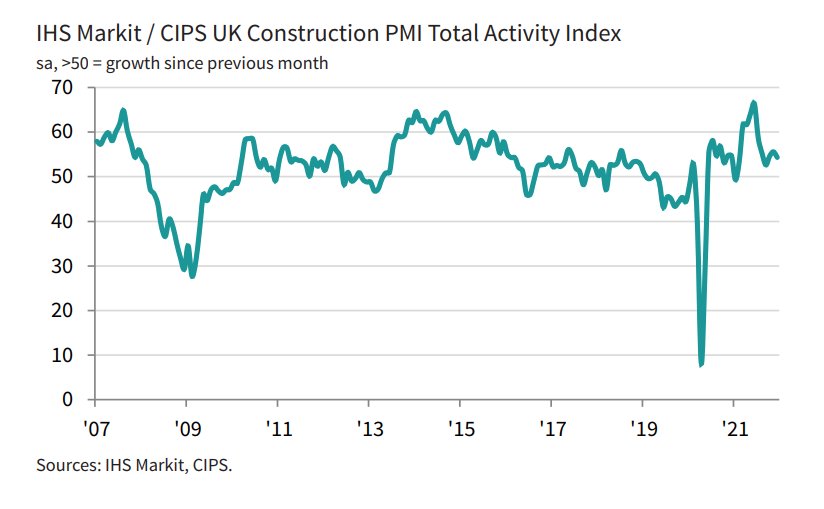
Tim Moore, IHS Markit director, said UK construction companies ended last year on a slightly weaker footing as renewed pandemic restrictions held back the recovery, especially in commercial work and civil engineering.
“Some firms commented on disruption from rising COVID-19 cases, while others noted a lack of new work to sustain the rapid growth rates seen earlier in 2021,” Moore observed.
"The worst phase of supplier delays seems to have passed as the availability of construction products and materials continued to turn a corner in December. While suppliers to the construction sector have caught up on backlogged work and boosted capacity, there were still widespread reports citing unresolved transportation issues and driver shortages.
"Input cost inflation moved down another notch in December, helped by the alleviation of some supply chain pressures. The latest rise in purchasing prices was far slower than the 24-year peak seen last June,” he added.
The FTSE 100 was up 4 points (0.1%) at 7,455, which by today’s standards represents a violent upsurge.
9.10am: The big snoozzzzzzzzzze
The initial stanza of the morning trading session was almost as exciting as the World Creosote Drying Championships held in Slough.
The FTSE 100 was a couple of points in the red despite investors’ enthusiasm for mining stocks this morning, especially Rio Tinto PLC (LSE:RIO), BHP Group PLC (LSE:BHP) and Glencore PLC (LSE:GLEN), all of which are more than 2% higher.
Traders are keeping their powder dry ahead of this afternoon US jobs report, which could have a big influence on the US Federal Reserve’s interest rate policy.
“Investors remain apprehensive following the Federal Reserve’s move to a more hawkish stance, with the jobs report later providing further colour to the economic backdrop,” said Richard Hunter at interactive investor.
“The much stronger than expected ADP jobs number could be echoed in the non-farm payrolls [NFP] number today, where the consensus is for around 400000 jobs to have been added and for the unemployment rate to reduce slightly to 4.1%. November’s figure of 210000 was significantly lower than expected, and a bounce back is expected.
“The number also goes to the heart of the Fed’s dual mandate in controlling employment and inflation. A strong NFP number could play into the Fed’s hands in that maximum employment is close to being reached, thus allowing full attention to be turned to the question of persistently high inflation, thereby giving the green light for earlier than expected interest rate rises,” Hunter said.
8.35am: UK house prices hit new high in December
Not even the strength of mining stocks was enough to rouse the Footsie in early trading as the index was little changed.
Housebuilder Taylor Wimpey PLC (LSE:TW.) edged 0.3% higher after the Halifax House Price Index suggested the average UK property price hit a new high of £276,091 in December.
The mortgage lender said the average house price increased by more than £24,500 in 2021, making it the largest annual increase since 2003.
Mercifully for first-time buyers, the Halifax expects house price growth to slow in 2022.
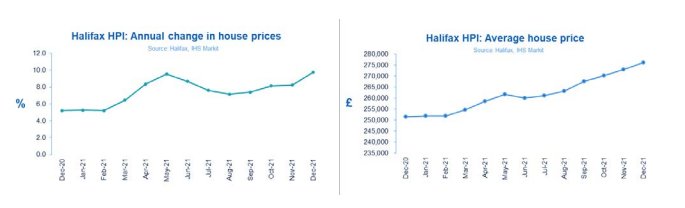
“UK house prices climbed again in December for the sixth consecutive month in a row, up 1.1%,” said Russell Galley, the managing director of the Halifax.
“The housing market defied expectations in 2021, with quarterly growth reaching 3.5% in December, a level not seen since November 2006. In 2021 we saw the average house price reach new record highs on eight occasions, despite the UK being subject to a ‘lockdown’ for much of the first six months of the year.
“The lack of spending opportunities afforded to people while restrictions were in place helped boost household cash reserves. This factor, alongside the Stamp Duty holiday and the race for space as a result of homeworking, will have encouraged buyers to bring forward home purchases they’d maybe planned for this year. The extension of the Government’s job and income support schemes also supported the labour market and may have given some households the confidence to proceed with purchases,” Galley said.
“Looking ahead, the prospect that interest rates may rise further this year to tackle rising inflation and increasing pressures on household budgets suggest house price growth will slow considerably. Our expectation is that house prices will maintain their current strong levels, but that growth relative to the last two years will be at a slower pace; however, there are many variables which could push house prices either way, depending on how the pandemic continues to impact the economic environment,” Galley concluded.
Oil giant Royal Dutch Shell PLC (LSE:RDSB) dipped 0.1% to 1,718p after it released a fourth-quarter update note.
The Anglo-Dutch Footsie giant said the remaining US$5.5 billion of proceeds from the Permian divestment will be distributed in the form of share buybacks “at pace”. This decision was taken on 31 December 2021, at the first board meeting held in the UK following the decision to implement the simplification of the company’s share structure.
6.35am: Traders to sit on the fence ahead of US jobs report
Stop me if you have heard this before but ahead of today’s US jobs report, traders are set to sit on their hands in London.
Spread betting quotes suggest the FTSE 100 will open little changed as traders wait to see how many jobs were added to the US economy in December.
“Expectations are for December payrolls to improve to 420k, and the unemployment rate to fall further to 4.1%, although some estimates for payrolls have come in as high as 900m. It will certainly need to see a decent number to help push the US dollar up from current levels, and don’t forget to keep an eye out for an upward November revision,” said CMC’s Michael Hewson.
“Ultimately, today’s number is unlikely to make that much difference to how investors view the potential timing of the first US rate rise, with the most attention likely to be on the average hourly earnings numbers which are expected to fall back from 4.8% to 4.2%. This big drop is likely to be as a result of large-scale temporary hiring in the leadup to Thanksgiving and the Christmas period,” he added.
US markets were weak yesterday, with the Dow Jones declining 171 points to 36,236 and the S&P 500 dipping 5 points to 4,695.
In Asia this morning, Japan’s Nikkei 225 is trading around 9 points lower at 28,479 while in Hong Kong the Hang Seng is 371 points to the good at 23,444.
“In China, markets are trading positively with a story circulating from REDD that policymakers will exclude debt accrued by property developers from buying up distressed assets from weaker developers, from their overall debt compliance ratios. That’s a mouthful but basically, it looks like State-Owned Enterprise (SOE) developers are going to get a juicy carrot in return for taking on the assets of weaker private developers,” reported OANDA’s Jeffrey Halley.
In London, the corporate agenda is a bit of a mystery but there are sure to be some retailers reporting on Christmas trading. If last year’s calendar is anything to go by, Marks and Spencer Group PLC (LSE:MKS) will be among those reporting and the key question is whether the company’s strong start to the second half of its financial year has been maintained.
Around the markets
- Sterling: US$1.3547, up 0.16 cents
- Gilt: 1.161%, up 7 basis points
- Gold: US$1,789.80 an ounce, up 60 cents
- Brent crude: US$82.72 a barrel, up 72 cents
- Bitcoin: US$41,585, down US$1,529
- Ethereum: US$3,186, down US$240
6.50am: Early Markets - Asia / Australia
Shares in Asia-Pacific were mixed on Friday as Chinese real estate firm Shimao Group defaulted on a trust loan, renewing concerns over the sector.
Long considered one of the healthier builders, Shimao failed to pay 645 million yuan (US$101 million) of a total 792 million yuan due by December 25.
China’s Shanghai Composite dipped 0.05% while Hong Kong’s Hang Seng index surged 1.71%.
The Nikkei in Japan slipped 0.03% and South Korea’s Kospi lifted 1.17%.
Australia’s S&P/ASX200 jumped 1.29% to 7453.3 points, retracing Thursday’s losses led by gains in energy, financial and utilities.