
Aldoro Resources Ltd (ASX:ARN) has made strong exploration progress at its VC1 and VC3 targets within the Narndee Igneous Complex in Western Australia with the latest results of up to 1.74% nickel and 0.89% copper confirming the project's prospectivity.
Assay results have been received for four drill holes at VC1 and one hole at VC3.
By the end of 2021, the company had completed six new diamond holes and eight reverse circulation (RC) holes at VC1 with the 1.74% nickel result coming from NDD0016 and 0.89% copper from NDD0006.
Drilling at VC1
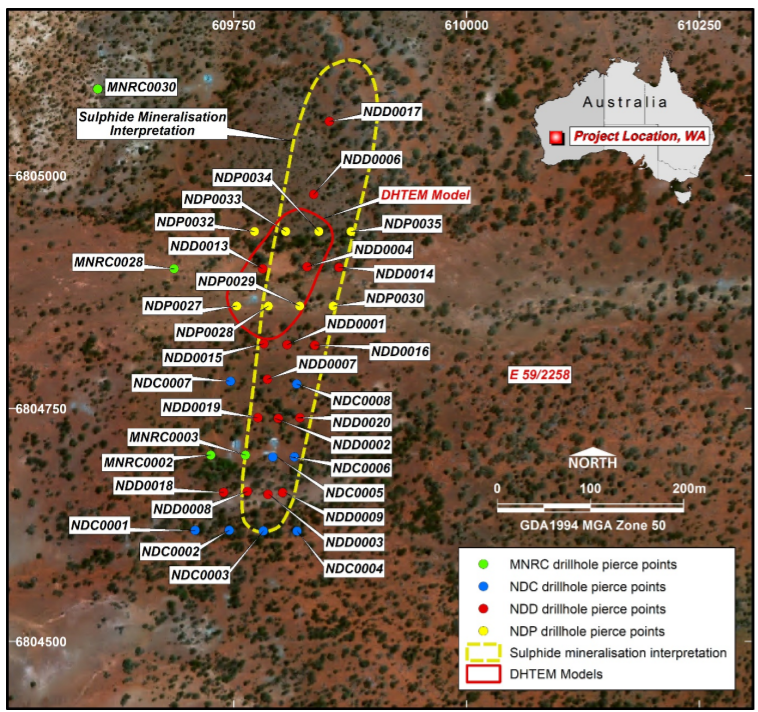
Plan projection showing completed and planned drill hole pierce points of the VC1 target.
Since the previous update, assays have been received for five drill holes at VC1 with significant wet chemistry intersections returned from all drill holes:
- 2.05 metres at 1.00% nickel, 0.21% copper and 0.06% cobalt from 212.75 metres in hole NDD0003;
- 80.9 metres at 0.26% nickel, 0.07% copper and 0.02% cobalt from 192 metres including 1-metre at 1.35% nickel, 0.36% copper and 0.09% cobalt from 271.9 metres in NDD0004;
- 55.6 metres at 0.19% nickel, 0.06% copper and 0.01% cobalt from 246 metres including 0.38 metres at 1.11% nickel, 0.04% copper and 0.07% cobalt from 301.22 metres in NDD0006;
- 2.9 metres at 0.92% nickel, 0.4% copper and 0.06% cobalt from 106.3 metres in NDD0008;
- 0.5 metres at 0.84% nickel, 0.16% copper and 0.08% cobalt from 214.5 metres and 1.65 metres at 0.53% nickel, 0.24% copper and 0.03% cobalt from 211.2 metres in NDD0015;
- 1.6 metres at 0.53% nickel, 0.19% copper and 0.04% cobalt from 217.25 metres in NDD0016;
Following on, the visual results and context of the remainder of the holes will be reported when the relevant datasets have been interrogated, QAQC checked and 3D modelling completed to provide a clear interpretation of the results.
Drilling at VC3
At VC3, drill hole NDD0005 ended in 31.3% magnesium oxide and 0.22% nickel, demonstrating the high prospectivity of this region, particularly at depth.
Aldoro drilled NDD005 to a depth of 654.9 metres where the hole was extended as it re-entered a high magnesium oxide ultramafic package with occasional dissemination of magmatic sulphides after passing through the VC3 target.
The VC3 EM target was intersected at about 380 metres downhole where the anomaly appears to be associated with an internal raft of basalt and metasediments hosted by high MgO ultramafics and mafics.
Rocks immediately below the metasediment contain blebby and disseminated magmatic sulphide. This zone returned 7.0 metres at 0.22% nickel and 0.06% copper from 389 metres downhole
A large loop high power electromagnetic survey is ongoing over this area aiming to detect deeper or very high conductance targets, which may have been difficult to see with the VTEM system.
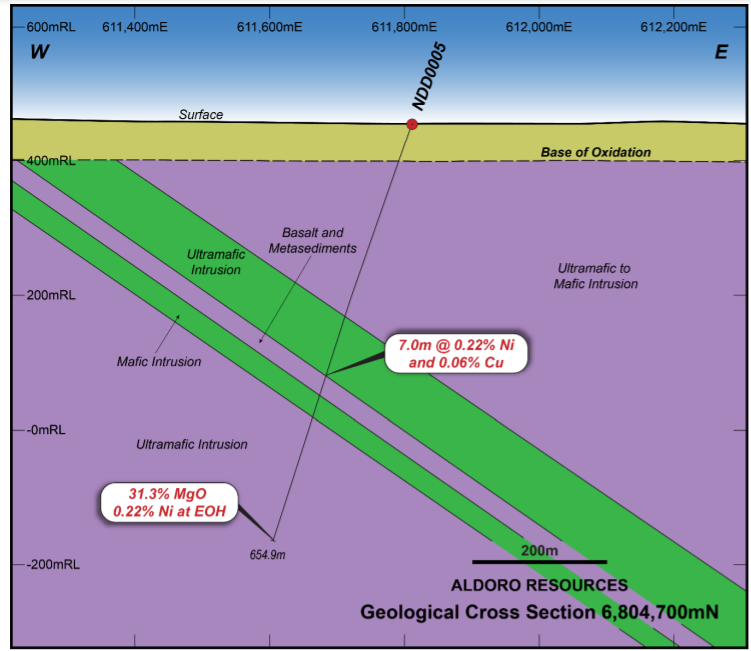
Cross-section of NDD0006.
Forward plan
A priority 1 VTEM survey is on schedule for completion early this month with the survey to screen the Kiabye Greenstone Belt (KGB) along the western margin of the NIC.
The KGB is interpreted to be a possible feeder or basal unit of the NIC and represents a high priority exploration target for nickel-copper sulphide deposits.
A large loop HPFLTEM survey is ongoing over the VC1, VC3 and VC11 target areas aiming to detect large, highly conductive and possibly deeper metallic bodies that would have been difficult for the VTEM system to detect.
Following the priority 1 VTEM survey in early January, any conductors generated will be ground-truthed, mapped and sampled by surface geochemistry.
The VTEM survey will be followed up by target ranking, surface EM work and drilling.
Furthermore, a similar approach will be applied to conductors generated by the ongoing HPFLTEM survey.