
From cancer treatments to stem cell breakthroughs and 3D printed organs, science is setting the trends that many of us thought were science fiction (although we still don’t have teleportation). Imagine how much less the environmental footprint would be if we had teleportation. Come on scientists, do your thing.
Back to reality and tangibility.
Many of the major breakthroughs in medical science have come through research in the field of biotech.
But what is biotech and why does it attract billions of investment dollars?
And what is a blockbuster, if it isn’t a Marvel or James Bond movie?
In this article:
- What is biotech?
- A big deal
- The biggest biotech drugs
- What is a blockbuster?
- Pros of biotech investing
- Cons of biotech investing
- Weigh up the risk vs reward before investing
In this explainer, we’ll attempt to answer these questions and more. We will look at what biotech is, major breakthroughs in biotech, why it attracts so much money and why you should consider biotech stocks in your investment portfolio.
What is biotech?
You’ve heard the term. You know it has something to do with breakthroughs in medicine. However, biotechnology is so much more.
There are five branches that modern biotechnology can be divided into:
- Human
- Environmental
- Industrial
- Animal
- Plant
Each of these branches helps to fight disease and hunger. They contribute to sustainable production and may help reduce our ecological footprint and save energy.
Biotechnological processes are also behind the beer and wine you drink, the bread you eat and your lactose-free milk.

Beer and bread aside, biotech is generally associated with doctors and researchers investigating and hopefully succeeding in producing medicine derived from a living organism using technology.
Put simply, it is biology combined with technology.
In medicine, biotech can be used to fight debilitating and rare diseases and improve quality of life. This included the creation of vaccines to fight everything from hepatitis, measles, mumps and even some of the most common cancers including cervical vaccines such as Merck’s Gardasil®.
Some of the biggest breakthroughs made in the biotech space include.
- Stem cell research
- Nerve regeneration
- Targeted cancer therapies
- Gene editing
- Human genomic sequencing
- Augmented reality in surgery
- 3D printed organs
- And more…
Biotech is a big deal
Given some of the breakthroughs made in biotech, it is unsurprising the space attracts billion-dollar deals and large investments.
A successful biotech company can enjoy enormous growth in revenue and profits.
Grandview Research reports the global biotechnology market is expected to reach $2.44 trillion by 2028.
This may be helped along by the COVID-19 pandemic.
Pfizer reported 86% revenue growth in the second quarter of 2021: the sale of its COVID-19 vaccine was excluded in those figures.
Pfizer’s Q3 results showed revenue of $24.1 billion, compared to a forecast of $23.5 billion and $22.6 billion consensus estimate.
The company’s bottom-line of $1.34 on a per share and adjusted basis was up a solid 133% year-over-year.
No matter what you think of the COVID-19 vaccine, vaccines in general are a key growth driver for any company. For Pfizer, it generated sales of $13 billion during the quarter.
The nine-month sales (ending September 2021) for the vaccine stands at more than $24 billion, with forecasts of $36 billion for the full-year 2021, and another $29 billion in 2022.
Pfizer is one of the biggest companies in the world and exemplifies just how much money a biotech can make when it nails its products. If you’re a small company, big pharma may just come knocking on your door to snap you up.
Blackstone’s $2 billion investment in Alnylam Pharmaceuticals (NASDAQ:ALNY) in April 2020 was one of the biggest private financings of a biotech company.
The following graph shows the biggest deals done in pharma mergers and acquisitions to early 2021:
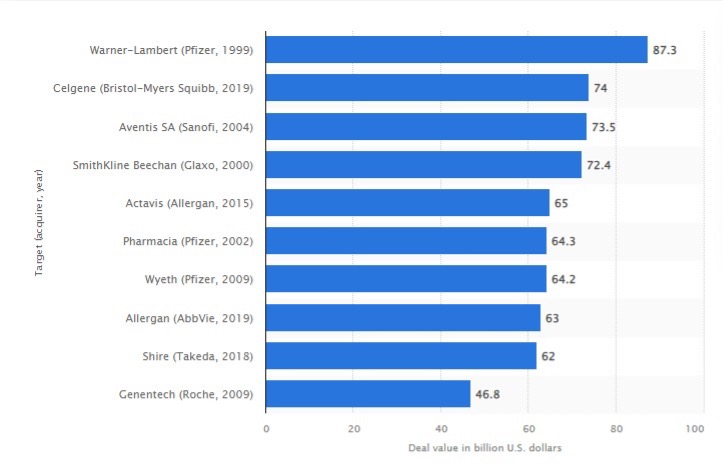
The numbers are a boon for those companies and their investors.
Also of note was AstraZeneca’s $39 billion deal for Alexion Pharmaceutical and Gilead’s $21 billion acquisition of Immunomedics.
In 2020, the top 10 deals saw about $97 billion worth of biopharma assets changing hands. This was lower than the nearly $207 billion recorded in 2019, but that is due to the pandemic and the wheel is set to turn.
The biggest biotech drugs
Statista reports that AbbieVie and Roche hold the biggest biotechnology drugs currently on the market. Roche is the biggest biotech company in the world with its biotech prescription drug revenue estimated to reach over $US48 billion in 2028.
Roche’s Avastin drug generated about $US7.1 billion in 2019 — before the pandemic hit. Avastin is used to inhibit the growth of new blood vessels to treat some types of cancer. Roche’s Rituxan is used to treat certain autoimmune diseases and types of cancer and generated $4.5 billion last year.
AbbiVie’s Humira is an antirheumatic drug. It treats moderate to severe rheumatoid arthritis in adults and generated $US19.8 billion in 2020.
What is a blockbuster?
It is not a redundant video store, nor is it a Marvel movie or anything with Tom Cruise.
A blockbuster in biotech terms is a drug that achieves over $1 billion in sales.
Drugs include Lipitor or Zoloft and usually treat common medical problems such as high cholesterol, diabetes, high blood pressure, asthma and cancer.
Every biotech wants to develop blockbuster drugs and every investor is urging them to do so.
A blockbuster drug can make a biotech company, but for investors, it’s not all big dollar signs. There are pitfalls in investing in biotechnology and you need to be on your guard when considering what stock to put your money into.
The pros of investing in biotech
Due diligence is paramount to your biotech investment success.
A high level of scrutiny is required to separate the wheat from the chaff.
A biotech stock – a stock that represents a company in the biotech sector – is sometimes the hardest to pick successfully.
With biotech investment come great risks and while investing in biotech companies can lead to massive gains, there are pros and cons every investor should be aware of.
Let’s start with the pros.
Required products
It is every biotech company’s aim to develop medicines and technological innovations that can change the world: stop the spread of disease, eliminate world hunger etc …
Any product that purports to do that and has the right finance, people and potential product is a company to watch.
Products must fill a community need, if not, don’t bother looking.
Growing market
While the numbers vary between research house, biotech is a growing market. Global Market Insights predicts the market will surge to US$950 billion by the year 2027.
That's on the back of an increase in chronic diseases and healthcare costs associated.
A company that can help mitigate disease or pain through drug production will grow. Further to that, a company with innovative tech products can keep costs down and ease the burden on healthcare.
Those companies could grow exponentially in value.
Fior Markets predicts the biotech sector to have a compound annual growth rate of 7.02% between 2020 and 2027 and to reach US$833.34 billion by the end of the forecast period.
Grandview Research estimates the global biotechnology market is expected to reach $2.44 trillion.
ESG
Biotech companies give investors socially responsible companies to consider.
They will generally meet investors’ concerns for the environment, corporate governance and/or ethical factors, as well as financial return.
Ethical investors invest based on personal values and most biotech stocks are usually working toward creating good within society and for the environment.
Balanced portfolio
Biotech stocks provide a means for maintaining a balanced portfolio.
Not only can investors back groundbreaking technology, they can add to their portfolio with a mix of high-risk high reward plays such as up and coming biotech small caps like Imugene Ltd (ASX:IMU, OTC:IUGNF), Noxopharm Ltd (ASX:NOX) (brain cancer), Chimeric Therapeutics Ltd (ASX:CHM) (cell therapy), Pharmaxis Ltd (ASX:PXS, OTC:PMXSF) (bone marrow and liver cancer treatments), Arovella Therapeutics Ltd (iNKT cell therapy platform), and Kazia Therapeutics Ltd (ASX:KZA, NASDAQ:KZIA) (newly diagnosed glioblastoma), as well as more established, profitable companies such as Roche.
Make money
Investing in biotech stocks can be lucrative. If you are at the front of the line following a successful product launch of a new treatment, it is common to see a share price rise.
If it is a small-cap stock, the sky is the limit.
If it's Pfizer during a pandemic, there are gains to be made.
However, caution is required. Not all companies will make a breakthrough or find a blockbuster and as we have said, due diligence is required and advice should be sought before making an investment decision in a biotech stock.
The cons of investing in biotech
Commercial failures
A biotech company may produce what looks like the best product in the world, but that doesn’t mean it will be a commercial success.
It takes millions of dollars to create a product and if it doesn’t make its money back, you are likely to see a share price decrease.
Clinical failures
Before it even gets to the commercial stage, a product has to undergo a battery of trials.
Often, those trials fail and it is back to the drawing board, with millions of dollars wasted.
When considering a biotech stock, always examine what stage their clinical trials are at.
- Stage 1 is the research and discovery phase and is the riskiest. There is no product.
- Stage 2 is preclinical and also risky. Capital requirements are required and regulatory hurdles must be navigated.
- Stage 3 is where early clinical-stage companies have developed their product and had it approved for human trials. This stage could present shorter-term gains, but still comes with risks.
Anything later stage is less of a risk. Late-clinical-stage biotech companies at the final step before bringing new medical products to market and commercial-stage companies are ones to watch.
No money
Sometimes early-stage biotech just can’t raise the money they need to go to trials. Stay clear of those struggling to raise capital.
Weigh up the risk vs reward before investing
There are great rewards, but also great risks involved with biotech investing.
Do your homework.
The better prepared you are and the more knowledge you have, the better decision you will make.
Put simply, be diligent and understand your risk appetite.