
Cauldron Energy Ltd (ASX:CXU) has resumed drilling ahead of schedule as it targets depth extensions related to historic bonanza gold grades that sparked an 1800s gold rush at the Blackwood Goldfield Joint Venture Project in Victoria.
The company's immediate drilling focus is on a fan of five underground drill holes designed to target a potentially high-grade, under-explored area adjacent to the Annie Laurie Reef – last mined between the 1860s and 1890s
In preparation for drilling, Cauldron uncovered historical reports of a population explosion alongside mined shallow bonanza gold grades at Blackwood
Promisingly, the historical review highlights multiple unexplored areas down-dip of exceptional gold grades in the Western Reefs region.
“Valuable information”
Cauldron executive chairman Simon Youds said: “The review of historical information and data is throwing up some valuable information with stark similarities between Blackwood and other local, more well known, gold rush centres like Bendigo and Ballarat.
“The similarities of population explosion and extreme grade in the same geology settings are obvious.
“What is not so obvious is the reason why no exploration or mining was continued down-dip at Blackwood, as is the case in most of the other surrounding mines in the Central Victorian Goldfields.
Drilling program
At the outset of the resumed drilling, an initial fan of five holes will target the historically worked Eastern Gold Reefs, which are accessible from the Tyrconnel Adit.
Previous drilling, channel sampling and mapping have confirmed the potential of this specific target area adjacent to the Annie Laurie Reef.
The reef at this level was last mined during the 1860 and early 1890s during the Victorian Gold Rush period which saw intense mining activity in the Barrys Reef area.
Notably, underground drilling with a Kempe Diamond Drill allows multiple short holes and maximises target structure intersections.
Blackwood discovery
Historic accounts state that Blackwood’s first gold discovery was in 1855 at Jackson’s Creek when the finding of one gold nugget started a gold rush in the area.
The bonanza gold grades discovered both from alluvial and quartz reef sources resulted in rapid population growth and the establishment of villages such as Blackwood and Barrys Reef.
Notably, the rapid population expansion mirrors the better-documented gold-rushes of surrounding regions (eg, Ballarat and Bendigo).
However, there has been very little exploration undertaken at depth down-dip and plunge of the historically mined areas, leaving great potential for remaining ore reserves of similar exceptional gold grades.
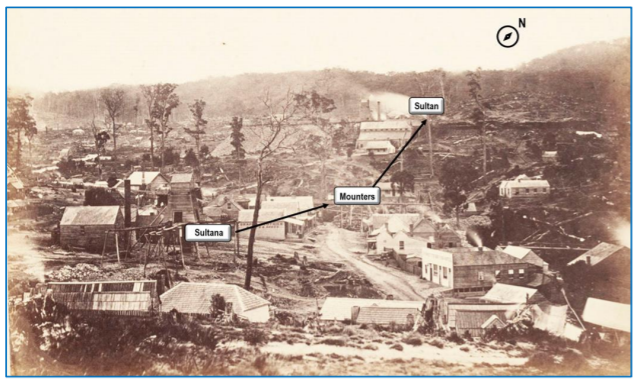
Historic mining at Blackwood.
Undiscovered resource potential
Strong structural complexities produced mineralisation reportedly up to 9 metres in width and grades of up to 920 g/t gold at Sultan Mine.
Notably, historic mining is reported to have stopped at approximately 230 metres depth at Sultan and 134 metres at Mounters, leaving the potential for deeper undiscovered gold resources.
Promisingly, new high-quality targets can be accessed from within the northern Tyrconnel Adit drive, thus enabling low-impact drilling activities.
“Underground drill platform”
Youd adds: “The exciting aspect of this operation for Cauldron is having an underground drill platform to be able to assess the down-dip potential here.
“Coupled with more modern techniques and recent geological understanding in the area, we will be able to answer the question of depth extensions.
“This will assist in the search for additional gold reserves down-dip of historical operations.
“At the same time, we will be able to live up to our commitment to leave the surface-sensitive environment pristine and undisturbed.
“This has already been achieved for a number of years at the Henty Gold Mine in Tasmania.”
Potential gold at Western reefs
The current known trend of gold mineralisation in Blackwood is a generally north-south strike over a distance of 3.5-kilometre strike length, from the North Sultan mine in the north to the Imperial mine in the south.
Various cross-sections sourced from historical reports contained one particular longitudinal view of the Pioneer to North Sultan mines of the Western Reef system.
Given that mining only occurred to an average depth of 60 metres throughout the Western Reefs, the comparison chart, along with the bonanza grades and thicknesses reported historically, leads to the logical question of the remaining, as-yet-undiscovered scale of potential gold resources at depths below 100-150 metres at Blackwood.