
Strickland Metals Ltd (ASX:STK) ends the year with a 1.3 kilometres gold anomaly intersected within the Horse North area in the Celia Shear Zone, along with numerous secondary high-grade intercepts.
Excellent targets have been identified for follow-up reverse circulation (RC) drilling.
The follow-up RC drill program will be incorporated into the 2022 exploration programs.
Did what it was designed to do
“The aircore program achieved precisely what it was designed to do – identify gold targets of significant scale, which we can follow up with subsequent RC drilling,” CEO Andrew Bray said.
“The 1.3 kilometres anomalous gold trend is, from a technical perspective, very significant in that it is hosted entirely within the Celia Shear structure itself, unlike much of the gold mineralisation on the Yandal Belt, which is hosted in secondary structures.”
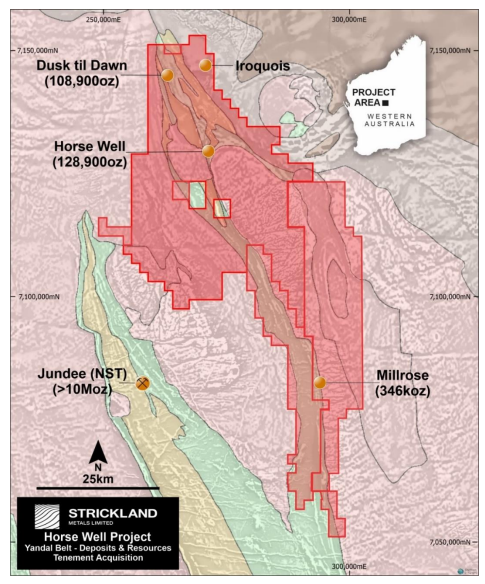
“Importantly, this is the same host structure as Strickland’s existing Millrose Mineral Resource, which too is hosted within the shear zone, meaning that this gold trend represents a potential analogue to Millrose.”
“Overall, the number of large-scale targets we are continuing to develop regionally over our 100 kilometres of strike demonstrates the fantastic potential we have to make multiple gold discoveries in 2022.”
Horse North results
Significant gold mineralisation across four-metre composite samples include:
• HNAC152: 8 metres at 3.3 g/t gold (including 4 metres at 6.3 g/t) from 40 metres;
• HNAC154: 12 metres at 2 g/t (including 4 metres at 4.8 g/t) from 44 metres;
• HNAC059: 8 metres at 2.2 g/t from 28 metres; and
• HNAC002: 4 metres at 1.5 g/t from 72 metres.
Wide-spaced aircore drilling targeted extensions to the Celia Shear Zone, identified from both magnetic and ground gravity survey datasets. In addition to the high-grade results, drilling successfully delineated a shallow, 1.3 kilometres long gold anomaly (greater than 0.2 g/t gold across 4 metres composites), which remains open along strike to the north and at depth. This trend is hosted entirely within the shear structure itself.
This style of gold mineralisation is analagous to the Millrose Mineral Resource to the south, which also shares a similar geological setting, being on the contact between mafic volcanics to the east, and felsic sediments to the west.
Historic drilling missed it
Historic drilling was either too shallow, too wide-spaced or too sporadic to have effectively tested this key mineralised structure. The shear structure is clearly defined from geophysical datasets, and there are several northwest secondary structures, as well as areas of dilation which are ideal targets for gold mineralisation.
The significant gold intercepts are along strike from the existing Horse Well inferred mineral resource and provide an excellent opportunity to add to this resource inventory.
“Next year is certainly shaping up to be a very exciting time for Strickland,” Bray said.