
Krakatoa Resources Ltd (ASX:KTA) has closed out drilling and survey activities just before the Christmas season at its Mt Clere Project in Western Australia.
The company embarked on a maiden reconnaissance aircore campaign at the multi-element exploration camp in November, traversing 95 holes and 3,383 metres.
In addition, a stage one, helibore Versatile Time-Domain Electromagnetic (VTEM) survey was completed over the rare earth element (REE), heavy mineral sands (HMS), nickel-copper-cobalt and platinum group element (PGE) property.
Looking ahead, Krakatoa plans to unveil results from the aircore drilling and VTEM survey in the first quarter of 2022 — assays that will underpin future ground exploration plans.
“Many opportunities” for KTA
Speaking to the wrap-up at Mt Clere, CEO Mark Major said it was “an exciting time” for Krakatoa and its shareholders.
“We have completed our first-pass VTEM geophysical survey, which provides a direct detection method to identify nickel, copper and PGE-bearing sulphides; as well as reconnaissance drill testing over several regolith profiles to test for clay hosted REEs and heavy mineral sands within depositional alluvial terraces.
“This project has many opportunities for the company and our shareholders.”
Drilling campaign
Krakatoa’s reconnaissance drilling program consisted of 95 holes, covering 3,383 metres of aircore drilling over several prospective areas.
The program was broken up into the following segments:
- Thirty-nine holes, for 1,047 metres, were drilled into the deeply weathered relict regolith profiles around the Tower anomaly;
- An additional seven holes, for 242 metres, were drilled into the deep regolith north of the Tower area; and
- Two traverses, totalling 49 holes for 2,094 metres, were drilled along the vast alluvial terraces in the south of the Wheelo Creek catchment area.
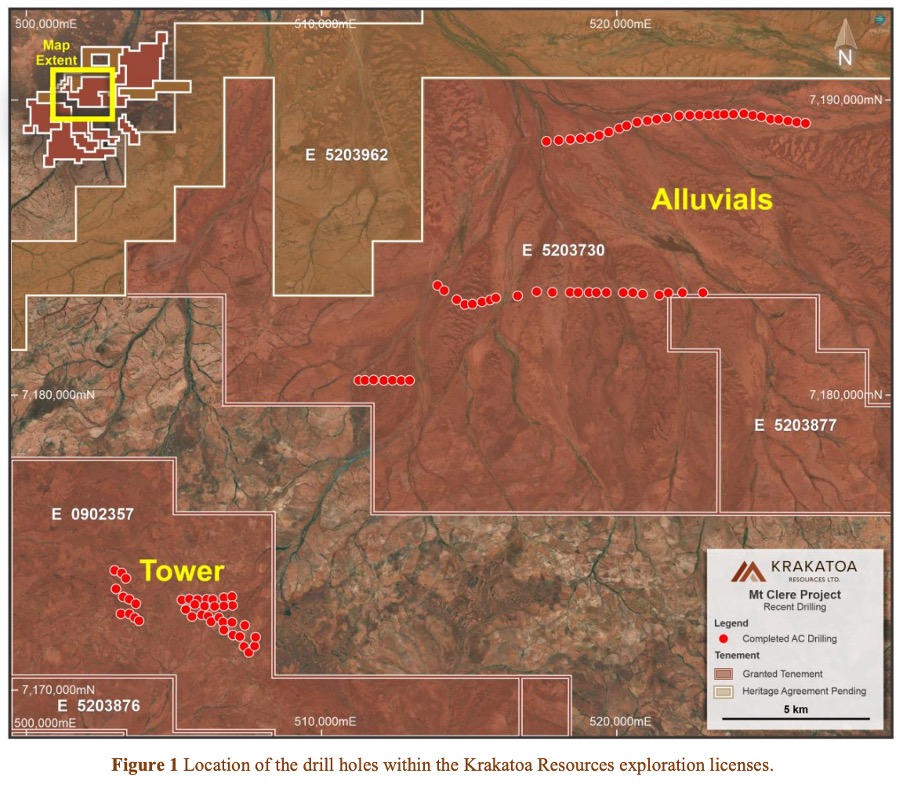
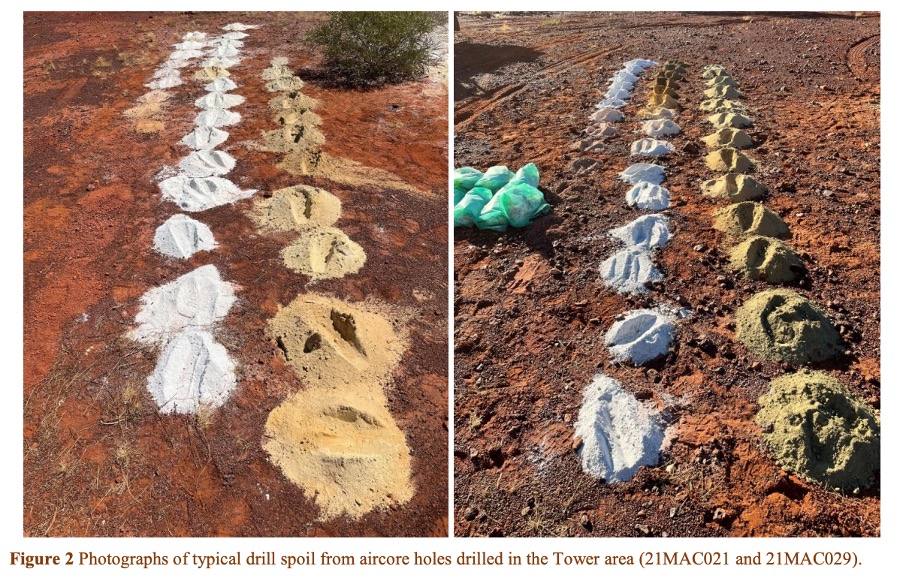
Drilling undertaken over the Tower area aimed to investigate and test for well-developed clay-rich regolith profiles that could be prospective for ion adsorption REE mineralisation.
Most of the holes intersected the expected bedrock made up of alkaline granitic and gneissic basement rocks, which are typical precursor rocks for this style of mineralisation.
An additional short traverse was drilled along the mid to upper alluvial plains north of Tower to investigate the extent of relict regolith profile below the shallow transported materials, and to confirm the bedrock in this location.
This traverse also encountered clay zones up to 33 metres thick within a regolith profile up to 66 metres deep.
Looking ahead, these clays will also be tested for ionic adsorption clay (IAC) REE mineralisation.
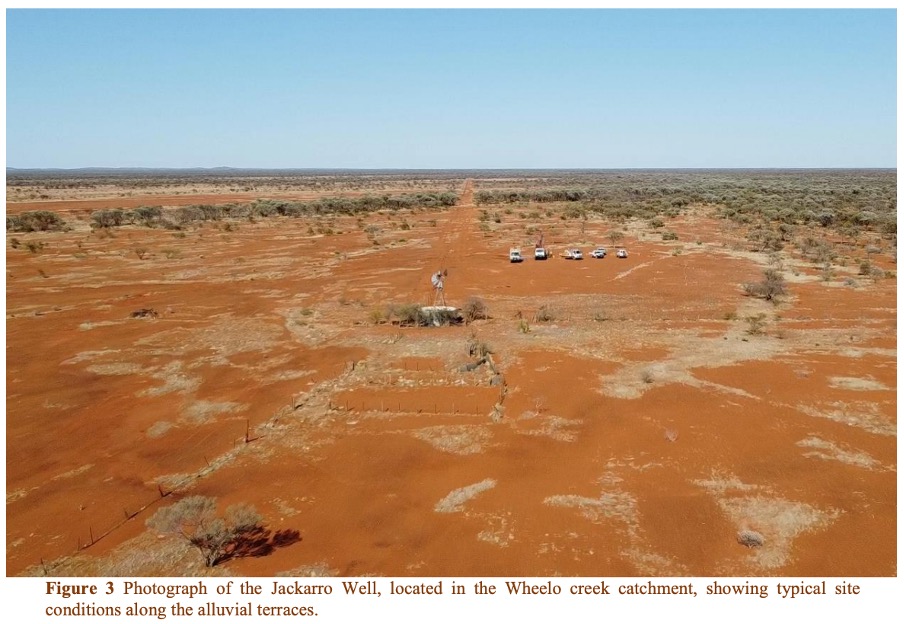
Meanwhile, drilling over the alluvial terraces was designed to test the viability of HMS mineralisation, including monazite sands and the potential for secondary ionic weathered clays.
Two significant drill hole traverses were completed, with the south line run over along the mid-level alluvial plain and the north line drilled within the lower reaches of the plain.
The southern line encountered a mixture of shallow felsic crystalline bedrock, while several areas exhibited deeper regolith profiles (up to 81 metres deep) with some transported material.
On the other hand, the northern line was more consistent and encountered considerable thicknesses of recently transported material (23 to 39 metres), then generally passed into a stripped (eroded) regolith profile underneath.
Most holes in this line were terminated at around 40 meters, or upon drilling through the transported material.
Samples are being prepared for laboratory analysis with results expected to be returned within the first quarter of 2022.
Heliborne VTEM Survey
UTS Geophysics has completed an extensive, helicopter-borne VTEM geophysical survey system over a large proportion of the southern tenements and three discrete targets in the north at the Mt Clere project.
All up, 1,936 line kilometres were flown over areas identified within the Narryer Terrane that show structural complexity.
It also targeted zones where strong magnetic anomalies and surface nickel and chromium geochemical results indicate that these areas represent reworked remnants of greenstone sequences.
These could be prospective for intrusion-hosted nickel-copper-cobalt-PGE and maybe even gold.
In addition, there are mafic and ultramafic intrusive bodies identified within these areas.
Areas identified within the Yarlarweelor Gneiss complex (especially the northernmost areas) are discrete magnetic anomalies, which lie adjacent to interpreted structures that have strong geochemical signatures.
The data from the VTEM is being processed, with results expected in mid-late January.