
Orthocell Ltd (ASX:OCC) says a shoulder study on its SmrtGraft™ tendon repair treatment indicates the therapy can effectively augment surgical repair of full-thickness tears on a patient's rotator cuff tendon.
The regenerative medicine company saw results from the study published in the Journal of Orthopaedic Translation, a highly regarded peer-reviewed scientific journal.
Overall, the findings indicate that patients experience significant improvements in pain, function and quality of life after undergoing surgery with the SmrtGraft™ treatment, while no patients required further surgery to manage a re-tear.
The data also reveal that SmrtGraft™ reduces risk of treatment failure, as demonstrated by no reported adverse events or revision surgeries.
Ultimately, the new findings support the breadth of Orthocell’s cornerstone CelGro™ platform, with positive results now recorded across nerve, tendon and bone repair studies.
The publication was spurred on thanks to a collaboration between professors and doctors across Western Australia and South Africa.
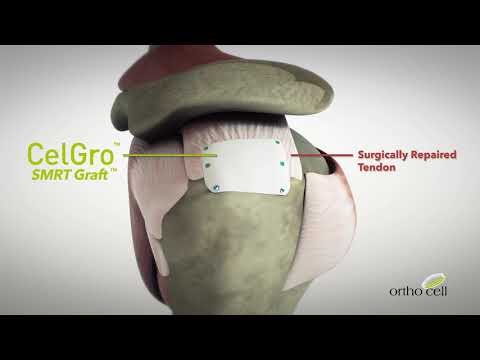
A scaffold for tendon regeneration
Speaking to the publication, Orthocell chief scientific officer Professor Minghao Zheng said: “Rotator cuff tear is very common and repair can be challenging.
“An effective biological augment to surgical repair is increasingly desired by the orthopaedic community.
“SmrtGraft™ has shown to be the ideal scaffold to support tendon regeneration with significant potential to improve tissue healing.”
Orthocell managing director Paul Anderson echoed his comments and said: “This is exciting research that opens up potential for novel treatments addressing significant unmet medical needs and we will explore these development options alongside our nerve repair applications.
“SmrtGraft™ continues to be an impressive pipeline product and this further validates the very valuable CelGro™ platform technology addressing multiple medical needs.”
The trial
To assess the safety and efficacy of SmrtGraft™ when augmenting the surgical repair of rotator cuff tendons, a prospective case series study was undertaken on 18 trial participants.
Patients had previously suffered full-thickness tears of the rotator cuff tendon in the shoulder, following work-related, motor vehicle or sporting incidents.
In addition, participants experienced chronic pain and difficulty performing basic activities of daily living (such as sleeping, bathing and dressing), playing sport and/or working.
The Journal of Orthopaedic Translation reports the 12-month follow-up of 17 trial participants after SmrtGraft™ shoulder surgery (one participant withdrew due to reasons unrelated to SmrtGraft™).
Promisingly, results showed that all patients achieved a successful tendon repair with significant improvements in pain, function and quality of life.
No patients required further surgery for a re-tear of the rotator cuff tendon – an important finding since revision surgeries for re-tears is reported to occur in up to 57% of cases.