
Sovereign Metals Limited (ASX:SVM, AIM:SVML) has tabled a positive scoping study for the Kasiya Rutile Project in Malawi — a report it believes confirms its asset as a globally significant rutile play.
The initial scoping study considers a multi-decade mine, which will provide a stable supply of highly sought after materials like rutile and graphite while building up Malawi’s economy.
What’s more, the study’s life-of-mine inventory covers just 38% of its mineralised footprint, meaning further resource growth — pencilled in for early 2022 — will further enhance the scoping metrics.
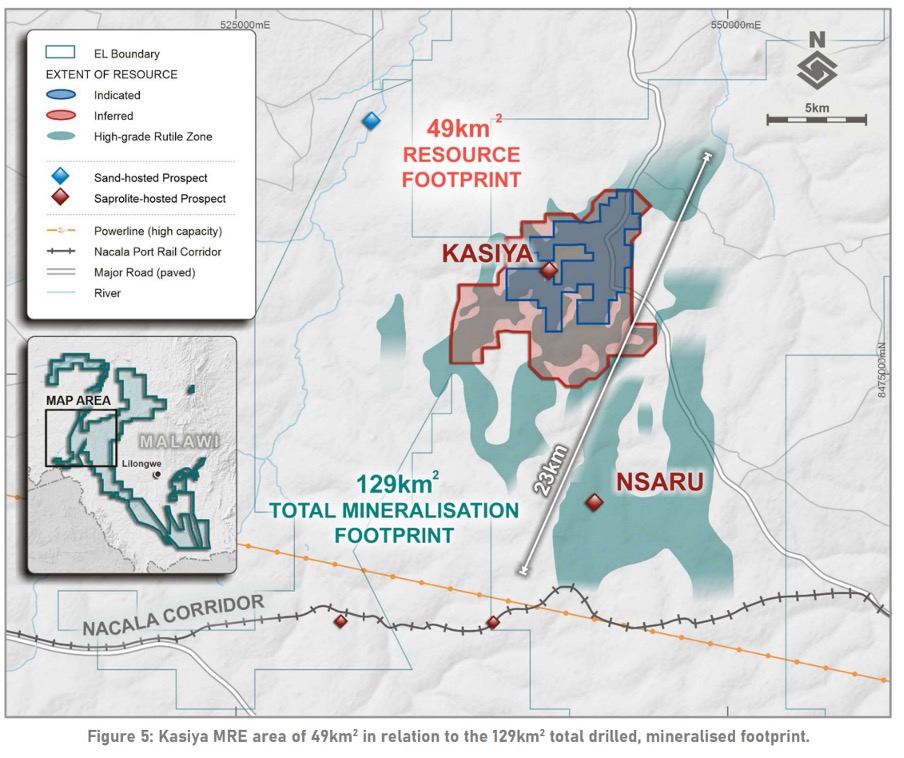
Kasiya is the largest undeveloped rutile deposit in the world, so there’s major upside tied to its development in a market characterised by extreme supply deficit.
“Just the beginning of the story”
Commenting on the paper, Sovereign Metals managing director Julian Stephens said: “To have achieved this fantastic scoping study milestone for the Kasiya Rutile Project within just 20 months of the initial discovery is a huge result for Sovereign and a testament to the dedication and hard work of our Malawi and Australia-based team.
“We believe that Kasiya is also just the beginning of the story in the new Central Malawi Rutile Province.
“We will expand our resource significantly early next year with the addition of the Nsaru Rutile Deposit and potentially other regional prospects.
“The project benefits from world-class existing infrastructure and natural ESG advantages. Natural rutile has a far lower carbon footprint compared to other titanium feedstocks used in the pigment industry, and the vast majority of power will be supplied by renewable hydro and solar.
“Furthermore, natural graphite is a significant component in lithium-ion batteries and is an important mineral underpinning the energy transition.
“The future development of the Kasiya Rutile Project will bring substantial benefits to Malawi in terms of GDP, royalties, taxes, employment and training, local business opportunities and community development.”

Economics
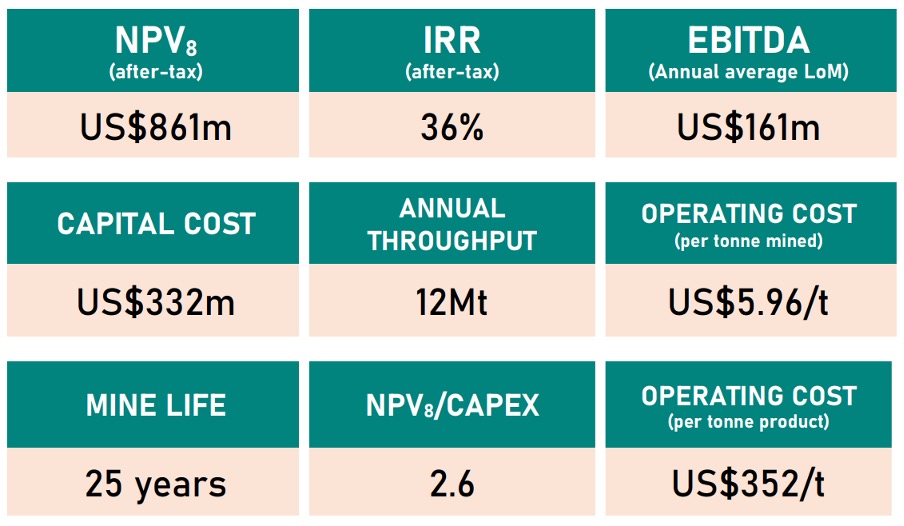
Based on the initial scoping study, Kasiya bears a 25-year mine life and will need US$332 million in project capital to get off the ground.
With an annual throughput of 12 million tonnes, each tonne will cost US$5.96 to mine, while the operating costs will stack up to US$352 per tonne.
The rutile and graphite play has a US$861 million net present value and a 36% internal rate of return post-tax.
It’s anticipated to generate US$161 million in earnings before interest, taxes depreciation and amortisation (EBITDA) every year, on average, over its life of mine.
A snapshot of the economic details is:
Operations
Sovereign is aiming to develop an environmentally and socially sustainable operation to supply highly sought-after natural rutile and graphite to global markets.
The proposed large-scale operation will process soft, friable mineralisation mined from surface.
Sovereign’s project already has some of the key surrounding infrastructure in place, including bitumen roads, a rail line connecting to the deep-water of Nacala on the Indian Ocean and hydro-sourced grid power.
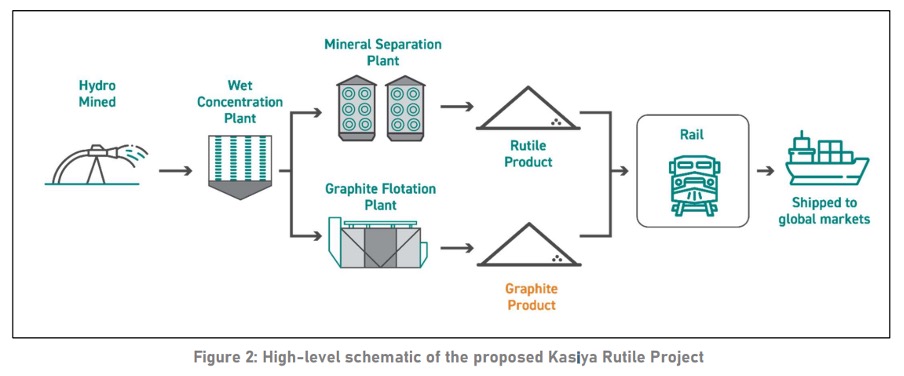
The operation will primarily employ conventional hydro-mining to produce a slurry that is pumped to a wet concentration plant, where the material is sized.
A heavy mineral concentrate (HMC) is produced as the sand fraction is processed through a series of gravity spirals.
The HMC is then transferred to the dry mineral separation plant, where premium quality rutile is produced via electrostatic and magnetic separation.
Graphite-rich concentrate is collected from the gravity spirals and processed in a separate graphite flotation plant, producing a coarse-flake graphite product.
The rutile and graphite products will be trucked a short distance via existing bitumen roads to the Kanengo rail terminal, where they will be railed to the deep-water port of Nacala on Mozambique’s eastern seaboard.
Positioned for growth
The current mining inventory for the scoping study covers only 49 square kilometres, or 38%, of the total drill-defined area of high-grade rutile mineralisation, spanning 129 square kilometres.
Sovereign expects to be able to materially increase the overall mineral resource estimate tonnage in early 2022, which will enable the study options to be reviewed in terms of potential for scale-ups or mine life extensions beyond the current 25 years.
The objective of this study was to provide an initial technically validated concept that will be scalable in future.
Through the study process, a number of opportunities and options were identified to enable potential increases in production rates via additional mining units, plant modifications or modular additions.
A critical mineral in a supply deficit
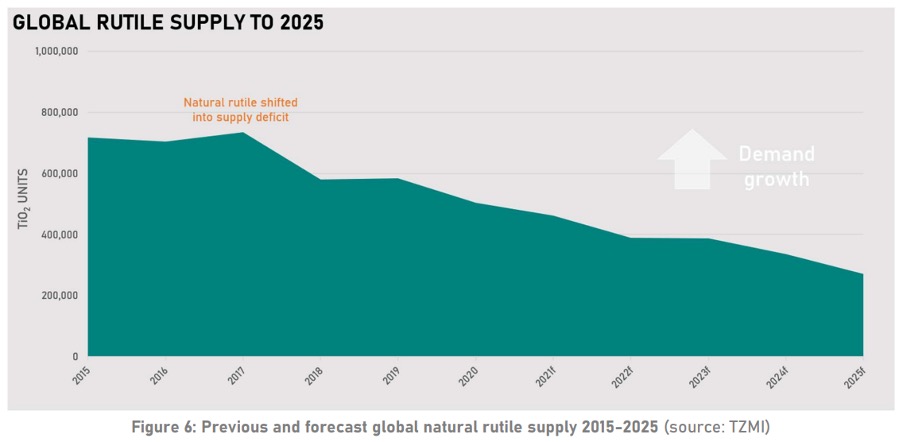
Natural rutile is a genuinely scarce commodity, with no other large rutile dominant deposits having been discovered in the last half-century.
Current sources of natural rutile are in decline as several operations’ reserves are depleting concurrently with declining ore grades.
These include Iluka Resources Ltd (ASX:ILU)’s Sierra Rutile and Base Resources Limited (AIM:BSE, ASX:BSE)’s Kwale operations in Kenya.
Recent announcements by Iluka advising of the potential suspension of operations at Sierra Rutile may cause further additional product to be removed from the market in the near- to medium-term.
Additionally, there are limited new deposits forecast to come online, so supply of natural rutile is likely to remain in structural deficit.
Next steps
Beyond the scoping study, Sovereign is looking to accomplish several more milestones in the coming two quarters.
These include:
- An updated mineral resource estimate (MRE) to grow the indicated and inferred JORC resource base, including the addition of the Nsaru deposit;
- A revised life cycle assessment based on the scoping study results to quantify Kayisa’s environmental impacts with a specific focus on carbon footprint;
- A scoping study update based on the expected new resource base, planned for mid2022;
- Continued product marketing and potential execution of memoranda of understanding with future rutile off-takers; and
- The commencement of ESIA field data collection and community engagement activities.
Once the above activities are ticked off the to-do list, Sovereign will commence a pre-feasibility study on Kasiya-Nsaru to realise the true potential of the rutile project.
In parallel to the technical study developments, exploration will continue, with programs including;
- Infill drilling at KasiyaNsaru to increase MRE confidence and upgrade MRE categories;
- Deeper aircore drilling at KasiyaNsaru targeting the northeast-striking, higher-grade zones to roughly 25 metres below surface;
- Aircore drilling targeting an initial MRE for the Bua Channel – a traditional placer deposit just 10 kilometres northeast of Kasiya; and
- Regional reconnaissance drilling, targeting additional Kasiyalike saprolite-hosted rutile mineralisation.