
Miramar Resources Ltd (ASX:M2R) has outlined two large iron oxide-copper-gold (IOCG) targets after follow-up surface geochemical sampling at the Whaleshark Project in the Gascoyne region of Western Australia.
Importantly, the new sampling has delineated two large areas of coincident copper-uranium-REE anomalism with associated lead, zinc, gold and silver anomalism suggestive of buried IOCG mineralisation.
Looking forward, Miramar will re-examine the existing gravity data over the area to collect new geophysical data to help in refining drill targets for testing in 2022.
“Large coherent anomalies”
Miramar executive chairman Allan Kelly said: “The new results confirm and upgrade the anomalies generated from the first pass sampling and have greatly increased the likelihood for the presence of buried IOCG mineralisation at Whaleshark.
“We now have two large coherent surface geochemical anomalies at Whaleshark, with strongly coincident copper, uranium and rare earth elements overlying a Proterozoic granitoid intrusion.
“Unlike IOCG targets currently being explored in places like the Paterson Orogen and the Stuart Shelf in South Australia, we only have about 100 metres of cover, not 500-800 metres, which will make it much easier to cost-effectively drill test these targets.
“With much shallower cover, the potential to commercially exploit any new discovery is also greatly increased.”
Phase 2 MMI Soil survey
Miramar has conducted infill soil sampling in two areas identified by the first pass sampling conducted in July 2021.
The sampling was conducted on a 250 x 250-metre grid with 294 samples collected.
Notably, the samples were analysed by the mobile metal ion (MMI) technique, a partial digest technique that extracts loosely bound metal ions that may have travelled through transported cover and deposited in surficial material.
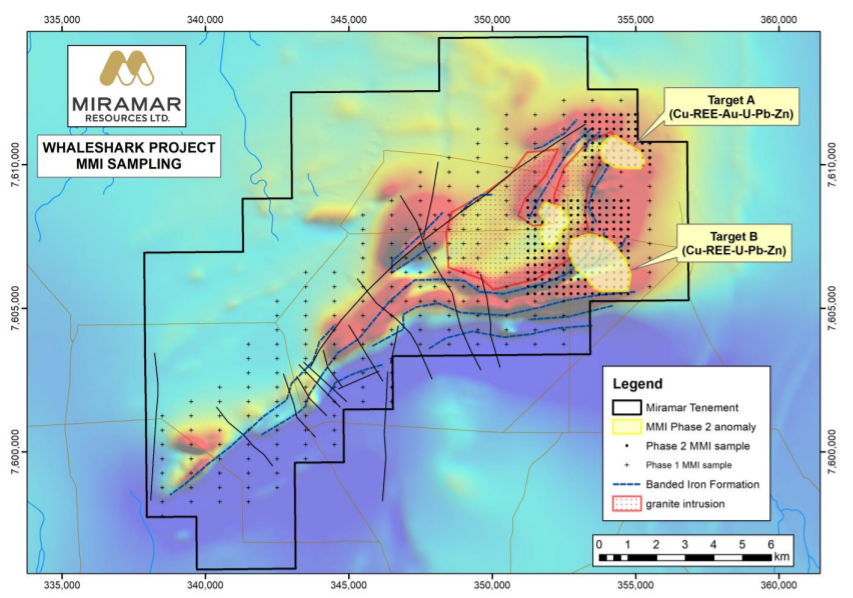
Phase 2 MMI sampling showing anomalism over magnetics and interpreted geology
IOCG mineralisation
The new sampling outlined two large areas of coincident copper-uranium-REE anomalism with associated lead, zinc, gold and silver anomalism:
- Target A – NW trending 1.5 kilometres x 800 metres anomaly with elevated copper, REE, uranium, gold, lead and zinc.
- Target B – NW trending 4 kilometres x 1.3 kilometres anomaly with elevated copper, REE, uranium, lead and zinc.
Promisingly, the association of copper, REE and uranium is strongly suggestive of buried IOCG mineralisation.