
St George Mining Ltd (ASX:SGQ) has identified another target for nickel-copper sulphides following recent seismic surveying at its flagship high-grade Mt Alexander Project in Western Australia's north-eastern Goldfields.
The find comes directly after the discovery of a similarly promising target found at Mt Alexander last week and sets the company up for a lucrative 2022.
SGQ has conducted modelling and interpretation of data from the survey and has found a large, shallow target, S2, in an underexplored intrusive structure parallel to the highly mineralised Cathedrals Belt.
S2 has a dip extent of more than 400 metres, starting around 350 metres below surface. Its seismic properties are consistent with those of the other recently discovered target near Cathedrals Belt, now named S1.
St George has designated S2 a priority target for the potential discovery of a large-scale nickel, copper and platinum-group deposit and has placed it on the list for the next diamond drilling program, scheduled for late January.
Proactive's Andrew Scott spoke with executive chair John Prineas today.

“Our first-ever seismic survey at Mt Alexander continues to deliver strong results with another outstanding new target for a potential massive sulphide deposit," Prineas said.
“The north-south seismic lines completed at Mt Alexander straddled the Cathedrals Belt and stretched to the north into our 100%-owned Exploration Licence 29/548, where an underexplored east-west oriented structure - the Transits Belt - has been identified by shallow drilling.
"Importantly, Cathedrals Belt style host lithologies were also confirmed in the drilling.
“The seismic data has mapped the Transits Belt structure as dipping to the north, similar to the highly mineralised intrusive-host structure in the Cathedrals Belt to the south.
“S2 - the new, large target identified in the Transits Belt - has the same seismic properties as S1 in the Cathedrals Belt and just like S1 is interpreted to be a target for massive nickel-copper sulphides.
“We are very excited to have two robust targets lined up for immediate drilling in our 2022 diamond drill program.”
Seismic survey
Independent consultants Rock Solid Seismic interpreted the results of the survey for St George.
The three north-south seismic lines completed at Mt Alexander commenced to the south of the east-west Cathedrals Belt and continued north into the St George-owned E29/548, where there are underexplored structures parallel to Cathedrals Belt.
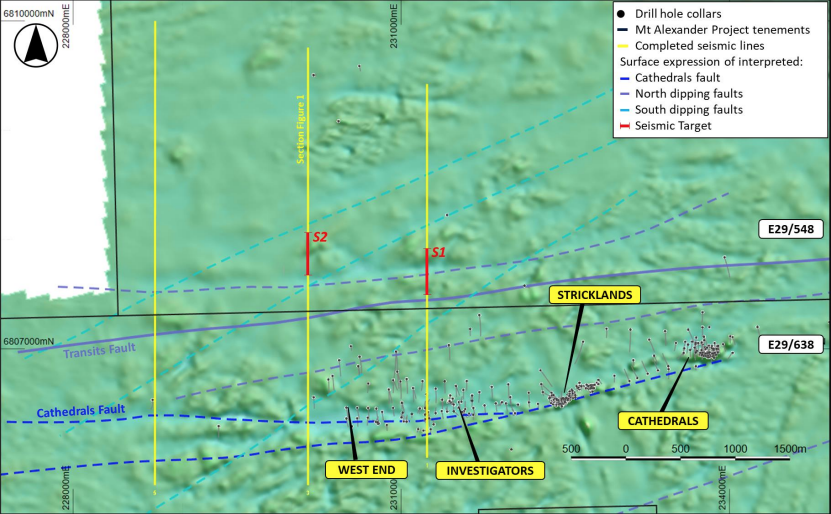
Map of the region showing seismic lines.
Data from the centre line revealed S2, which has seismic properties consistent with the shallow massive sulphides drilled in the Cathedrals Belt.
S2 is located down-dip in the Transits Belt structure, an east-west trending north dipping structure that has many affinities to the Cathedrals Belt.
It is the most prominent of the east-west structures identified on E29/548.
St George has intersected ultramafics during previous drilling in the Transits Belt, which gives the company confidence that the structure has potential to host high-grade mineralisation similar to the Cathedrals Belt structure to the south.
Deep-seated intrusive network
Seismic data shows the Transits Belt structure and the Cathedrals Belt structure dipping to the north and converging at more than 1,000 metres below surface into a larger mantle-tapping structure, which would have been a primary conduit through which intrusive rocks and nickel-copper sulphide mineralisation travelled to the surface.
Deep magmatic structures of this kind usually point to a large mineral system with the potential to host significant volumes of mineralisation.
The company continues to model and interpret the seismic data and will provide updates on further findings and ongoing exploration in due course.