
Racura Oncology Ltd (ASX:RAC) is advancing its Phase 2/3 cancer drug Zantrene which is a potent inhibitor of the fat mass and obesity associated (FTO) protein.
Overexpression of FTO has been shown to be the genetic driver of a diverse range of cancers.
Race is exploring the use of Zantrene as a new therapy for melanoma and clear cell renal cell carcinoma, which are both frequent FTO over-expressing cancers.
In breakthrough preclinical research, Race has also discovered that Zantrene protects from anthracycline-induced heart damage, while in tandem acting with anthracyclines to improve their ability to target breast cancer.
In August 2021, Race dosed the first patient in its Phase 1b/2 trial in relapsed/refractory Acute Myeloid Leukaemia (AML).
The trial will run in parallel with a separate Australian Phase 2 trial in patients with extramedullary AML.
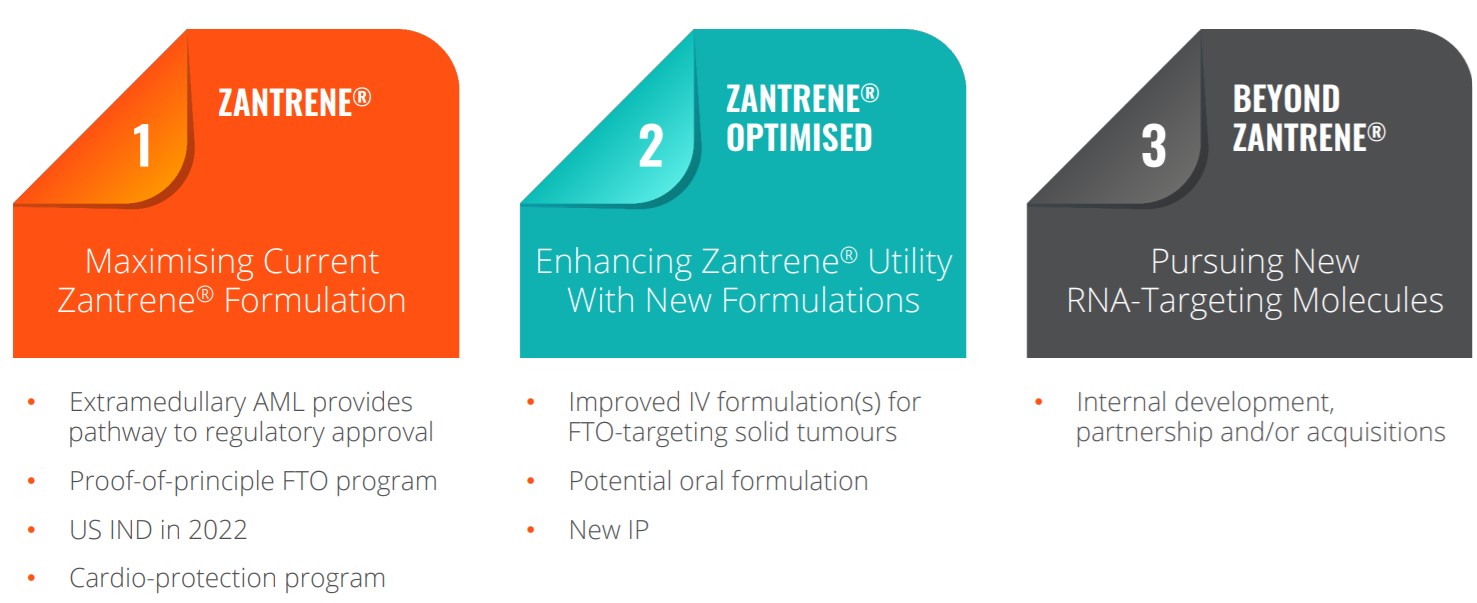
Both trials are key components of Race's Three Pillar strategy.
Three Pillar strategy
Pillar 1 seeks to build on the published City of Hope (COH) findings around the FTO protein and its role in regulating RNA translation and cancer progression as reported in the June 2020 Cancer Cell publication by Su et al.
The Race team has embarked on an extensive pre-clinical program in partnership with the University of Newcastle, investigating Zantrene and its FTO targeting activity in AML, melanoma, and clear cell renal cell carcinoma.
Pillar 2 builds on the known lower cardiotoxic properties of Zantrene and its potential to be used in chemotherapeutic settings more safely or adjunctively to complement existing therapies.
A pre-clinical program is underway to determine Zantrene’s low cardiotoxic mechanism of action and to guide its appropriate clinical translation.
Pillar 3 leverages the company’s long history in AML, working again with Professor Nagler at Chaim Sheba Israel, on a Phase 1b/2 R/R AML program using a novel combination drug approach.
Race has a Phase 1b/2 clinical trial in Australia for patients with extramedullary AML, which will use Zantrene in combination with other standard of care drugs seeking to improve patient outcomes as part of its pathway to drug registration in the USA, and other markets.
Melanoma research program
In September 2021, Race shared interim results from its collaborative preclinical melanoma research program with the University of Newcastle.
Eminent melanoma researchers, Professor Xu Dong Zhang and Associate Professor Lei Jin, are leading the project.
This program is exploring the use of Zantrene as a novel potential treatment for melanoma using cellular and mouse models.
The aim is to identify drug combinations and melanoma subtypes that show improved treatment responses, with a focus on treatment-resistant melanomas.
These interim results showed Zantrene to be highly effective at killing a diverse range of high FTO producing melanoma cell subtypes.
Data showed an association between FTO expression level and sensitivity to Zantrene.
“New treatment options for melanoma patients.”
Race CSO Dr Daniel Tillett said at that time: “These interim results are highly encouraging and support our clinical plans for Zantrene, with the correlation between FTO overexpression and sensitivity to Zantrene suggesting a strong anti-FTO therapeutic opportunity.
“The high sensitivity of many of the melanoma cell lines to Zantrene as a single agent at concentrations well below chemotherapeutic doses is unexpected and may offer new treatment options for melanoma patients.”
Heart-safer alternative to anthracyclines
In November 2021, Race received positive interim results from a preclinical heart safety research program led by eminent cardiotoxicity researchers, Associate Professors Aaron Sverdlov and Doan Ngo, in collaboration with cancer scientist Associate Professor Nikki Verrills, at the University of Newcastle.
The research program found that Zantrene is capable of protecting heart muscle cells from a new class of anti-cancer chemotherapy drug, carfilzomib, which induces heart cell death, while also improving the ability of carfilzomib to kill cancer cells.
Carfilzomib (trademark Kyprolis®) is a highly effective anti-cancer drug used in the treatment of multiple myeloma (a dangerous blood cancer), but it can cause serious and permanent damage to the heart in many patients.
The risk of cardiac damage is so great that its use in older patients with pre-existing heart disease is often contraindicated.
“Results are genuinely remarkable”
University of Newcastle associate professor Doan Ngo said following the release of interim results: “Carfilzomib is a highly effective anti-cancer drug, but its use is limited due to cardiotoxicity.
“Our laboratory has tested numerous drug candidates over the years, we observe that Zantrene has: 1. potent anti-cancer effects; 2. synergistic anticancer effects with both carfilzomib and doxorubicin; and 3. cardioprotective effects against both carfilzomib and doxorubicin-induced cardiotoxicity.
“Zantrene was shown to salvage over 30% of carfilzomib-induced human heart cell from death. These results are genuinely remarkable, as with other clinically used cardioprotective drugs, we only observe a 10-15% protection from heart cell damage.
“Zantrene is the first anti-cancer agent that we have found to exhibit a cardioprotective profile while being synergistically effective as an anti-cancer treatment.
“These results give hope to the millions of patients living with cancer that once they survive cancer, they may not have to live with heart disease.”
Short-term value drivers
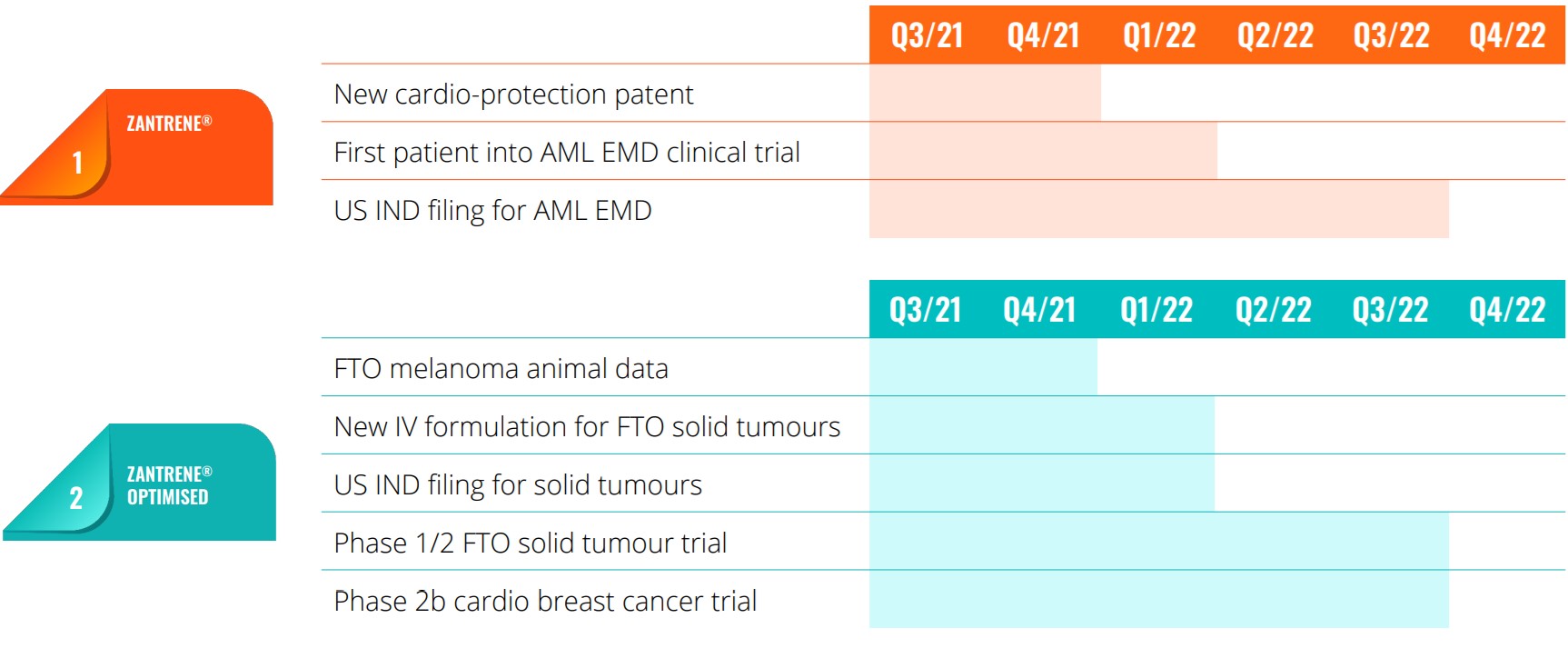
Race has significant potential for Zantrene as the annual market for AML, renal cancer and melanoma alone is conservatively at US$2.6 billion.
The existing market for cardio-protection is also substantial, with millions of patients given anthracyclines each year.
Race CEO Phillip Lynch noted in the company’s September quarterly update: “The team continues to successfully progress Race’s preclinical and clinical programs.
“We were particularly excited with the interim melanoma results where Zantrene was shown to inhibit melanomas with high FTO expression.
“Those results provide a strong early validation of our thesis that Zantrene could have a significant patient and economic opportunity.
“We are now moving to determine appropriate clinical translation plans.”