
Newfield Resources Ltd (ASX:NWF) is buoyed by results of an exploration program on Peyima Kimberlite within the Tongo Mine concession area in Sierra Leone with 110 carats of diamond recovered from a bulk sample.
A 108 dry tonnes kimberlite bulk sample was collected and processed yielding 110.20 carats of diamonds with an encouraging sample grade of 102 carats per hundred tonnes (cpht).
The largest stone weighs 5.07 carats with 74% of recovered diamonds categorised as gem/near-gem quality.
“Encouraging sample grade”
Newfield executive director Karl Smithson said: “The Peyima Kimberlite is one of 11 known kimberlites on the Tongo Mine concessions, located some 5 kilometres to the southeast of the current mine development on the Kundu and Lando kimberlites.
"Earlier this year Newfield decided to undertake a bulk sample of the Peyima Kimberlite for a first assessment on the diamond grade and quality of the body.
"This initial evaluation program was successfully completed through the collection and processing of a 108 dry tonne sample which yielded 110 carats of diamond, for an encouraging sample grade of 102 carats per hundred tonnes (cpht).”
Peyima potential
Peyima Kimberlite is in the southeast of the Tongo mining concession and has been mapped along surface over a distance of 2.24 kilometres, primarily following historical artisanal mining.
In 2010 a limited drilling program was conducted with four holes drilled, three of which intersected kimberlite with the deepest intersection being 130 metres from surface. In addition, a ground geophysical survey was conducted across the area of drilling interest.
Petrographic studies of drill core intersections identified the kimberlite as a medium-grained, garnet macrocrystic, phlogopite hypabyssal kimberlite.
Artisanal mining
Historical reports identified Peyima Kimberlite as being diamondiferous and this is supported by the fact that the upper parts of the dyke have been subjected to significant artisanal diamond mining over the years.
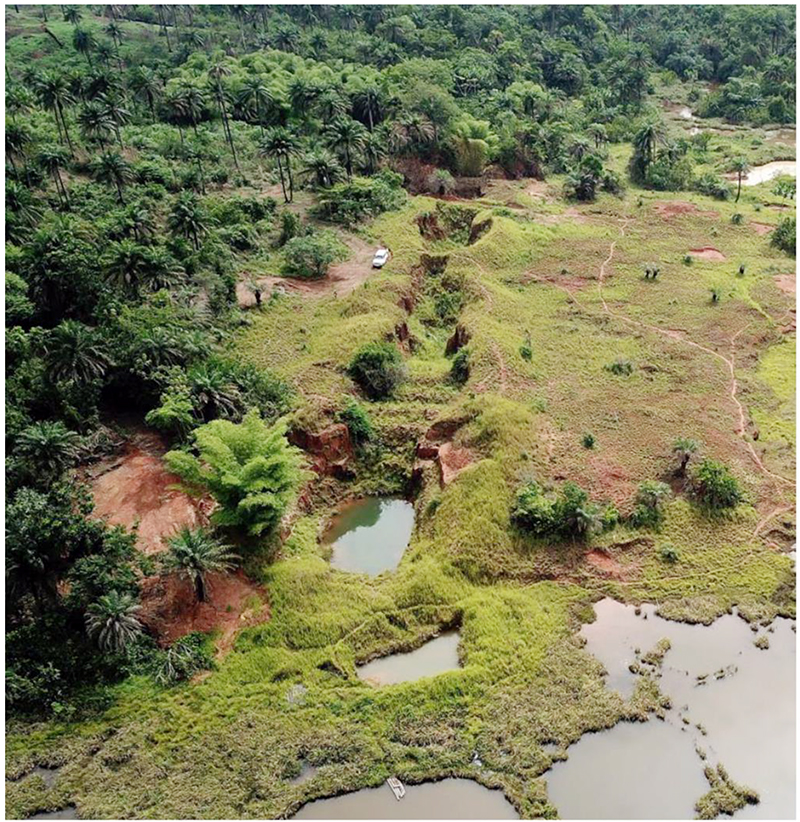
Artisanal diamond mining along the Peyima Kimberlite.
Bulk sampling exercise
Newfield undertook a bulk sampling exercise from two separate but relatively proximal locations on the body.
One area was challenging in that the kimberlite and ground conditions were relatively decomposed, so the majority of the bulk sample was collected from an area where ground conditions were better and the kimberlite was hard and fresh.
The sample was carefully measured and surveyed every metre to determine the volume extracted and the specific gravity and moisture content measured from kimberlite samples collected every 1 metre. It was calculated that a total of 108 dry tonnes of kimberlite was collected along a sample strike length of 40 metres.
In addition, at every 2 metres along the sample trench, samples of kimberlite were collected to give a composite weight of approximately 200 kilograms.
Further analysis
These samples will be consigned to the SRC Laboratory in Canada for microdiamond analysis, the results of which will assist in the evaluation of the kimberlite.
“This first assessment of the Peyima Kimberlite diamond grade and quality is highly encouraging and supports the further work which will include the processing and analysis of a 182-kilogram microdiamond sample to better assess the grade potential of the kimberlite,” Smithson said.
"Initial independent valuation of the recovered diamond sample confirmed diamond value consistent with the Kundu and Lando kimberlites in the smaller sieve classes.
“Supports confidence”
“The success of this sampling program is very exciting exploration progress which supports the company’s confidence that Peyima holds the potential to expand the global diamond resource at Tongo which currently stands at 8.3 million carats hosted in just 5 of the 11 kimberlites on the concession.”
The kimberlite samples were trucked and stockpiled in a secure sample paddock next to the 5 tonnes per hour bulk sample plant at the Tongo camp and plant site.
Samples were processed at a bottom cut off of +1.2mm, with diamond recovery by X-Ray Flowsort machines. The diamonds were recovered from the heavy mineral concentrate by an experienced diamond sorter under strict security and in the presence of a government observer.
Preliminary grade estimate
A total of 110.58 carats of diamond were recovered from the 108 dry tonnes processed, giving a recovered sample grade of 102.37cpht at a +1.2mm cut off. The diamonds are categorised as gem (49%), near-gem (25%) and industrial (26%) quality.
Results provided are only a preliminary grade estimate based on a small sample and are not sufficient to determine a mineral resource estimate.
Further work, including drilling, bulk-sampling and microdiamond analysis must be undertaken if a mineral resource estimate for the Peyima Kimberlite is to be established.
The diamond parcel was exported to Antwerp in adherence to the Kimberley Process Certification Scheme, where the goods were deep boiled to remove any impurities and dirt and re-weighed, giving a total weight of 110.20 carats.
Initial independent valuation of this small diamond parcel in Antwerp confirmed the Peyima sample to have average values per sieve class to be similar to the Kundu and Lando kimberlites in the +3 DTC sieve to 8 grainer sizes (ie up to 2 carats in size).
Highly encouraging
While it is premature at this point of the work program to compare the overall revenue per carat, as the coarser sizes are under-represented in the small sample size, this result is highly encouraging and suggests that Peyima may host the same high percentage of gems as the other kimberlites currently in the mineral resource and reserve inventory.
Lando and Kundu diamond reserves have a modelled diamond value of U$222 per carat (+1.18mm cut off).
The Tongo Diamond Mine Development comprises two adjacent mining licences covering a combined area of 134 square kilometres in eastern Sierra Leone.
Tongo hosts 11 identified diamondiferous kimberlites, only five of which are incorporated in the current JORC-compliant indicated and inferred diamond resource estimate of 8.3 million carats. Of this resource, a 1.1 million carat probable reserve, has been estimated.