
Pan Asia Metals Ltd (ASX:PAM) is back with more encouraging drilling results from the Reung Kiet lithium play in southwest Thailand.
Late last week, the specialty metals explorer and developer said it was honing in on a new lithium zone at the project.
Now, the company has returned with assays from four more drill holes, each of which is prospective for lithium, tin, tantalum, rubidium, caesium and potassium mineralisation.
Drilling continues at the Reung Kiet project, with assays from four more holes expected prior to the end of this year.
On track for Q1 estimate
Speaking to the fresh results, Pan Asia Metals managing director Paul Lock said: “As per our recent release, we continue to be very satisfied with the results we are seeing, which compare very favourably with the lithium mica peer group.
“We remain on track to deliver a mineral resource in the first quarter of 2022.
“Our drilling results suggest that a 10,000-tonnes-per-annum lithium chemical plant is a realistic objective.
“Once delivered, we of course will be seeking to expand on this with further targets identified in the Reung Kiet blocks, as well as in our nearby Kata Thong blocks, which are currently under application.”
Exploring Reung Kiet
As one of PAM’s key assets, Reung Kiet represents a priority exploration opportunity.
In the past, open-pit mining extracted tin from Reung Kiet’s weathered pegmatites and was conducted into the early 1970s.
This old pit is roughly 500 metres long and up to 125 metres wide, and it forms part of a prospective zone that runs for at least 1 kilometre across the property.
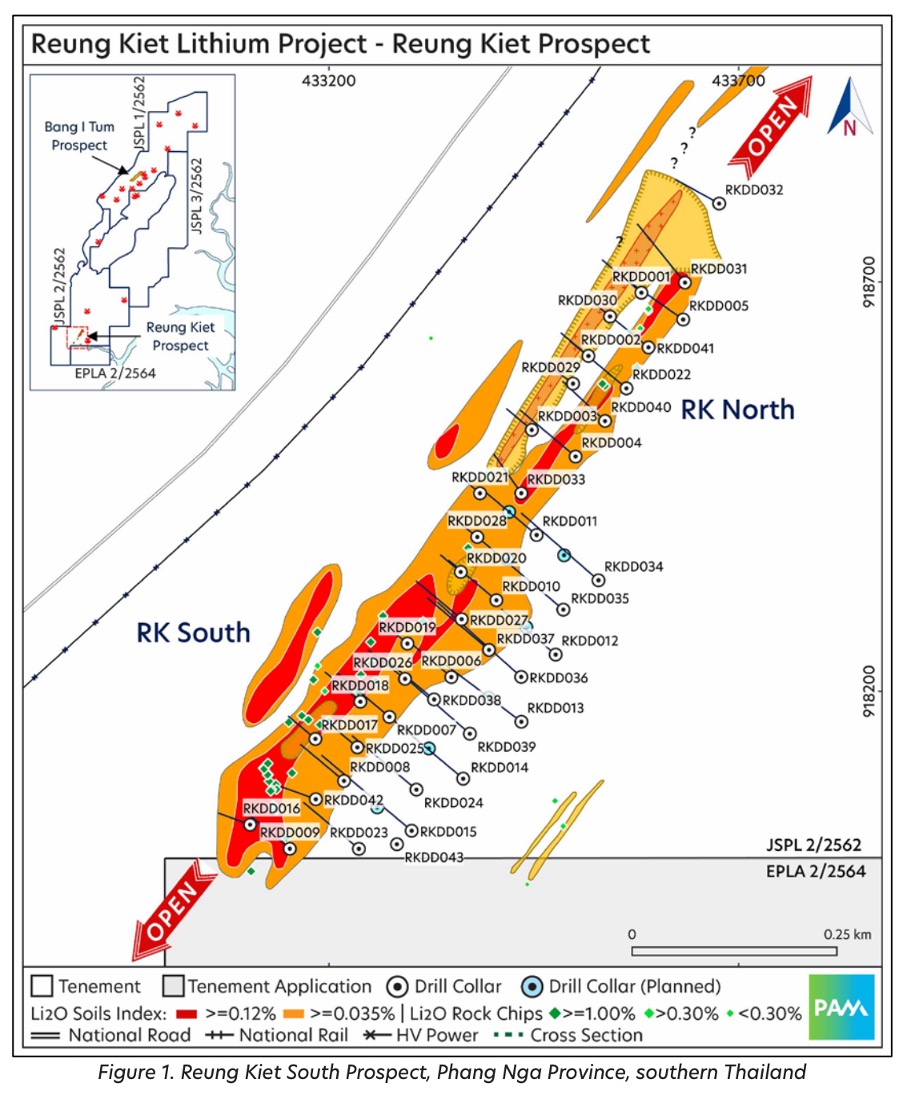
The Reung Kiet pegmatite trend is divided into two main parts — RK North and RK South — and each measures roughly 500 metres long.
The whole 1-kilometre trend remains open to the north, south and down dip on many sections, and additional infill and extensional drilling is underway to better understand its prospectivity.
Fresh assays
The latest four drill holes from Reung Kiet have returned promising assays:
- Hole RKDD027 hosts 26.35 metres of composite mineralisation at 0.84% lithium oxide from 6.9 to 64 metres including 6.4 metres at 0.51% lithium oxide, 406 parts per million (ppm) tin, 263ppm tantalum oxide, 821ppm caesium, 0.39% rubidium and 2.90% potassium from 55.8 metres and 10.6 metres at 1.24% lithium oxide, 540ppm tin, 144ppm tantalum oxide, caesium, 0.43% rubidium and 3.21% potassium from 28.3 metres;
- Hole RKDD028: 0.51% lithium oxide, 667ppm tin, 70ppm tantalum oxide, 127ppm caesium, 0.22% rubidium and 2.61% potassium from 66 to 68 metres;
- Hole RKDD029 hosts 12.2 metres at 0.66% lithium oxide, 970ppm tin, 117ppm tantalum oxide, 209ppm caesium, 0.31% rubidium and 3.03% potassium from 61 metres; and
- Hole RKDD030 hosts 35.35 metres of composite mineralisation at 0.65% lithium oxide from 11 to 83.8 metres including 20.7 metres at 0.66% lithium oxide, 149ppm tin, 128ppm tantalum oxide, 216ppm caesium, 0.35% rubidium and 2.66% potassium from 46.2 metres and 8.25 metres at 0.52% lithium oxide, 981ppm tin, 98ppm tantalum oxide, 186ppm caesium, 0.28% rubidium and 2.76% potassium from 72 metres.
Pan Asia has devised that tin, tantalum rubidium, caesium and potassium mineralisation occur in association with lithium, and are identified as lithium indicator elements in spot hand-held XRF analysis over the Reung Kiet drill core.
Forward work program
PAM has more drill holes planned at both the Reung Kiet and Bang I Tum lithium prospects.
Here, the company hopes to define mineral resources and exploration targets in the coming months.
At Reung Kiet, drilling will focus on deeper holes at RK South, seeking to extend higher grade zones down-dip.
Further ahead, results for holes RKDD031 through RKDD035 are expected by year-end.
Finally, samples from holes RKDD036 to RKDD042 have been dispatched to the laboratory.
Pan Asia will continue to keep the market updated on work at the lithium camp as it turns the soil on fresh results.