
Nova Minerals Ltd (ASX:NVA, OTCQB:NVAAF) has welcomed news that its lithium-centric spinout, Snow Lake Resources Ltd, has made headway on a prospecting and mapping program over its Manitoba properties.
Snow Lake’s vice president of resource development, Dale Schultz, and vice president of exploration, Brian Youngs, looked after the program.
The company’s latest expedition was designed to hone in on more lithium-bearing targets, which would be targeted for resource expansion during upcoming drilling campaigns.
Snow Lake also set out to confirm the locations of the previously identified Sherritt Gordon Dyke and Grass Rivers Dyke and follow up on potential extensions to the Thompson Brothers Lithium (TBL) pegmatite.
Nova owns the majority of Snow Lake Resources Ltd, which hit the NASDAQ board in late November following a US$24 million initial public offering (IPO).
Expanding identified resource
Speaking to the program, Schultz said: "Lithium was first identified on the Snow Lake Lithium claims back in the 1930s and 1940s, with subsequent drilling programs over the decades confirming the rich nature of the lithium-bearing pegmatites on our property.
“The challenge now is to continue to organically expand our identified resource using all the tools at our disposal.
“Our summer prospecting program was extremely successful and the upcoming previously announced drone survey will deploy the latest state of the art technology to give us real-time, in-depth and layered data to further improve our understanding of the geology.
“Our prospecting program is providing us with the geological intelligence to perform what promises to be a very exciting winter drilling program that we believe will deliver substantial enhancements to our resource comprehension.”
Exploring Manitoba’s lithium potential
During the prospecting and mapping expedition, Snow Lake took samples from the field to assess their lithium oxide quantities.
A dyke known as the BY pegmatite returned promising results, grading between 1.2 weight per cent (wt%) and 1.6 wt% lithium oxide.
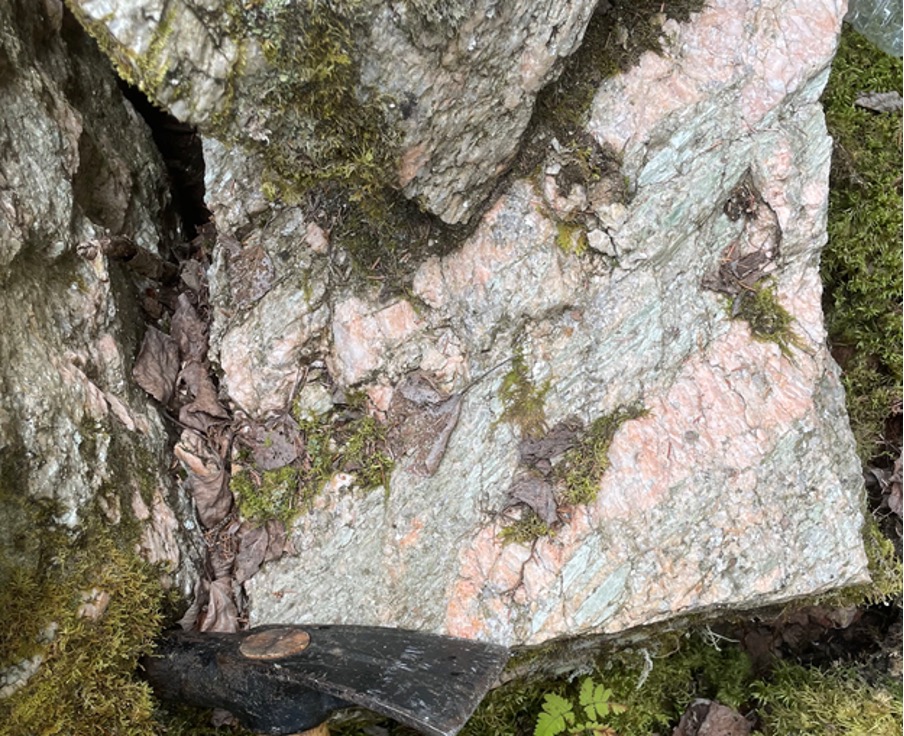
Spodumene at the BY Pegmatite.
It’s located to the north and east of the main resource block of TBL and will represent a new target area outside the already known and established crystallisation areas in the resource.
The other targets of interest include the Grass River (GR) and the Sherritt Gordon (SG), dykes located to the south and west of TBL across the Crowduck channel.

Notably, one sample from the Grass River dyke returned a value of 1.27 wt% lithium oxide.
Of further interest are two spodumene crystal samples that were taken from the outcrops.
These crystals returned as much as 6.86 wt% and 6.97 wt% lithium oxide, respectively.
Ultimately, this suggests that the Grass River dyke should be able to produce concentrates at the 6% level or greater.

Spodumene crystal from the GR Pegmatite.
The Sherritt Gordon dyke also returned some very strong numbers, grading between 2.73 wt% and 3.42 wt% lithium oxide.
Both the Grass River and Sherritt Gordon dykes contain more coarse-grained spodumene than TBL, with crystals measuring upwards of 40 centimetres long and 5 to 8 centimetres wide.

A 40-centimetre-long spodumene crystal from the SG Pegmatite.
All samples were sent to SRC Geoanalytical Laboratories in Saskatoon for analysis.
“One of the most promising resources”
Echoing Schultz’ comments, CEO Philip Gross said: "The results of this prospecting expedition are incredibly encouraging and affirming of our belief that Snow Lake Lithium sits on one of the most promising resources in North America for lithium supply.
“Our recent laboratory analysis results would also suggest that our rock is amenable to producing a quality raw material for the battery industry.
“As the North American market pivots to full electrification of its automobile fleet, there is currently a systemic deficit of lithium supply for this critical demand.
“Snow Lake is perfectly positioned with geographic proximity, a viable resource and access to infrastructure to play a key role in what promises to be the most significant development in the industrialised world this century."