
Anteris Technologies Ltd (ASX:AVR, OTC:AMEUF) has seen its unique, 3D single-piece DurAVR™ transcatheter heart valve featured at PCR London Valves 2021.
PCR London Valves is the world’s largest educational conference focused on transcatheter therapies for valvular heart disease.
This year’s edition took place from November 21 to November 23 and attracted more than 3,600 attendees, including interventional cardiologists, cardiac surgeons, imaging specialists and industry partners committed to the field of structural heart solutions.
For the second consecutive year, Anteris’ novel transcatheter device, which is designed for lifetime patient management, was the only aortic valve featured in the innovation section.
“Developing next-generation technologies”
Speaking to the showcase, Anteris CEO Wayne Paterson said: “[The] DurAVR™ heart valve has the potential to deliver a functional cure in the treatment of severe aortic stenosis.
“Our focus is on developing next-generation technologies that create life-changing outcomes for patients.
“We are thrilled by the interest we received for DurAVR™ at PCR London Valves.
“This is one of the most important medical conferences of the year and is keenly watched by physicians, analysts and industry executives.
“With our first-in-human study now underway, we anticipate even more profile for the company in 2022 at the major medical conferences.”
PCR presentation
DurAVR™ THV was presented by Dr Christopher Meduri, an internationally recognised interventional cardiologist at Karolinska University Hospital in Stockholm and Anteris’ recently appointed chief medical officer (CMO).
Throughout his career, Dr Meduri has successfully performed in excess of 1,700 transcatheter aortic valve replacement (TAVR) procedures and is passionate about providing novel therapies and optimising care of patients with valvular heart disease.
Dr Meduri highlighted the features and benefits of the transcatheter heart valve, as well as its bench and pre-clinical studies results aiming at proving valve preservation.
Essentially, he concluded that:
- DurAVR™ THV is designed to address the current gaps in TAVR therapy, especially in younger patients, with longer life expectancy and active lifestyle;
- Patented anticalcification tissue treatment has proven to be superior to other tissues treatments currently available; and
- Bench and animal studies demonstrate excellent durability and superior hemodynamics.
Valve that lasts longer and works better
Anteris’ technology comprises many different components, but there’s one overarching goal: to create a heart valve that lasts longer and works better than the current solutions.
The structural heart company’s TAVR product utilises three key elements: the ADAPT® tissue, the DurAVR™ 3D, single-piece transcatheter heart valve and the ComASUR™ transfemoral delivery system.
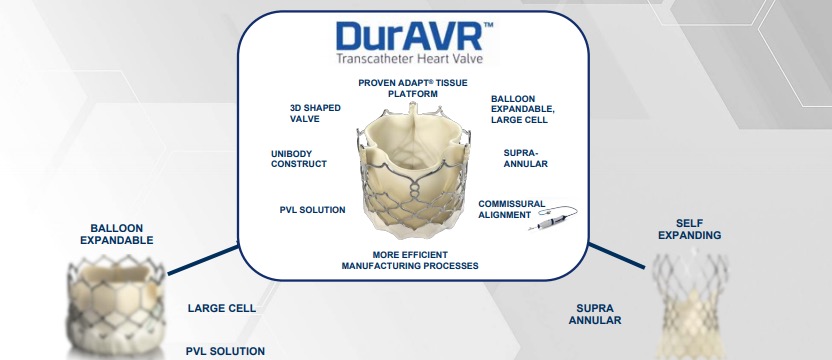
The DurAVR transcatheter heart valve.
ADAPT
Anteris’ core ADAPT technology makes up the tissue component of the heart valve. It’s a special type of material that combats calcification, a phenomenon that narrows a patient’s heart valve and increases pressure.
The ADAPT technology has been proven not to calcify across 10 years worth of studies, meaning it has already been established as a working anti calcification treatment.
DurAVR
Anteris used this technology to develop the DurAVR product, with a mission to create a durable heart valve that has very few sutures.
Because it’s made of one piece of material, the DurAVR valve is structurally sound and more cost-effective to produce.
The heart valve has already been involved with some human surgeries and promising results to date have strengthened the product’s regulatory pathway, expediting its development.
Anteris is conducting pre-submission work for an early feasibility study with the FDA and is working to secure breakthrough status for its technology.
In addition, a TAVR human study is scheduled to start later this year, with hopes the new results will compound on previous data.
ComASUR
Finally, Anteris has developed the ComASUR catheter with some of the world’s leading cardiologists.
This is a commissural alignment device that can help surgeons most accurately position the heart valve, which expands like a balloon when it is put in place.
With the three key technologies working in tandem, Anteris believes it is well-positioned to transform the TAVR space.