
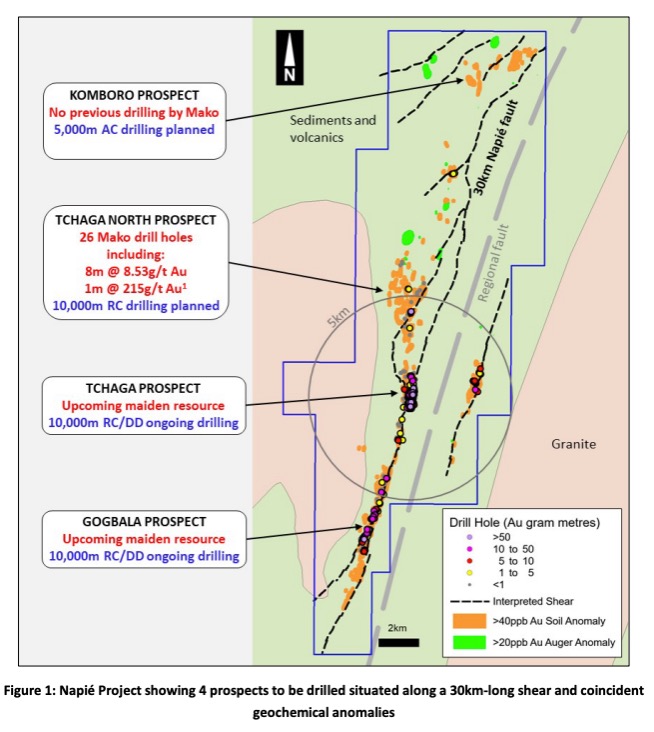
Mako Gold Ltd (ASX:MKG) has brought in another drill rig to turn the soil on high-priority targets at its Gogbala and Tchaga prospects, which form part of the flagship Napié Project in Côte d’Ivoire.
The explorer has pressed play on a drilling program at Gogbala as it looks to follow up previous high-grade gold results, while the new diamond drill rig is being mobilised for drilling at the Tchaga prospect.
Each drilling campaign serves a different purpose: at Gogbala, Mako hopes to accelerate exploration towards a maiden, JORC-compliant mineral resource estimate (MRE).
Meanwhile, extensional drilling at Tchaga will look to expand mineralised zones and add potential gold ounces to the foreshadowed MRE.
The exploration campaigns will also target high-priority regional exploration targets in a bid to identify new areas for resource drilling post-resource.
Accelerating exploration
Speaking to the progress at Napié, Mako managing director Peter Ledwidge said: “We are very pleased to have secured a second drill rig for the Napié Project.
“The second rig will accelerate exploration as we move towards our maiden mineral resource estimate — scheduled for the first half of calendar year 2022.
“Having two drill rigs will allow Mako to focus on drilling the Gogbala prospect while also completing the extensional diamond drilling on the Tchaga prospect.
“The second rig will also add optionality to test regional targets with the aim of discovering new zones along the 30-kilometre Napié fault for future additional resource definition.”
Turning the soil at Gogbala
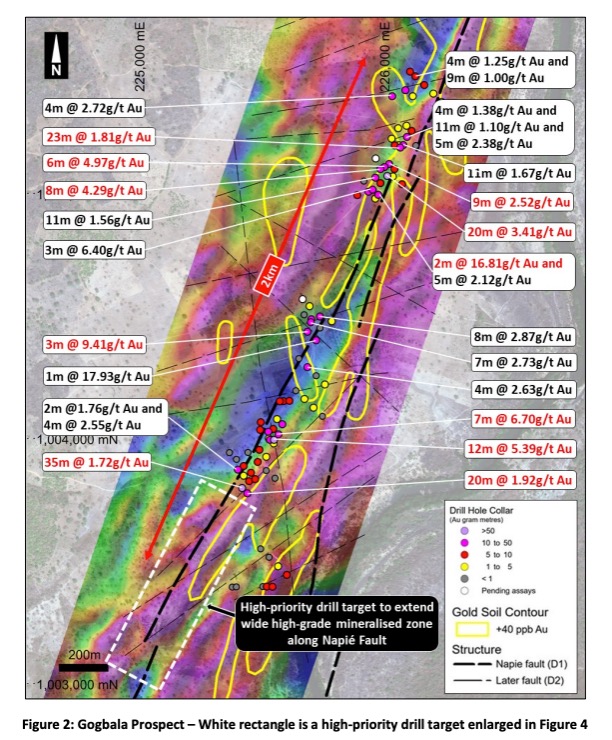
As it explores the high-priority targets at Gogbala, Mako is on a mission to inspect large, undrilled zones along strike of recent and previous shallow, wide and high-grade intercepts.
The immediate focus is to drill south of a historical section, which returned 35 metres at 1.72 g/t gold and 20 metres at 1.92 g/t.
So far, no drilling has been completed south of this section on the western splay of the 30-kilometre-long Napié fault.
What’s more, a permit-scale soil anomaly — grading more than 40 parts per billion gold — and an induced polarisation anomaly hints the mineralisation continues to the south.
Ultimately, these coincident anomalies validate and further prioritise this target.
Some of the past highlights from drilling at Gogbala include:
- 20 metres at 3.41 g/t gold from 19 metres;
- 12 metres at 5.39 g/t from 11 metres;
- 7 metres at 6.70 g/t from 6 metres;
- 35 metres at 1.72 g/t from 43 metres;
- 23 metres at 1.81 g/t from 19 metres;
- 20 metres at 1.92g/t from 33 metres;
- 8 metres at 4.29 g/t from 82 metres; and
- 2 metres at 16.81 g/t from 2 metres.
Exploring Tchaga
In the meantime, a second drill rig is currently being mobilised to Tchaga to expedite diamond drilling, which has continued since the end of the wet season.
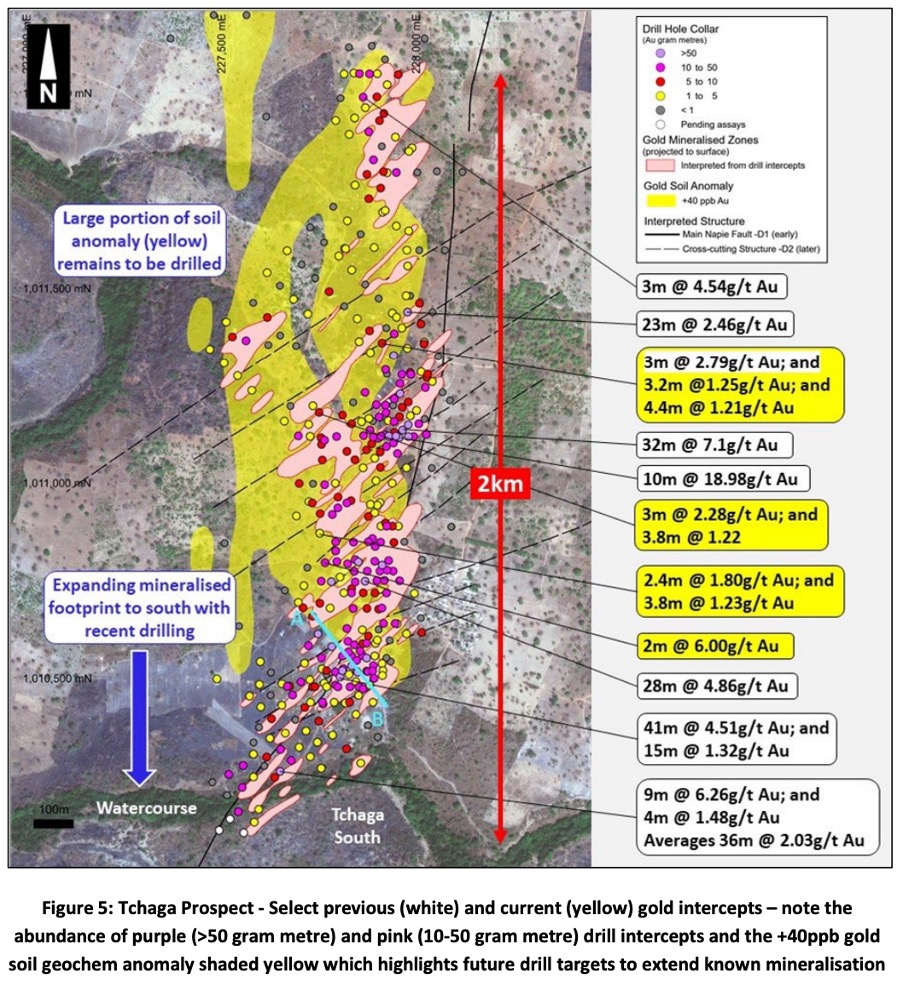
Mako has emphasised that all drilling planned for the prospect is extensional in nature — no infill exploration is on the cards.
This means that any significant mineralisation intersected should add potential ounces to the upcoming maiden MRE.
Ultimately, drilling is doubling down on mineralised zone extensions to the southwest and at depth, as well as new zones south of the seasonal watercourse.
Some of the best results from previous exploration at Tchaga include:
- 10 metres at 18.98 g/t gold from 7 metres;
- 41 metres at 4.51 g/t from 17 metres;
- 32 metres at 7.1 g/t from 13 metres;
- 13 metres at 20.82 g/t from 32 metres;
- 9 metres at 22.73 g/t from 36 metres;
- 7.7 metres at 11.65 g/t from 169 metres;
- 2 metres at 24.06 g/t from 112 metres; and
- 4 metres at 8.24 g/t from 70 metres.
The road ahead
With two drill rigs now turning the soil at Napié, Mako has the flexibility to test numerous regional targets in the hopes of uncovering new discoveries.
While the short-term objective is to announce a maiden MRE on Tchaga and Gogbala in the first half of 2022, the broader vision is to discover new zones at Napié, which could then be advanced to resource.
This aligns with the company’s ultimate aim: to establish a multi-million-ounce, project-scale resource along the 30-kilometre-long Napié Fault.
In the immediate future, current assay results will be slightly delayed due to IT issues at the primary assay laboratory the company is using.
As it works to establish regular assay newsflow, Mako may send the next batch of samples to a secondary hub until the IT issues are solved at the primary lab.