
Caspin Resources Ltd (ASX:CPN) has intersected up to 40 metres of disseminated nickel and copper sulphides during reverse circulation (RC) drilling over a key anomaly within the Yarawindah Brook platinum group element (PGE)-nickel-copper property.
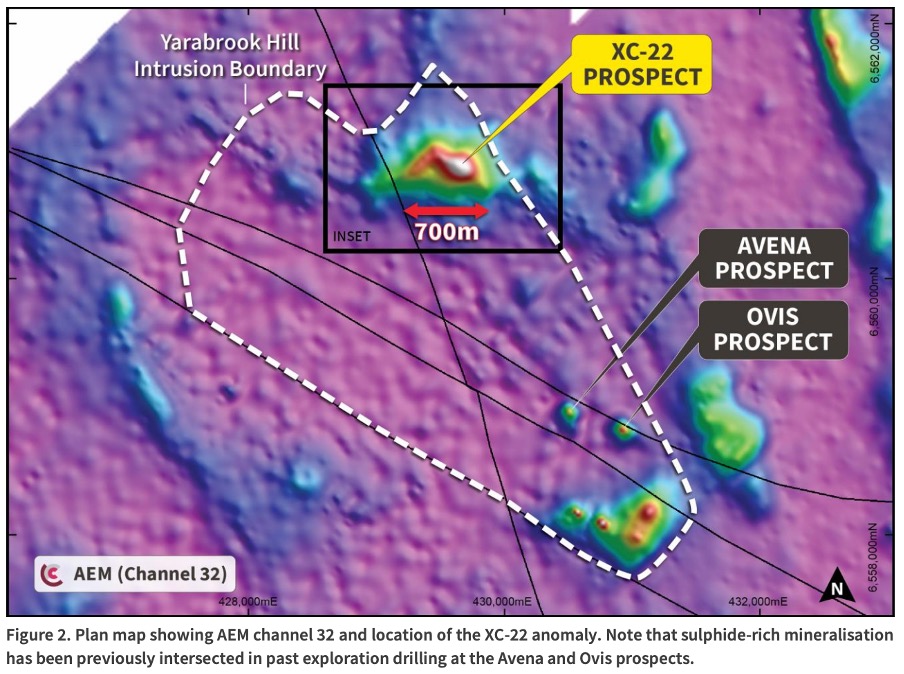
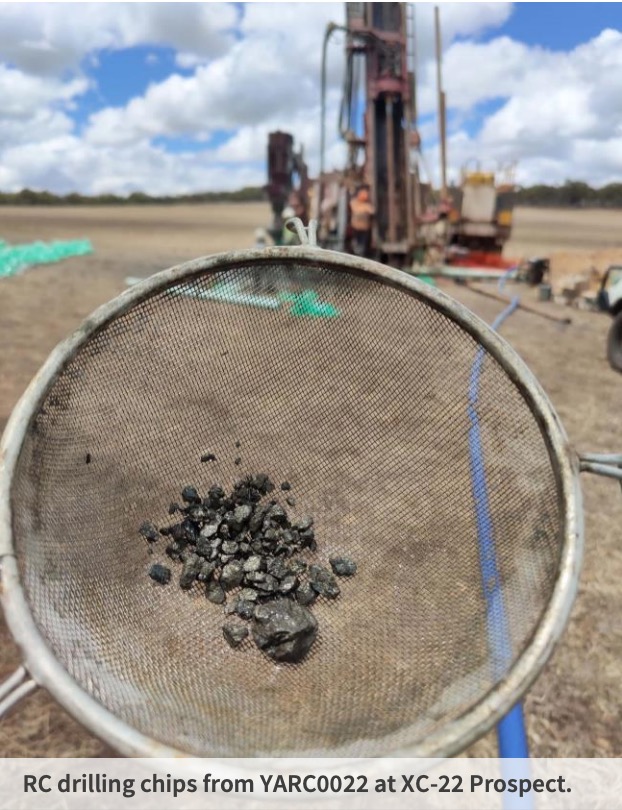
The explorer is digging deeper at the XC-22 airborne electromagnetic (AEM) anomaly, where visual observations reveal a recent drill hole intersected a 2-metre zone of up to 20% sulphides from 46 metres downhole.
More broadly, there’s confirmation that XC-22 represents a bedrock sulphide source, striking over 500 metres.
Early results could also have implications for other AEM anomalies, prompting a review of all previous AEM anomalies at the Yarawindah Brook Project.
A third phase of AEM work is scheduled to cover the remainder of the project area early next month.
In tandem, a stratigraphic diamond hole — completed at 1,199 metres — hit multiple zones of sulphides, while the lithologies support Caspin’s conceptual geological model.
Anomaly could represent “significant body”
Caspin CEO Greg Miles said: “While still early days, given the current extreme delays on assay turn-around, we felt it prudent to advise the market of the exciting visual observations at XC-22.
“The large size of the XC-22 anomaly suggests that if it is coincident with mineralisation throughout its entire extent then this could represent a significant body of mineralisation.
“Many more drill holes are required before this can be confirmed as a significant discovery and laboratory assays are required to confirm the tenor of any PGE mineralisation that may be present.
“This is an exciting development for the Yarawindah Brook Project and the results to date have given us reason to review similar AEM anomalies in the region that, in light of this new information, are potentially significant.
“In addition, the remainder of the project area is about to be surveyed by AEM, commencing early in December.
“We look forward to providing further updates on RC drilling at XC-22 and the interpretation of stratigraphic diamond hole YAD0019 as they come to hand.”
Key findings
RC drilling at the XC-22 AEM anomaly has intersected significant nickel and copper sulphide mineralisation.
Overall, the mineralised zone in drill hole YARC0022 is at least 40 metres thick with up to 20% sulphides over the first 2 metres and becoming more disseminated at depth.
At this stage, all reported sulphide intersections are based on visual observations.
A second hole, YARC0023 — drilled about 175 metres along strike and down dip from YARC0022 — has also intersected gabbro and pyroxenite sequences.
This includes trace to minor disseminated sulphides, except for a 2-metre zone consisting of roughly 5% sulphides with visible chalcopyrite and lesser pentlandite.
The interval may correlate with the mineralised interval observed in YARC0022 at 46 metres.
These intersections are supported by a historical drill hole, YBR063, which intersected 5 metres at 1.05 g/t PGE (palladium and platinum) from 43 metres in the interpreted primary sulphide zone, which was not assayed for nickel and copper.
The AEM anomaly has an apparent strike length of 500 metres and has not been previously targeted for drilling.
However, due to the nature of the AEM survey, the anomaly is currently poorly constrained.
As such, the company has commissioned new ground fixed-loop and downhole electromagnetic surveys to assist further targeting of the mineralisation intersected to date.
What’s more, the geological setting appears similar to that which hosts Chalice Mining Ltd (ASX:CHN, OTCQB:CGMLF)’s Gonneville Deposit.
Upcoming work program
As it continues to explore its asset potential, Caspin has been actively working on multiple fronts at the Yarawindah Brook Project.
A geophysical crew has been engaged to provide downhole electromagnetic surveys of diamond hole YAD0019 and RC hole YARC0022, as well as fixed loop electromagnetic surveys at XC-22 to better constrain the anomaly and assist further drill targeting.
The RC rig will continue to drill broad-spaced holes at XC-22 before moving to the northwest geochemical anomaly.
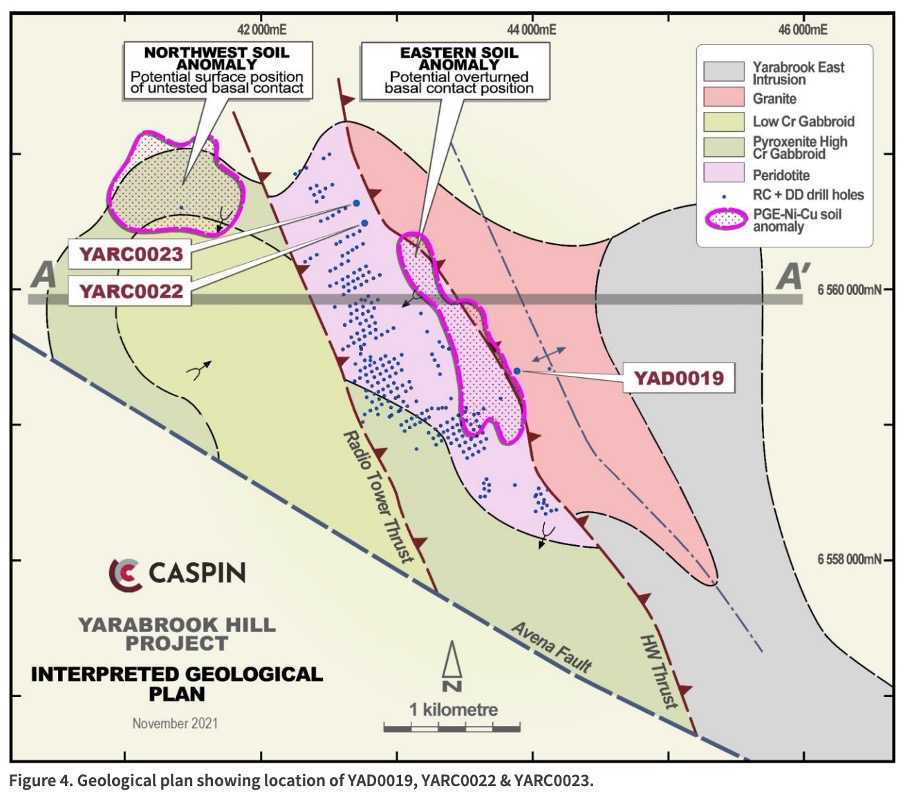
The diamond rig will now move to complete several diamond tails on RC holes that did not reach target depth, particularly at the Eastern geochemical anomaly, due to difficult ground conditions.
The company has also commissioned NRG Australia to fly an AEM survey covering almost 2,000 line kilometres over the northern half of the project area, completing AEM coverage over the entire 440-square-kilometre Yarawindah Brook Project.
This survey is due to commence in early December.
In the meantime, the company is still awaiting assays from RC drilling completed in August and September and looks forward to providing updates in due course.