
- Explainer – the importance of nuclear energy
- Overcoming the fear
- How is the transition happening in other parts of the world?
- Australia lags behind
- Aussie companies forge their own uranium path
- Who else is in the mix?
- The case for nuclear
Debate as to whether nuclear energy has a place in society has raged for decades.
Fear, brought on by reactor meltdowns, weaponisation and waste management, has long been pervasive.
Given the disasters at and subsequent effects of Hiroshima and Chernobyl that fear is understandable.
Those events aren’t to be trivialised or downplayed. Lives were lost and the fall-out (nuclear or otherwise) lasted for decades. The survivors of those disasters must be treated with the respect they deserve, and their concerns heard.
Fukushima is an entirely different discussion. The systems did what they were meant to do. They shut down when the plant detected what happened to be Japan’s largest-ever earthquake.
However, when a wave over 14 metres high hit Fukushima, the water breached the defensive sea wall, flooded the plant and knocked out the emergency generators.
Radioactive material did leak into the atmosphere, however this year, on its 10th anniversary, the United Nations released a report saying there were "no adverse health effects" documented among Fukushima residents directly related to the radiation from the disaster.
It also went on to say that future radiation-related health effects were "unlikely to be discernible".
Who is to blame for the disaster is still a matter of conjecture. Nevertheless, with all the talk about net-zero targets and with all the improvements made to uranium production and safety practices, now seems as good a time as any to talk about nuclear energy and the use of uranium as a safe, clean energy alternative to fossil fuels.
“Net-zero commitments from the nuclear supply chain make an even stronger case for a more significant contribution from nuclear power to help meet net-zero goals,” World Nuclear Association director general Sama Bilbao y León said.
A recent study by Aurora Energy Research - commissioned by Urenco - found both nuclear and renewables are needed for power and hydrogen production to facilitate rapid decarbonisation and cut dependency on fossil fuels, at a minimum cost.
"We believe nuclear power has a key role alongside renewables in a clean energy transition through the generation of electricity and for the production of hydrogen for transportation and industrial use," León said.
"For COP26, it is vitally important for the nuclear industry to participate in the dialogue and debate to make the case that nuclear energy is a critical part of the solution for climate change and achieving decarbonisation."
Leon, of course, has her own agenda. As does Australia’s own Andrew ‘Twiggy’ Forrest who is towing the hydrogen line and said establishing a nuclear energy industry to achieve a net-zero target is “unnecessary”.
In the end, despite the clout of both, it will be up to governments to decide on policy.
France has already taken the step. So has Australia’s AUKUS allies – the UK and the US.
Australia won’t go there.
So why is Australia reluctant to adopt, given it has the most abundant uranium resource in the world.
We’ll get to that, but first let’s have a look at how uranium works, why it is important and the dangers it presents.
Explainer – the importance of nuclear energy
Uranium is a heavy metal, (not the Metallica or Iron Maiden kind) that is used as an abundant source of concentrated energy … and has been for more than 60 years.
It is the basic fuel for a nuclear power reactor and is the only element with a naturally occurring fissile isotope.
Uranium atoms split apart relatively easily, which makes the metal ideal to create nuclear energy.
However, like hydrogen, there are different types of uranium and the one required for nuclear energy is U-235, which is rare.
U-235 is found in only 0.7%, or thereabouts, of uranium found naturally.
How does it work?
As the World Nuclear Association explains, “In a nuclear reactor the uranium fuel is assembled in such a way that a controlled fission chain reaction can be achieved. The heat created by splitting the U-235 atoms is then used to make steam which spins a turbine to drive a generator, producing electricity.”
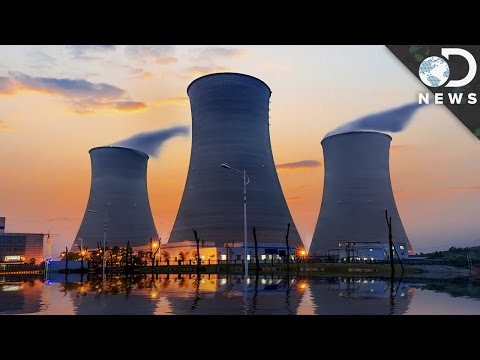
This is about as 'sciencey' as we are going to get. For more information, the following video explains how uranium becomes nuclear fuel.
With all that in mind, there is no doubt, uranium plays an important role in the energy mix. In 2015, the Environmental Protection Agency said nuclear accounted for about 20% of electricity. That number hasn’t changed, but it could soon grow.
Fact: In Australia, which has the most abundant uranium resource in the world, it is just 4%.
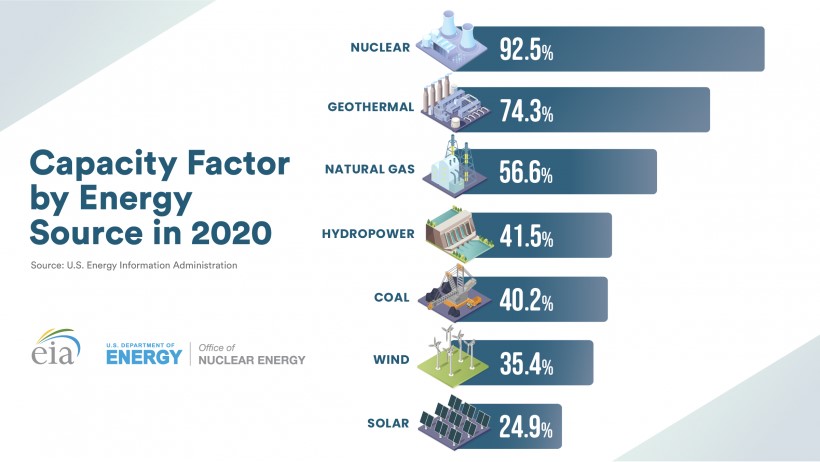
Nuclear energy has by far the highest capacity factor of any other energy source.
And now, it is being taken more seriously as an alternative energy source to meet net-zero goals.
Overcoming the fear
Demand for uranium to feed nuclear reactors is growing.
Supply is shrinking, while demand is skyrocketing.
It seems the fear we once had that held us back from using nuclear energy as a power source is eroding.
There are potentially several reasons for this.
GTI Resources Ltd (ASX:GTR) MD Bruce Lane tells Proactive, “Nuclear energy has three image problems. One is the association with nuclear weapons. Two is the generation that I grew up in were worried about nuclear war. There is now a hangover from those of us who grew up in that era, because there's a lot of people of power in this country, and elsewhere, who were a product of that generation. The nuclear Holocaust threat is still attached to nuclear power. Thirdly, in this country, there is a political issue.
“Due to the fractured nature of politics in Australia, it's a politically toxic issue. It doesn’t seem like there's anything to be gained in Canberra at this point and so there's still some very vocal opposition to it. This includes elements within the Labor and Greens Parties who are saying it's high cost, dangerous and toxic. Politically, it doesn't really have a strong force behind it in this country.”
However, Lane says that while the politicians in Australia are baulking, the younger generations are now starting to accept nuclear energy as an alternative energy to combat climate change.
A poll published by Essential about Australian attitudes to nuclear energy found that a near majority of Australians support nuclear energy.
Importantly, millennials are in favour, with the only significant opposition coming from Greens supporters; however, even among that group, 38% are in favour of peaceful nukes.
This is a global trend.
“There are people in Germany protesting on the streets that they're (Germany) not pursuing a nuclear path program,” Lane says.
“The equation has flipped. You've got the climate change and sustainability activists who, as recently as a few years ago, used to turn up for the uranium conferences and throw eggs. Those people are now having to examine their motivations and what they are more worried about.
“For instance, they are asking, ‘can we achieve net-zero targets without nuclear power? I think in a lot of countries, the answer is no.”
Beyond Australia, the politicians, lobbyists and policy influencers are also changing the discourse … and attitudes.
How is the transition happening in other parts of the world?
UK ministers have put nuclear power into Britain’s strategy to reach net-zero carbon emissions by 2050.
“A clean, reliable power system is the foundation of a productive net-zero economy as we electrify other sectors – so we will fully decarbonise our power system by 2035, subject to security of supply,” the UK government said.
“Our power system will consist of abundant, cheap British renewables, cutting edge new nuclear power stations, and be underpinned by flexibility including storage, gas with [carbon capture and storage] CCS, hydrogen and ensure reliable power is always there at the flick of a switch.”
In France, in a joint statement made earlier this year by the US Secretary of Energy Jennifer Granholm and French Minister for Ecological Transition Barbara Pompili, the two countries said they would work together on new technologies, including innovative and advanced nuclear, to contribute significantly to zero-carbon generation solutions.
"France and the United States share common goals and common resolve in fighting climate change and working towards reaching the ambitious target set forth by the Paris agreement.
"Our ministries, the French Ministry for the Ecological Transition and the US Department of Energy, are moving with urgency to mitigate the current climate crisis by leveraging cutting-edge research and science to dramatically accelerate the deployment of energy technologies, breakthrough innovations, and policies that will provide a cleaner, safer, and more prosperous future," they said.
In November this year, French President Emmanuel Macron said France would construct a series of large nuclear power plants to help neutralise carbon emissions by 2050 and reduce its reliance on unreliable gas imports.
It is the first time in decades that France has done so.
As for the US, well, the White House is taking a more cautious approach but understands nuclear will play a key role in the country meeting its targets.
The US has 94 nuclear power reactors.
"Now, I don't expect those old ones [nuclear reactors] to be around a long time. But I do expect them to be safe and I expect them to continue in a way that's going to allow us to keep the greenhouse gas emissions down with really stable baseload capacity," the President’s climate adviser, Gina McCarthy, told a webinar hosted by the Columbia University Center on Global Energy Policy.
"We are not going to be able to achieve our climate goals if nuclear power plants shut down. We have to find ways to keep them operating," Energy Secretary Jennifer Granholm said early last month before a House Appropriations subcommittee.
"I absolutely agree," said senior vice president and chief nuclear officer for Dominion Energy Dan Stoddard. "If we are going to achieve our zero-carbon or net-zero goals, nuclear has to be a part of the solution. So, it's very gratifying to see people at the federal level — important people in important positions — acknowledging that, as well."
Lane says, “One of the last bastions is California. The Diablo Canyon nuclear power plant has been scheduled for shut down. And yet California's been suffering from rolling brownouts and that was an economic and political disaster for them.
“The recent stimulus bill passed by the Biden Administration will help address these issues, with a portion of the bill going to nuclear.”
Nuclear got about $25 billion of a $1.2 trillion bill.
Distributed as:
- $3.2 billion (to FY2027) Advanced Reactor Demonstration Program (ARDP); and
- $21.5 billion (to 2025) for an Office of Clean Energy Demonstrations in DOE including a $6 billion civil nuclear credit program to preserve the existing nuclear fleet and prevent premature shutdowns of nuclear power plants like Diablo Canyon.
The IAEA released Nuclear Energy for a Net Zero World, a special report that highlights nuclear power’s critical role in achieving the goals of the Paris Agreement and Agenda 2030 for Sustainable Development.
Nine countries — Canada, China, Finland, France, Japan, Poland, Russia, the United States and the United Kingdom — provided statements in the report in support of the IAEA’s belief that nuclear power can be a powerful contributor to climate action.
If the rest of the world is on board, why isn’t Australia?
Australia lags behind
As Lane says, there is not yet any political will for Australia to follow the rest of the world’s lead on nuclear energy. This is despite one-third of the global uranium supplies being buried under Australian ground.
Those currently benefitting from Australia’s uranium resource are importers.
Is this a mistake?
“Short answer is yes,” Lane says.
“There is a really significant opportunity for Australia to build a cheap, long-term electricity supply and uranium should be part of the strategy.
"Uranium and subsequent nuclear power generation could help Australia become more energy independent and competitive, with the exception of only a few sectors such as transport."
Lane believes we have the ground to store waste safely and the distance to build plants away from populations.
“From a safety point of view, nuclear is now one of the safest footprints and from an emissions standpoint, it is extremely low to zero. The plants can run for very long periods. There are many arguments for, but the longer Australia waits to get on board, the further it will be behind other countries.”
A fact that Lane deems unacceptable.
Aussie companies forge their own uranium path
Despite Australia’s lack of interest, it hasn’t stopped Australian companies from taking up the uranium cause.
GTI Resources is based in the US and was recently approved to drill at the Thor ISR Uranium Project in Wyoming’s Great Divide Basin. The Thor project is part of a package of 22,000 acres of sandstone-hosted ISR prospective uranium properties recently acquired by GTI.
The company is on track to begin a maiden drilling program in December that could confirm the grade and tenor of uranium mineralisation that was previously identified by Kerr McGee in the 1970 and 1980s and to support the definition of an economic uranium resource.

GTI also has 1,500 hectares in the Henry Mountains region of Utah where it is advancing a uranium project to supply high-grade uranium ore to help fill existing local mill processing capacity.
“One of the reasons we chose the US is that from a regulatory point of view, we think it's one of the best places to be,” Lane told Proactive.
Wyoming is a big energy state. Fuelled by coal and gas, it is now looking at transitioning to other energy.
“They have a large number of coal-fired power plants, and there are not that many people in Wyoming. Its population density is extremely low. So, that energy export business has been massively important to the state, which is now coming under increasing pressure.
“They've got people like Bill Gates and Warren Buffett saying coal is going to be redundant and encouraging the development of nuclear energy to take over. Trump identified how important uranium was for the US’s nuclear energy goals and Biden has now taken up the cause as well.”
In other words, the US will require uranium supply to fuel its nuclear ambitions and demand is likely to increase, which puts GTR in the right location at the right time.
Who else is in the mix?
Other Australian companies to watch include Peninsula Energy Ltd (ASX:PEN, OTCQB:PENMF), Alligator Energy Ltd (ASX:AGE), Okapi Resources Ltd (ASX:OKR) and Lotus Resources Ltd (ASX:LOT).
Peninsula Energy Ltd (ASX:PEN, OTCQB:PENMF)
Peninsula is another company operating in Wyoming.
It owns the Lance Uranium Projects, which is transitioning from an alkaline in-situ recovery to a low pH in-situ recovery operation.
The company is well placed to take advantage of the US Government’s programs supporting domestic uranium mines.
When back in operation, Peninsula has long-term sales contracts extending to 2030, representing about 15% of projected Lance production.
Peninsula is well advanced, with the sale of 200,000 pounds of U3O8 at US$50.35 per pound, generating a net cash margin of US$3.5 million in October 2021.
Further to this, there is 310,000 pounds of uranium in converter accounts at September 30, 2021, with a market value of US$13.1 million (US$42.20 per pound U3O8).
Speaking on macro events, non-executive chairman John Harrison said, “The US Department of Energy is making moves to continue the progression of a Uranium Reserve to revive and strengthen the US nuclear fuel supply chain capabilities.
“Peninsula continues to be an active participant within this process and looks forward to the potential opportunities presented by the US government. Influences such as Bill Gates’ TerraPower and the creation of its innovative Natrium Advanced Reactor make the nuclear sector look highly prospective.
“The progression of such technologies and innovations, combined with the topic of ‘net zero’ at the forefront of conversation globally, means that the benefits of nuclear energy are becoming more prominent, and Peninsula looks forward to furthering the advancement of the Lance Project, with the objective of creating a significant US uranium producer. The timing could not be better.”
Alligator Energy Ltd (ASX:AGE)
Alligator Energy is accelerating its transition from a junior explorer and development company into a bona fide uranium producer with a global supply profile and a matching market cap.
It has a strategic relationship with Traxys North America LLC, the US arm of global commodities trading group and one of the top 10 global uranium covering the Americas, Europe, Australia and Asia.
Lotus Resources owns a 65% interest in the Kayelekera Uranium Project in Malawi, which hosts a current resource of 37.5 million pounds of uranium oxide and has historically produced 11 million pounds of uranium between 2009 and 2014.
The project has a 1.4 million tonnes per annum processing facility and the company has spent around US$200 million on infrastructure including an on-site acid plant and accommodation camp.
Lotus believes Kayelekera can support a viable long-term operation and has the potential to be one of the first uranium projects to recommence production.
Read: Lotus Resources shows potential for increasing both size and grades of uranium: Red Cloud Securities
Okapi has begun initial field exploration programs at its high-grade Rattler Uranium Project in Utah, US, with a review of historical workings, geological mapping and rock chip sampling.
Read: Okapi Resources kicks off exploration at Rattler Uranium Project in US
The case for nuclear
Patrick Moore, one of the founders of Greenpeace, Michael Schellenberger, a Time magazine 'Hero of the Environment' and even Zion Lights, the former Extinction Rebellion spokesperson, are now promoting nuclear energy as a clean energy alternative.
So, the tide has turned in terms of acceptance.
Nuclear is seen as a low-cost alternative.
A clean alternative to existing energy supply.
And this is reflected in the price.
Toronto-based hedge fund Sprott Asset Management (TSX:SII) LP, a subsidiary of Sprott Inc., recently bought up millions of pounds of excess supply of uranium for a new trust. This caused prices to surge.
Sprott believes utilities will be knocking on the doors of uranium producers for supply.
"We're seeing a lot more interest from utilities right now because they have more competition," said Curtis Moore, vice president of marketing and corporate development at Energy Fuels Inc. (TSX:EFR, NYSE-A:UUUU), the largest uranium producer in the US.
"I wouldn't say they're running out, willing to sign long-term contracts at any price. I'd say they're still just dipping their toes into it. They're able to withstand some of these market shocks through inventories, but their inventories are sort of finite."
Uranium prices hit a high of $50/lb in mid-September and have hovered above $44/lb in November, reaching $47/lb on November 17, an approximately 60.4% increase year over year, according to S&P Global Platts data.
"Demand for nuclear is expected to grow globally and uranium is a key feed for that," said Sid Rajeev, vice president and head of research at Fundamental Research Corp. "We are very bullish on uranium."