
Shree Minerals Ltd (ASX:SHH) is honing in on a series of lead-zinc exploration targets at the Arunta Project’s Box Hole prospect thanks to a research study backed by Australia’s national science agency.
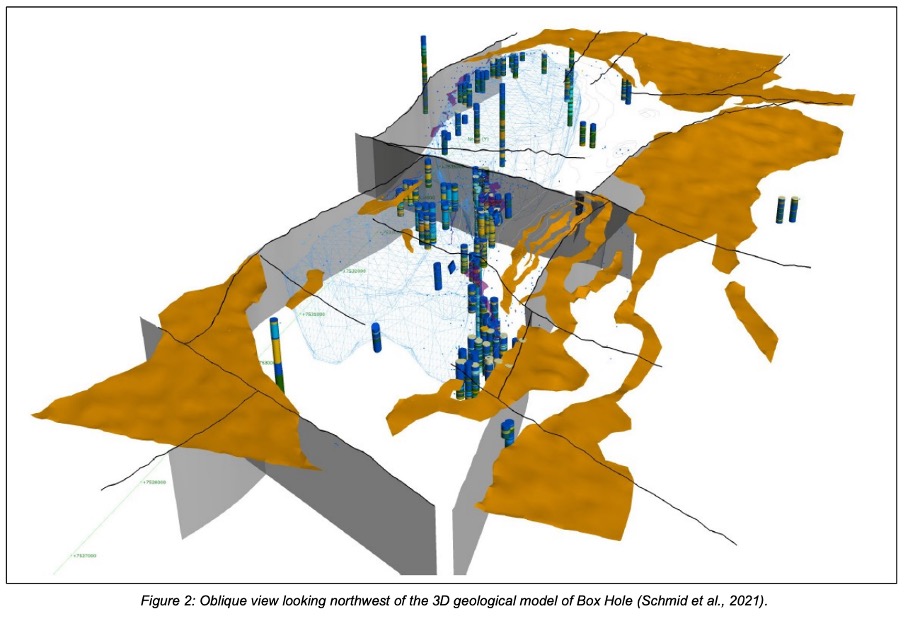
The CSIRO’s study program set out to evaluate and reprocess geophysical, lithological and geochemical data from Box Hole, underpinning a 3D model on the target and providing further information about its mineralisation.
Shree attributes the study to the CSIRO’s Kick-Start Program, an initiative that provides funding and support for Australian start-ups and small businesses to access the agency’s research expertise.
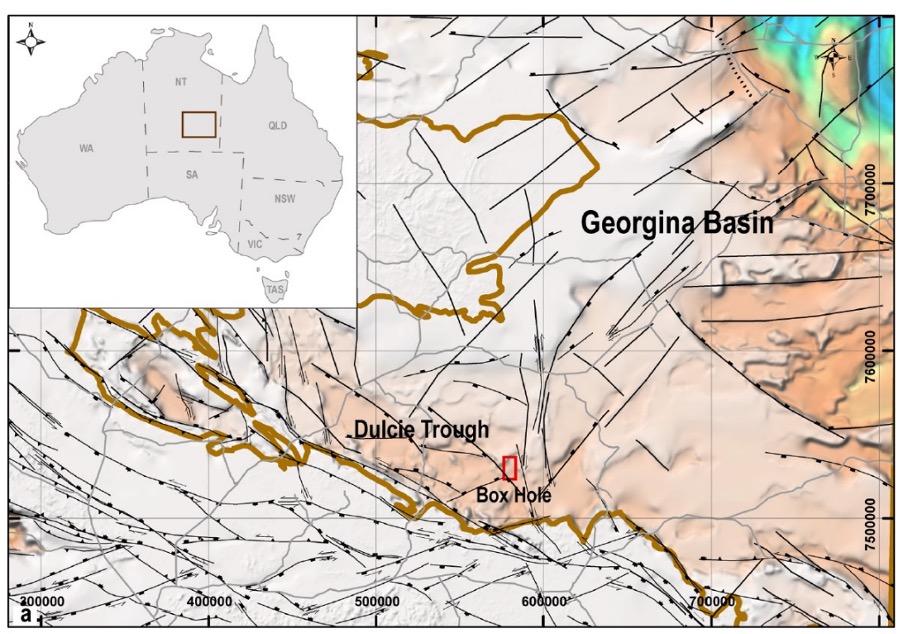
Box Hole,not far from Alice Springs in the Northern Territory, forms part of the northern flank of the Dulcie Trough structure, a region known to host Mississippi Valley Type (MVT) lead-zinc deposits.
Key findings
Thanks to the research program, Shree believes lead-zinc mineralisation at Box Hole occurs in two stratabound horizons within a 40-metre-thick interval.
The mineralisation is widespread across the tenement, but grade varies both horizontally and vertically.
Interestingly, pervasive barite and manganese alteration extends up to 10 metres from the stratabound mineralisation.
Meanwhile, mineralisation to the south is more structurally complex but is also higher grade, possibly indicating proximity to feeder structures.
The lead-zinc mineralisation is stratabound within favourable lithological units, however, on a prospect scale, the mineralisation shows a striking linear trend.
This could indicate an underlying structural control, such as coincidence with a feeder fault zone.
Box Hole has been explored by a range of companies since it was first discovered.
The most significant exploration program was completed by Uramet Minerals between 2007 and 2009, comprising various IP and gravity surveys, geochemical surveys and shallow drilling.
Uramet conducted rotary air blast drilling across select gravity and IP targets, interpreted to be less than 75 metres deep.
The best intersection was 12 metres at 2.8% zinc and 0.67% lead from 17 metres, including 1-metre at 14.7% zinc and 0.3% lead from 24 metres.
What’s to come?
Looking ahead, Shree remains determined to better understand the litho-structural setting of lead-zinc mineralisation at Box Hole.
To this end, future work may include:
- Prospect-scale soil sampling using a handheld XRF to delineate mineralisation and alteration;
- Soil sampling will locate prospective lithological and structural trends that will improve the 3D model and targeting;
- Extension of lithological and structural mapping to refine the 3D model;
- Sub audio magnetic (SAM) or IP surveys focused on the mineralised trends targeting mineralised feeder faults or blind stratabound mineralisation;
- Shallow vertical drilling to infill and extend coverage of the target mineralised horizon and to improve understanding of the controls on grade variability; and
- Angled RC traverses across the mineralised trends to target feeder zones.