Calima Energy Ltd (ASX:CE1) shares are trading higher after commencing flow back and production from three wells at its Throsby asset in Alberta, Canada.
Leo #3 commenced flowback on November 8th and is currently producing > 250 boe/d (barrels of oil equivalent per day) of oil and gas, which is exceeding expectations.
Leo #1 and #2 are both tied in and flowing back as of November 16th and are currently cleaning up.
“Seeing strong oil and gas shows”
Calima CEO Jordan Kevol said: “We are very pleased to be seeing meaningful oil and gas rates out of Leo #3 after only 1 week of clean up and flowback.
“Seeing strong oil and gas shows this early on in the flowback period is a very positive sign.
“We expect Leo #1 and #2 to act in a similar fashion.
“These wells should reach their full potential in the next 30-90 days, which will be impactful to corporate production and cash flow.”
Equipping and tie-in
Over the course of the last two weeks, the three Leo wells have been undergoing the process of equipping for artificial lift and tying into production facilities.
The wells are now producing into Calima’s on-site 16-5 oil processing facility battery.
This battery is capable of processing all the oil and related water expected from the three Leo wells. The associated gas is tied into a sales gas line that goes to a third-party sales point.
Drilling wells from existing pads wherever possible greatly reduces Calima’s operating costs and related pipeline tie-ins costs.
The nature of horizontal drilling enables the drilling of multiple wells from a single pad-site, reducing tie-in costs and reducing environmental footprint.
Initial production rates
Initial flowback of load fluid from the frac for all three Leo wells has commenced and it typically takes 7-10 days to see the first traces of hydrocarbon; Leo #3 saw first hydrocarbons on day 3.
It is anticipated that Leo #1 & 2 will behave in a similar fashion.
The operations over the next 30 days will consist of a combination of continued frac fluid flowback as well as production of formation oil/gas/water.
Each of the wells are anticipated to be producing at their full potential, mid-December 2021 to mid-February 2022.
Sparky economics
Prior to this drilling program, the company had drilled 11 Sparky wells.
Of this total, the tier 1 wells (2nd generation) averaged ~3,400 metres MD (measured depth) and 36 fracture stages with an average of 0.75 tonnes of sand per meter over the horizontal length.
The per well cost to drill, equip, and tie-in averaged $2.5 million.
The Leo 1, 2 and 3 (3rd generation) Sparky Wells have been optimised and averaged ~3,720 metres MD (~320 metres longer) and ~50 fracture stages with an average of 1.0 tonne of sand per meter over the horizontal length.
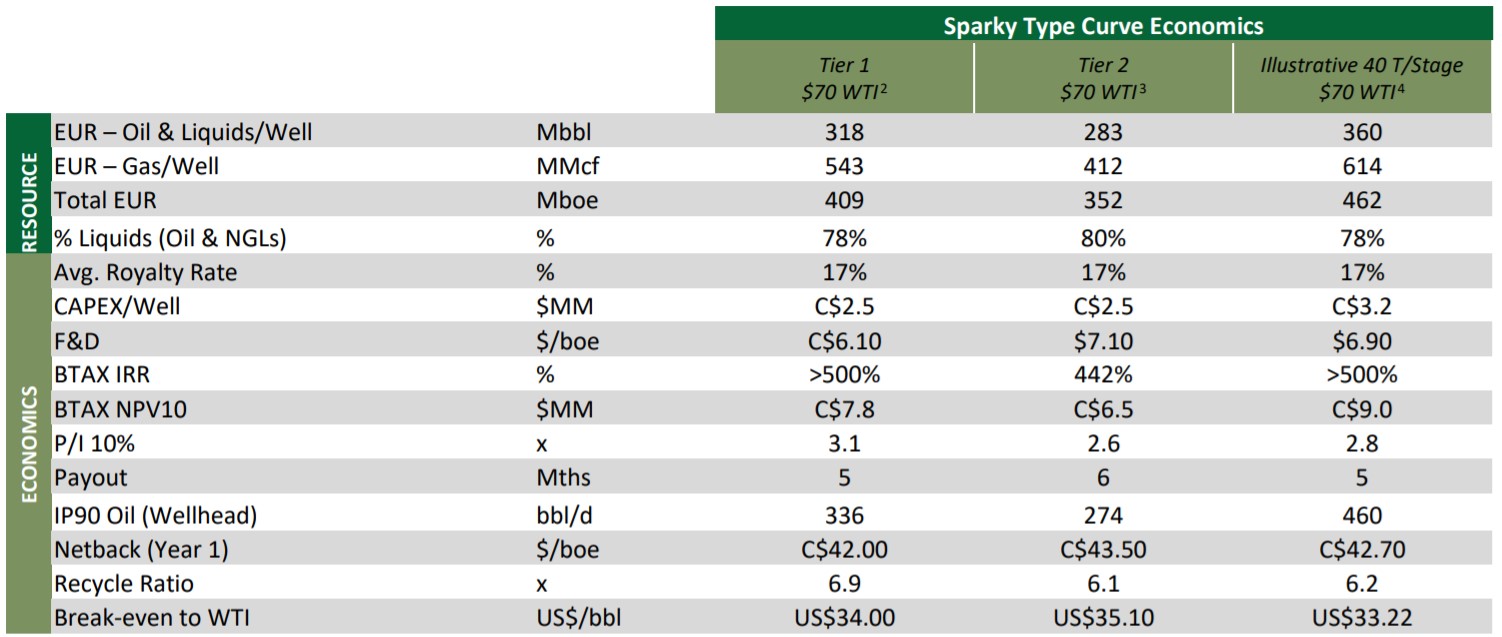
The optimised wells were budgeted for $3.2 million per well and the company anticipates IP90 rates of 270-460 boe/d (80% oil) with cumulative production of up to 462,000 boe.
Type curve well paybacks are 5-10 months from the time the initial drilling capital is spent, and the NPV at a 10% discount rate is ~C$6.5-$9.0 million.
Well economics are summarised below: