
Noxopharm Ltd (ASX:NOX)’s wholly-owned subsidiary, Pharmorage Pty Ltd has entered into an exclusive global licence agreement with Hudson Institute of Medical Research on its cutting-edge ribonucleic acid (RNA) technology.
The licence, subject to clinical trials and marketing approvals, covers both RNA drug discovery and mRNA vaccine manufacture.
RNA drugs already under development by Hudson will add to existing Pharmorage assets and help position the company at the forefront of chronic inflammatory/autoimmune diseases drug development.
The mRNA vaccine opportunity lies in the potential to limit unwanted inflammatory side-effects, an exciting commercial opportunity with the mRNA vaccine market predicted to reach US$23 billion by 2035.
"Major coup"
Noxopharm CEO and managing director Graham Kelly said: “This licence is a major coup for the company and is validation of our ability to translate research from the laboratory to the clinic.
“Pharmorage already had a strong business relationship with Hudson with a major initiative in anti-inflammatory drug development.
“The RNA technology and its anti-inflammatory functions is an obvious fit and an opportunity with which we are delighted to be entrusted.
Other programs unaffected
“The commercial terms are largely back-ended and designed to leave our other programs like the Veyonda clinical program unaffected by this new and exciting additional opportunity.
“The mRNA vaccine opportunity in particular does show strong potential for future out-licensing opportunities," Kelly said.
“With the whole world, including children down to five years of age, looking at being vaccinated against SARS-CoV-2, the dual benefits of reducing unwanted side-effects and increasing manufacturing efficiency have to be attractive.
“And with mRNA vaccine technology looking increasingly likely to extend eventually to most if not all viral diseases, this is an extraordinarily timely development.
Key terms
The key financial terms of the licence agreement are:
➢ No upfront fees;
➢ Material milestone payments relating to late-stage clinical development on initiation of Phase 3 trials and receipt of marketing approvals;
➢ A two-digit percentage of any upfront sub-licence fees; and
➢ A single-digit royalty on net sales.
The licence is effective immediately and lasts as long as royalty payments continue. It is subject to standard termination clauses.
Pharmorage is wholly responsible for the development of the technology and retention of the licence depends on meeting certain development milestones that the company believes are practical and achievable in terms of capital expenditure and time.
The IP underpinning the licenced technology is the subject of two patent applications.
Ground-breaking technology
The licence is for what both parties regard as potentially ground-breaking RNA technology developed over 15 years and highly relevant to the development of RNA drugs and mRNA vaccines.
The licence is exclusive and worldwide, serving in the company’s view to make Noxopharm, through Pharmorage, a foundation player in the field of RNA technology and putting it at the forefront in Australia of this emerging field.
Hudson’s RNA technology
With RNA technology now seen as a key contributor to future drug and vaccine development, foundation RNA technologies offer major value propositions for companies with valuable intellectual property (IP).
Noxopharm and Hudson see this as a valuable ground-floor opportunity to be an integral part of that growing market.
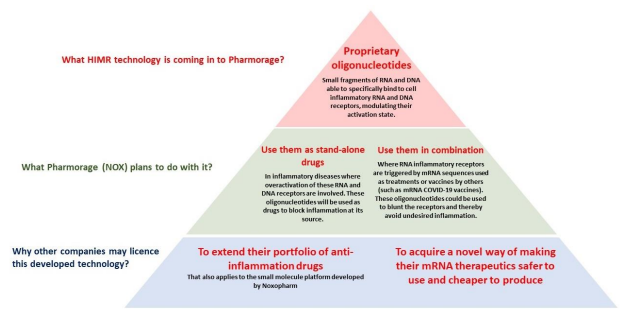
The Hudson technology platform is focused on the use of RNA fragments (oligonucleotides) to reduce inappropriate inflammation and this is achieved in a number of novel ways, two of which Pharmorage intends to pursue.
The first is the development of drugs as treatments of inflammatory and autoimmune diseases and the second is to apply it to improve the safety and manufacturing efficiency of mRNA vaccines.
The licence comes with several lead RNA drugs being developed as treatments for chronic inflammatory and autoimmune diseases.
These drugs target key immune sensors at the root of the inflammatory response.
They have been successfully tested in cell models, with Pharmorage now to advance them into animal models.
The cost of these studies is within the R&D budget allocated to Pharmorage.
These assets join the existing Pharmorage tank-binding kinase 1 (TBK1) inhibitor asset as potential novel treatments for chronic inflammation diseases such as rheumatoid arthritis, cardiovascular disease, various respiratory diseases, NASH etc. and autoimmune diseases such as multiple sclerosis, motor neuron disease, psoriasis, lupus, inflammatory bowel disease etc.
mRNA vaccine program
The Hudson technology provides a way of switching off the cell immune sensor known as TLR7, without reducing manufacturing efficiencies.
With this IP going to the heart of vaccine manufacturing efficiencies, Noxopharm sees it being of major interest to current manufacturers and developers of mRNA vaccines for coronavirus and other viral infections.
Several lead TLR7 inhibitors have already been characterised in cell models and are ready for preclinical evaluation in animal models. The identified business opportunity is of the potential out-licensing to vaccine developers and manufacturers in the future.
Hudson Associate Professor Michael Gantier and the lead scientist responsible for this technology, said: “Following on our efforts to characterise how TLR7 sensing is impacted by RNA chemical modifications, we have discovered a new class of TLR7 inhibitors that can outcompete immune sensing of therapeutic RNAs such as those used in mRNA vaccines; we propose that these inhibitors could be used in conjunction with therapeutic RNAs to limit their side-effects in patients and maximise their therapeutic potential.”