
European Lithium Ltd (ASX:EUR) and Jadar Resources Ltd are progressing their partnership in southern Austria, where plans are afoot to expand the Austrian Lithium Project, including the high-yield Wolfsberg lithium deposit.
Following an agreement to collaborate, signed in May, the companies agreed to establish a Technical Advisory Committee to work together on the Weinebene and Eastern Alps Projects, sharing information to identify the best options to advance these assets.
The committee, which is comprised of EUR chairman Tony Sage and Jadar chairman Luke Martino, will make recommendations for exploration programs, budgets and development scenarios to expand and consolidate the projects. In particular, the team is working to coordinate the proposed drilling program for the extension of the Wolfsberg mine.
Soil sampling, rock chips and mapping in the area have to date indicated a wealth of spodumene-bearing pegmatites, which means there are very high lithium values present. In short, the project area has significant exploration potential.
“We are excited to formally establish the Technical Advisory Committee and commence our collaborative efforts with our partner Jadar to maximise and potentially grow the resource at Wolfsberg,” Sage said.
The hills are alive – with lithium
Located three hours southwest of Vienna, the 64 square kilometre Austrian prospects hold the promise of high-grade lithium targets with significant residual brownfields plus greenfields exploration potential across the entire area.
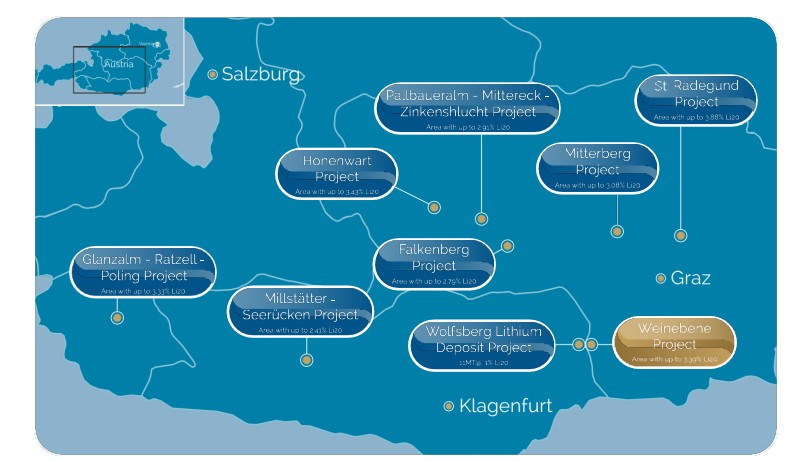
Jadar’s Weinebene project is immediately adjacent to European Lithium’s Wolfsberg deposit, where the companies anticipate that the veins that form part of the JORC-compliant 9.7 million tonnes at 1.03% Li2O Wolfsberg deposit strike into Jadar’s Weinebene project area.
Jadar has also identified several prospect areas within its Eastern Alps projects that require follow up evaluation and drill testing. Initial reconnaissance and rock sampling within the Eastern Alps projects defined numerous outcropping high-grade multiple spodumene-bearing pegmatite veins with the average value over the 70 samples being 1.61% Li2O and highest value 3.39% Li2O.
The two companies are at the forefront of modern and systematic lithium exploration on outcropping pegmatite.
Lithium deposits of this type are typically found in the form of spodumene bearing pegmatite vein-type deposits hosted by Paleozoic metamorphic formations - usually mica schist, amphibolite and marbles.
The pegmatites found in the Eastern Alps derive from crustal melting (anatexis) chemistry, during which lithium-enriched fluids are formed during regional metamorphism.