
Kin Mining NL’s initial aircore drilling at the Pegasus Prospect, adjacent to the cornerstone 374,000-ounce Bruno-Lewis deposit at Cardinia Gold Project in WA, has revealed a new shallow, high-grade gold discovery.
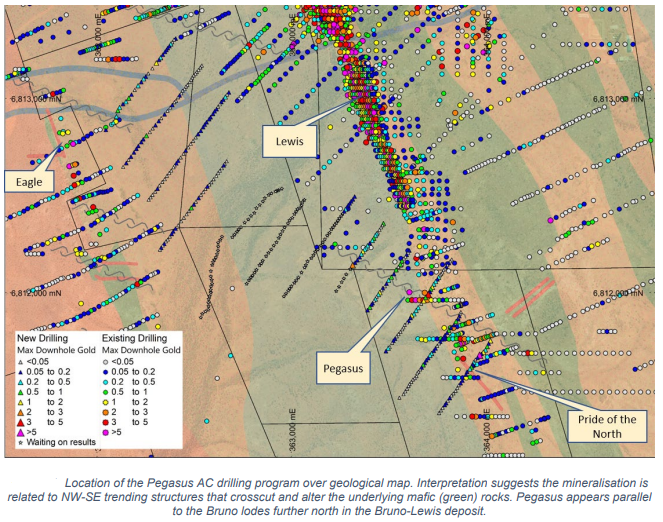
The results confirm that a continuous zone of mineralised lodes spanning at least 800 metres of strike and up to 100 metres wide is present, with similarities to the Bruno-Lewis deposit.
It has reinforced the company's view that gravity lows highlighted in the recent detailed survey over the greater Cardinia area represent priority exploration targets for new discoveries.
The latest results include a number of strong intercepts such as 4 metres at 10.1 g/t gold from 24 metres in PG21AC144 and 8 metres at 3.08 g/t from 8 metres in PG21AC224, together with other results on the eastern edge of the Pegasus Gravity Target.
Results are awaited for a further 107 holes over four 200 metres spaced lines of drilling to test the northwest extension of the Pegasus target below an extensive gold-in-soil anomaly.
Hallmarks of new discovery
Kin Mining managing director Andrew Munckton said: “While still early days, Pegasus appears to be a parallel structure to the adjacent Bruno-Lewis deposit and has all the hallmarks of a significant new discovery in the Cardinia area.
“The aircore drilling has so far outlined a substantial mineralised position in the eastern side of the gravity low which heightened our interest when we first reviewed the geophysical data in the September quarter.
“The eastern edge of the Pegasus gravity low contains numerous ore grade hits in shallow drilling within a zone extending over at least 800 metres in length and up to 100 metres wide.
“New intersections such as 4 metres at 10.1 g/t gold and 8 metres at 3.08 g/t gold supported by other previous drilling intersections such as 10 metres at 3.10 g/t and 16 metres at 1.04 g/t nearby at the historical Pride of the North workings indicate to the geological team that Pegasus is a potentially significant mineralised area.
Results
The results of the composite assay results received include:
- 4 metres at 10.1 g/t gold from 24 metres;
- 8 metres at 3.08 g/t from 8 metres;
- 4 metres at 1.61g/t from 20 metres;
- 4 metres at 2.25 g/t from 32 metres; and
- 12 metres at 0.70 g/t from 4 metres;
Additional mineralised intersections in historic adjacent holes:
- 10 metres at 3.10 g/t from 12 metres;
- 16 metres at 1.04 g/t from 4 metres;
- 8 metres at 1.07 g/t from 32 metres; and
- 9 metres at 1.15 g/t from 24 metres.
Remaining results
Munckton added: “Given the widespread nature of the ore grade intercepts we have seen in the results returned to date, we will now look forward to the remaining results from the northwestern extension of the anomaly which are expected to be returned over the next four weeks.
Next phase
The next phase of work, comprising reverse circulation (RC) and diamond drilling to confirm mineralisation in fresh rock, is planned to commence as soon as drill rigs become available – by which time the remaining assay results from the western edge of the gravity target aircore drilling lines are expected to have been received.