
Adalta Ltd is building its pipeline using proprietary i-body technology with a target of 10 programs by 2023, in addition to lead asset AD-214, to generate a promising new class of single-domain antibody-protein therapeutics to treat some of today’s most challenging medical conditions.
The clinical-stage drug development company aims to use its unique i-body technology to create multiple novel therapeutics for debilitating diseases that have proven difficult to drug with traditional antibodies.
It expects to be “back in the clinic by the middle of 2023”, according to the company’s CEO Dr Tim Oldham.
AdAlta is also seeking partners for its lead asset and co-development collaborators and investors willing to join it on an exciting journey to develop its i-body platform.
Four key features
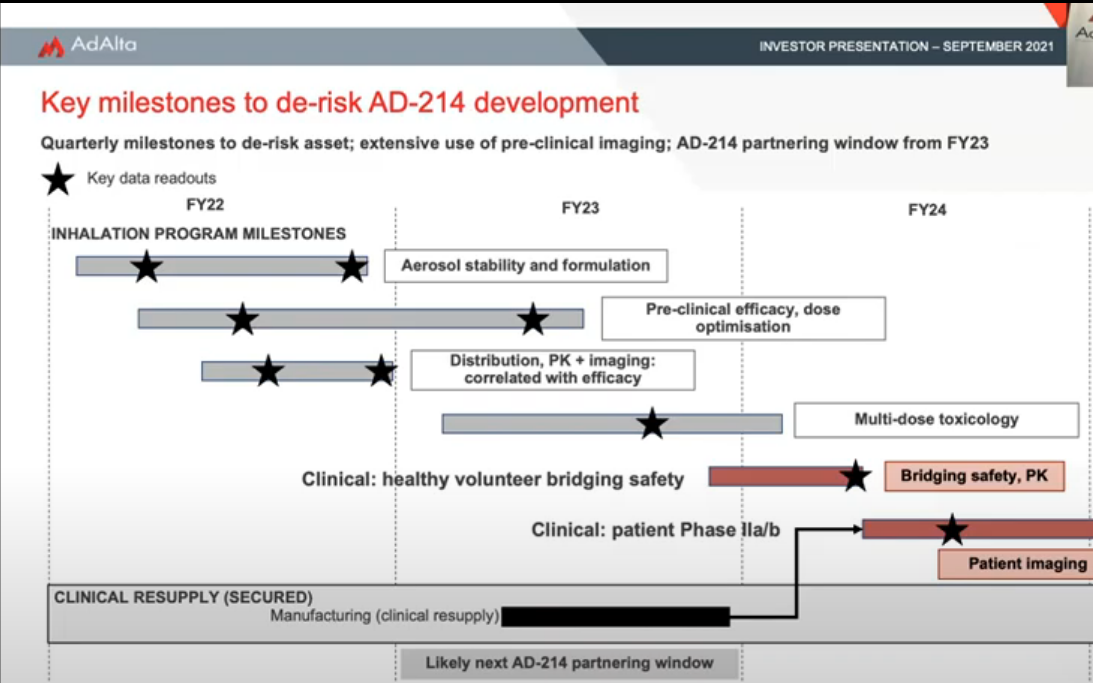
The four key features of the company are:
➢ i-body platform that can create therapeutics addressing targets underserved by traditional antibodies.
➢ Lead asset AD-214 is preparing an inhaled version for Phase II in Idiopathic Pulmonary Fibrosis (IPF), targeting a US$3 billion IPF market today.
➢ Two co-development collaborations:
- GZMB PET imaging agent with GE Healthcare, targeting the US$6.4 billion PET imaging agent market; and
- i-body enabled CAR-T with Carina Biotech, targeting a US$20 billion market by 2028.
➢ Building out its pipeline with additional programs – targeting 10 programs by 2023.
Phase II for inhaled formulation
AD-214 development
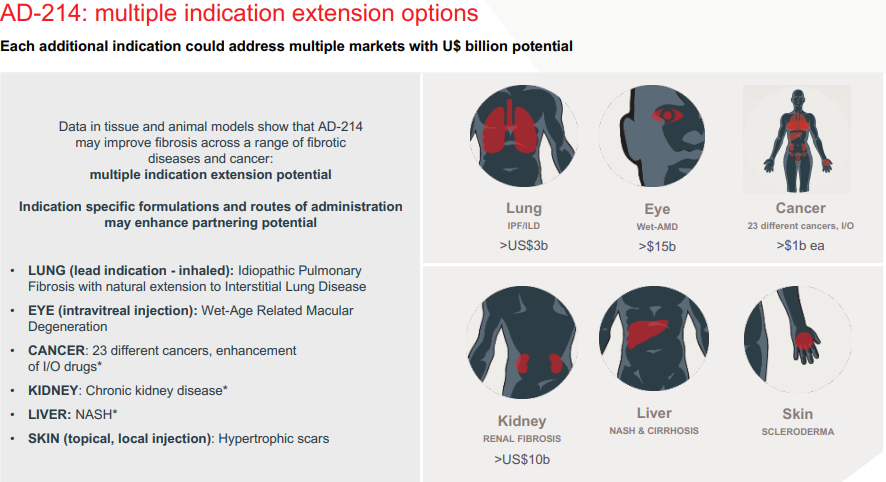
AD-214 is being developed for the treatment of IPF and other human fibrotic diseases and potentially cancers, for which current therapies are sub-optimal and there is a high unmet medical need.
AD-214 targets a GPCR called CXCR4 and has been specifically engineered to include features making it suitable for chronic use in fibrosis.
AD-214 is an Fc-Fusion protein that contains two AD-114 i-body molecules at the front end, that bind with high affinity to the human target, CXCR4. At the back end of AD-214 is the Fc Fragment or tail region of a traditional monoclonal antibody that will extend the half-life or duration of time in which the i-body will stay in the body.
When combined, the i-body and Fc Fragment create a superior next-generation lead drug candidate, with improved therapeutic and commercial potential.
It is the only agent against CXCR4 being developed for fibrotic diseases, giving it first-in-class status.
Key advantages
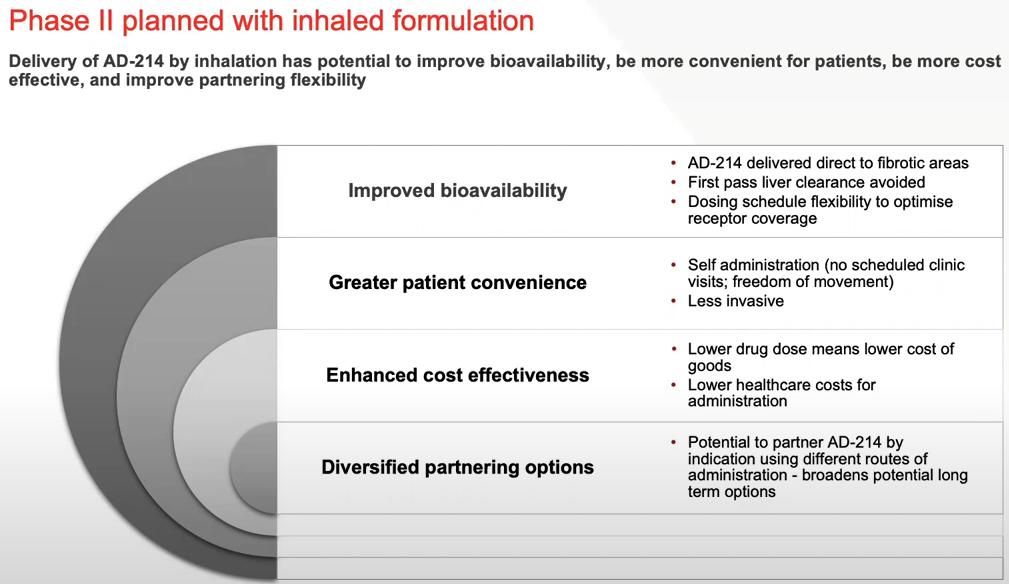
The delivery of AD-214 by inhalation has the potential to improve bioavailability, to be more convenient for patients, be more cost-effective and improve partnering flexibility.
AdAlta CEO Dr Tim Oldham said the company believed that inhalation was a more patient-friendly route of administration.
Overall, the inhalation route offers a better target product profile than the original intravenous (IV) plans.
AdAlta has completed Phase I clinical studies for AD-214.
AD-214 has demonstrated efficacy in animal models of IPF and kidney fibrosis and studies in eye fibrosis and metastatic cancer are underway.
In Phase I clinical trials, AD-214 was well tolerated in single and multiple intravenous doses in healthy volunteers and demonstrates high and sustained duration of CXCR4 receptor occupancy.
A radiolabelled version of AD-214 for safety and biodistribution (PET imaging) studies has also been developed.
AdAlta is developing a more convenient inhaled formulation for future clinical studies. AD-214 has Orphan Drug Designation from the US Food and Drug Administration (FDA).
The AD-214 i-body has potentially key advantages for IPF treatment. These include:
➢ Only targeting diseased human tissue with the drug's only shown on IPF tissue and not on normal lung tissue;
➢ Being more effective than existing IPF approved drugs with greater tolerability compared to the only approved therapies Nintedanib and Pirfenidone;
➢ Demonstrated efficacy in multiple animal models showing that the anti-CXCR4 i-body has both anti-fibrotic and anti-inflammatory effects; and
➢ A novel mechanism of action for fibrosis enabling a 'first in class' therapy.
Collaborative partnerships
The company is also entering collaborative partnerships to advance the development of its i-body platform.
It has an agreement with GE Healthcare to co-develop i-bodies as diagnostic imaging agents against Granzyme B, a biomarker of response to immune-oncology drugs, a program now in preclinical development.
It also has a collaboration with Carina Biotech to co-develop precision-engineered, i-body enabled CAR-T cell therapies to bring new hope to patients with cancer.
AdAlta’s strategy is to maximise the products developed using its next-generation i-body platform by internally discovering and developing selected i-body enabled product candidates against GPCRs implicated in fibrosis, inflammation and cancer and partnering with other biopharmaceutical companies to develop product candidates against other classes of receptor, in other indications, and in other product formats.
Diverse applications of i-bodies
The i-body technology mimics the shape and properties of a unique and versatile antigen-binding domain that was discovered initially in sharks and then developed as a human protein.
The result is a range of unique proteins capable of interacting with high selectivity, specificity and affinity with previously difficult to access targets such as G-protein coupled receptors (GPCRs) that are implicated in many serious diseases.
i-bodies are the first fully human single domain antibody scaffold and the first derived from the shark motif to reach clinical trials.
The diverse applications of i-bodies include:
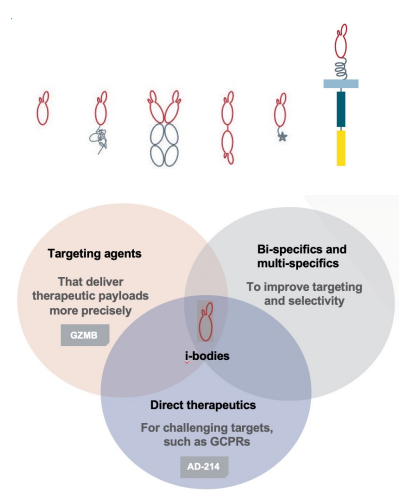
➢ Therapeutic: Flexible modular format i-bodies with variable half-life modifications allow direct therapeutics for example AD-214;
➢ PET Imaging: untagged i-body against important diagnostic targets eg i-body to GZMB (GE Healthcare); and
➢ CAR-T: therapy is a fast-emerging form of cancer therapy. i-bodies can be utilised as the binding domain of a CAR receptor that engages the tumour antigen
Targeting Asian investors
AdAlta has also appointed corporate advisory and Asian roadshow specialist, Spark Plus, to help the company with its capital markets and investor relations in Asia.
It believes that its lead asset AD-214, offer a compelling investment case to investors in the region as the diseases it targets affect the Asian population at a higher rate than western patients.
CEO Dr Tim Oldham noted: "Asian pharmaceutical markets are now comparable in size to Europe and growing more rapidly.
“Diseases like Idiopathic Pulmonary Fibrosis and Interstitial Lung Diseases affect the Asian population at a higher rate than western patients.
“We believe our lead asset, AD-214 which targets these disease areas, and our advancing pipeline of fibrosis and oncology assets offer a compelling investment case to investors in this region.”